A film review by Craig J. Koban
A HOME AT THE END OF THE WORLD

2004, R, 120 mins.
Clare: Robin Wright Penn / Alice Glover: Sissy Sapcek
/ Isabel Morrow: Wendy Crewson / Carlton Morrow: Ryan Donowho / Bobby (1967): Andrew Chalmers
/ Bobby (1974): Erik Smith / Jonathan (1974): Harris Allen
Directed by Michael Mayer / Written by Michael Cunningham,
based on his novel
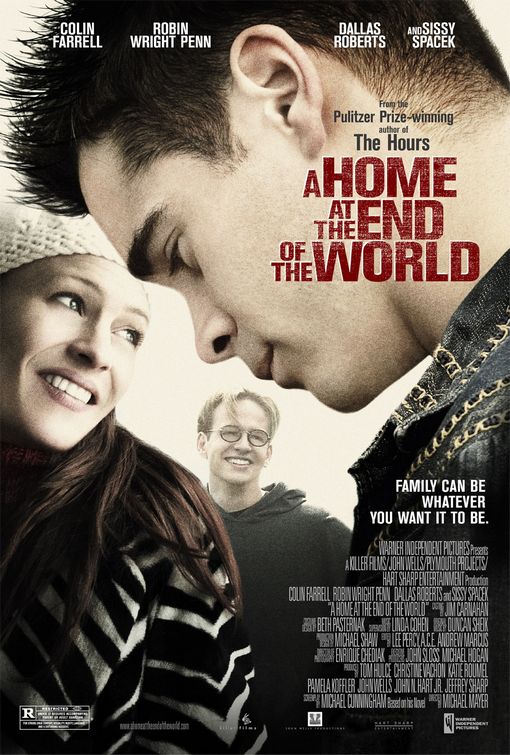
Colin Farrell is on a short list of young actors who has emerged as one of Hollywood’s finest talents. Is there a better young actor working in contemporary films? I am not altogether sure. Farrell’s resume is an impressive one, from his riveting performance as Private Roland Boz in the underrated 2000 film TIGERLAND, to his work as a POW lawyer in HART’S WAR, to his criminally overlooked performance as the quick witted and wiseass publicist in PHONE BOOTH to, yes, even his fiendishly and deliciously evil villain in DAREDEVIL.
It’s
abundantly clear that Farrell is an actor of true range, and if there was any
real doubt of this fact then one has to look no further than his touching,
sensitive, and introspective performance in Michael Cunningham’s film
adaptation of his 1990 novel. His
work in A HOME AT THE END OF THE WORLD as Bobby, the emotionally needy and unconditionally loving man with a
childlike enthusiasm who forms a family with his gay best friend and a bohemian
older woman, is a terrific and revealing breath of fresh air. It's
the type of performance that should be required viewing for those who forever
see the young Irishman as a grade A badboy with a cocky demeanour and swagger.
Here he’s vulnerable, intimate, quite, and unconventionally complex.
It’s his most mature and self-assured work, and it’s the cornerstone
to the film.
A HOME AT THE END OF THE WORLD
begins modestly in Cleveland in the late 1960’s where, after suffering a
devastating and gruesome family tragedy, young Bobby Morrow feels aloof and
emotionally adrift. We fast forward
years and follow Bobby through high school where he meets a young man that will
ultimately change his life. Now a
strong pot smoker, Bobby finds that he is gravitating to another introverted
high school kid named Jonathan, a geeky teen that appears to be struggling with
issues of his sexuality. It’s
very, very clear early on that Jonathon is a homosexual, but that does
not seem to bother the hip and trendy Bobby.
Bobby accepts Jonathan and the two become fast friends and share a bond.
Bobby introduces Jonathon to the wonders of grass, and Jonathon seems to
introduce Bobby to sex. In a small and tender moment, the two share a bed during a
sleepover as well as a small, sly sexual encounter, which more or less defines
their relationship in the future.
Despite the fact that the two teens
experiment in obvious ways with their own respective sexuality, Jonathon’s
parents nevertheless welcome Bobby into their home.
Sissy Spacek (always good to watch) plays Jonathon’s mother as a woman
of compassion and acceptance, and provides an outlet for which Bobby can gain
the sense of love and respectability that he so craves.
She is so loving and accepting of Bobby that, in one surprising moment
that may have you laughing at its audacity, she joins the two young boys in a
hit of pot. Hmmmm…if only all
mothers could be so understanding, hip, and cool.
So Bobby and Jonathon share a sexual
bond, but is Bobby gay? The
film sort of tantalizes its viewers with this prospect, and his sexual
orientation is not so clearly defined as Jonathon’s.
In a way, as Jonathon wisely points out, Bobby is not really gay or
straight. As Bobby at one point
explains (with his dead brother’s own philosophy) love is just love, nothing
more. As a matter of fact, love
becomes a guiding influence on his life, and his constant and perpetual fear of
loss and abandonment are predicating factors that propel his actions.
He’s not so much about finding love as he is about making sure that all
those around him feel good and are loved, no matter what the cost.
When Bobby turns 24 and is still living with Jonathon’s family long
after he has moved away, it takes the father to quietly and passionately tell
Bobby that, well, you just can’t live at home forever.
Bobby, in a way, is sweet and compassionate and has a desperate and
sensitive way of trying to heal all of those around him.
We see him try to please everyone so much that we really don’t get
inside his head. As a result, he
remains the enigma that Jonathon kind of describes.
Bobby is an outlet for others to feel better through, but how the hell
does Bobby feel? The film tiptoes through this brilliantly.
As the film journeys into the
1980’s Jonathon (played as an adult by Dallas Roberts) has left the cozy
confines of Cleveland for New York’s East Village, where he shares an
apartment with the eccentric Clare (the unrecognizable Robin Wright Penn).
Jonathon, being the hedonistic and energetic chap that he is, goes around
from one guy to the next in a search for love, but it’s clear that he has and
will always love Bobby dearly. After
Bobby accepts that it's time to leave home, he meets back up with Jonathon in
New York and eventually moves in with Clare.
At this point the three form a symbiotic family bond that sort of attacks
the very notions of family. The
three all grow to love each other equally, which sort of helps and hurts their
relationship, especially at a point where something happens that changes all of
their lives.
A HOME AT THE END OF THE WORLD is really about the re-defining notions and definitions of “family” in our ever-changing society. Writer Michael Cunningham, who also wrote the Oscar winning THE HOURS, again finds himself utterly fascinated with the nature of unconventional households and the problems that impede them. The film is ostensibly a poster boy for unconventional families and how traditionalists view them. It’s kind of sly in the way that it is not really completely obvious. Yes, one might think that most of the members of the family are, in fact, gay. Yes, Jonathon is gay, but Clare is clearly not, as she, at one point in the film, has a sexual encounter with the heterosexually virginal Bobby.
Bobby is the one mystery. He’s gay in the sense that he loves Jonathon, but he’s heterosexual in the way that he expresses love to all others around him. He sleeps with both Clare and Jonathon, but Bobby has a tenderness about him that reveals him to be a character that makes great pains to love the world around him. The filmmakers wisely removed a moment in the film of full frontal nudity on Ferrell’s part – that would have been too sexually obvious and kind of a hindrance to defining his character. For a man who is so sexually duplicitous, why focus on bodily functions?
Watching the film is like watching a
documentary about a three-member family that is unconventional to us but is
normal and well adjusted to its members. We
see the three form a bond and develop a family, and we study the most intimate
aspects of their daily lives. The
film kind of teases us with dealing with out own prejudices and preconceived
notions of what makes a “good” family, but the narrative kind of embodies a
philosophy that as long as there’s love, that’s all that really matters in
the large scheme of things. Of
course, the three do have their share of problems.
Jonathon sleeps around as a way of escaping his love for both Bobby and
Clare. Bobby loves Jonathon but also deeply cares for Clare.
Clare, who develops feelings for Bobby, has always loved Jonathon,
and maybe (just maybe) her fling with Bobby was an outlet to cry out to Jonathon
about how much she wanted Bobby to be him.
Paging Doctor Phil!
The true strength in A HOME AT THE END OF THE WORLD is set squarely on its performances. Colin Farrell has always been a likeable and macho screen presence, but his performance here as Bobby just may be his most subtle, layered, nuanced, and refreshing. Farrell can play confident, tough, and sarcastic better than any other actor (he seems to be a perfect fit as the historical conqueror in Oliver Stone’s upcoming ALEXANDER) but here he sheds away all of those mannerisms and quirks that we have come to expect from a performance by him. Bobby is a role that most leading men would never consider (you’d never, ever see Tom Cruise in such a sexually frank and ambiguous role), but I think that Farrell demonstrates as Bobby not only his range in terms of tastes and choices in roles, but his willingness to shed his tough guy image to play a character that’s soft spoken, reserved, and emotionally timid. It’s a role that Colin Farrell fans will probably not be prepared for.
As for the other supporters, Robin Wright Penn once again shows what a
chameleon of an actress she is and she cuts into her role of Clare with a
confidence and whimsicality. She’s
a really wonderful presence in the film, and her quirkiness and earthiness are
strong counterpoints to the male characters.
Dallas Roberts may have the trickiest role out of the three, playing gay
man who is in love with both a man and a woman.
A HOME AT THE END OF THE WORLD is far from a complete success. The film has the noblest intentions with its themes and has a sort of frankness and earnestness with its obvious sexual overtones that many films don’t have. However, at its core, it’s narratively not much more than a cleverly told soap opera that fights the uphill battle for non-traditional families in contemporary society. It’s one of those films that does not have a cohesive narrative that goes from point a to b clearly and explain things to us. Rather, it uses its characters to explore the themes through their interactions with one another and their performances. It’s a melodrama that’s more ambitious than most, and despite it’s unbalanced screenplay (Sissy Spacek’s character is all but forgotten at one point) A HOME AT THE END OF THE WORLD is a thoroughly strong emotional journey that works well as an engrossing character odyssey. As for Colin Farrell, his performance as Bobby carries the film, and his compassion in the role is what truly resonates the strongest in the film.
