A film review by Craig J. Koban March 14, 2012

RANK: #24
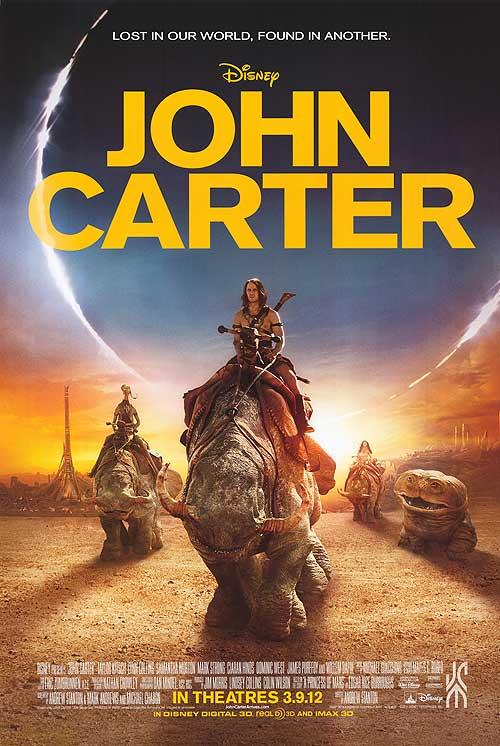
JOHN CARTER  ½
½
John Carter: Taylor Kitsch /
Dejah Thoris: Lynn Collins /
Tars Tarkas: Willem Dafoe /
Tal Hajus: Thomas Haden Church /
Sola: Samantha Morton /
Sab: Than Dominic West /
Tardos Mors: Ciaran Hinds
Directed by Andrew Stanton / Written by Stanton and Mark Andrews,
based on the story “A Princessof Mars” by Edgar Rice Burroughs
| SCREENED IN |
 |
| 3D |
JOHN CARTER harkens back to an innocent time when films encapsulated good old-fashioned escapism and a thrilling and jubilant sense of endless wonder.
Deeply
cynical film critics have lamented how the film is awash in old-school
thematic and narrative frivolity, but that’s precisely what makes
JOHN CARTER - during particular moments - as enjoyable and immersive as the
original STAR WARS.
It lovingly evokes the look and feel of B-grade adventure serials,
pulp science fiction novels, comic books, and young adult adventure magazines.
Yes, JOHN CARTER is pure cornball and more than a bit absurd with
its underlining premise, but it thrillingly succeeds as a pure popcorn
entertainment if you allow yourself to be taken in and suspend your
disbelief with its galaxy spanning tale of heroism and good versus evil. The film, as a result, is as playfully fun as it is epic in
scope and scale, traits that seem nearly extinct in the modern landscape of
film nihilism.
Of
course, comparisons of JOHN CARTER to STAR WARS seem inevitable, if not a
bit unfair. Carter first
appeared in the Edgar Rice Burroughs written magazine serial of 1912 that
was later collected in
the 1917
novel A PRINCESS OF MARS, the first in a
series of nearly a dozen books that chronicled its main character, an
Earth man, that finds himself way whisked away to Mars and, in turn, gets
in-between a planet-sprawling war amidst its resident factions.
Full of swashbuckling action set pieces, handsome and strong
heroes, endlessly beautiful heroines, exotic alien races galore, and
elements of pulp romance and western iconography, it’s no wonder how
Burroughs left an indelible influence on a century of writers and
filmmakers. Elements of his
sci-fi literary series can be seen sprinkled through Lucas’ STAR WARS
and even Cameron’s AVATAR.
Critics that have labeled JOHN CARTER as "derivative" of those films need to
give their collective heads a shake.
The
title character is not initially a cosmos-traveling hero in the spirit of
Buck Rogers, Flash Gordon, or Luke Skywalker, but rather a man from our own planet and
distant past. Carter (Taylor
Kitsch) is a former Confederate Civil War soldier from Virginia that,
while prospecting for gold and trying to evade the authorities for
shirking his military duties, finds a strange and ancient transmitter of
sorts in a deep cave that miraculously transports him to Mars.
The Mars of this film is that of Burroughs' original books and
not of science fact: this planet has a breathable atmosphere and warm
conditions that allow most of its characters to parade around shirtless.
Also, Carter, to his amazement, quickly learns that gravity reacts
differently for Earthmen on Mars, as he is granted Herculean strength and
the ability to hurtle himself over tall mountainous rock formations with a single
bound (a clear influence on the creation of Superman later in the
1930’s).
He has an initial
'close encounter' with one of the planet’s indigenous life
forms (Mars is called “Barsoom” by them), the ten-foot-tall, green
skinned, four armed, and horned Tharks, led by Tars Tarkas (William Dafoe,
providing a performance using the same motion capture technology as
employed in AVATAR). After
making some rather awkward attempts at getting to know these locals and
communicating effectively with them (one of the running gags in the film involves
the aliens referring to him as “Virginia” instead of by his name),
Carter learns of the existence of a human-like race of beings on the
planet that engage in their own civil wars for Martian supremacy.
|
|
Carter
finds himself rescuing Princess Dejah Thoris (the luminous and endlessly
photogenic Lynn Collins) who is set to be married – against her will –
to the leader of her enemies, Sab Than (Dominic West), who leads a faction
of “red” humanoid Martians that wants to see the end of the “blue”
ones. Princess Thoris offers
Carter a chance of finding a way back to his home world if he agrees to
help her and her people defeat the evil Than, who is being secretly
assisted by an immortal shape-shifting mystic, Matai Shang (Mark Strong,
so good at playing cold and detached villains).
Carter, who spent his time on Earth battling in his own country’s
Civil War, seems reluctant at first to agree to offer his assistance, but
as he grows closer to the Tharks and the princess, a sense of duty and
obligation overwhelms him to take the call of action.
JOHN
CARTER has been in developmental hell for nearly 70 years, which is
amazing considering that Burroughs' later literary creation, Tarzan, has
seen nearly 100 cinematic permutations during that span.
Andrew Stanton – previously a Pixar animation directorial wonder
that made FINDING NEMO and WALL-E –
makes his live action debut here with JOHN CARTER and has crafted a striking
and wondrously staged extravaganza of other-worldly grandness that easily
rivals the rich and textured fantasy films of George Lucas and Peter Jackson.
Like STAR WARS and the LORD OF THE RINGS, JOHN CARTER offers up a
sensational aura of transporting viewers to another time and place while
grounding us in its altogether strange, but oddly tactile surroundings.
The
visual effects here are extraordinary for they way they breathe thrilling
life to Burroughs' 100 year-old envisioned universe: The Tharks
themselves are thanklessly believable creatures that seamlessly interact
with the human actors despite their freakishly bizarre visages, and one
monster in particular, Woola – a ten-legged dog/lizard with an
ear-to-ear grin, a salivating and panting blue-tongue, and a canine-like
yearning to follow his masters wherever they go (he can also run at super
speed) – is so preposterously adorable and lovable that he nearly steals
scenes away from the other synthetically-derived creations.
Beyond the film’s aliens, Stanton and company create other
thrilling visions, like near city-sized vessels with legs that parade on
the Barsoom sands and flying air ships made of solar powered sails and maneuvered
by antiquated gears and pulleys. JOHN CARTER is an absolute triumph of state-of-the-art
technological whiz-bangery that is accentuated by the thrilling musical
chords of Michael Giacchino, who morphs the best of Bernard Hermann and
John Williams with a propulsive gusto.
It’s
deceptively easy to overlook the human element and performances in a film
such as this, but JOHN CARTER is assisted by the sincerity and
straight-laced work by both Taylor Kitsch and Lynn Collins, who both work
well off of one another and will greatly appease viewers of both sexes by
prancing around half naked and flexing their mighty physical endowments.
Kitsch may not have a deep and penetrating thespian range, but he
seems pitch perfect for his handsome matinee-idol-esque role and imbues Carter
with an aw-shucks gumption, a low key charisma, and a clear-cut
earnestness that the part simply demands. Collins
herself is an unendingly beautiful sight to behold (a living, breathing
Frank Frazetta pin-up painting come lovingly and alluringly to life).
More importantly, Collins gives her role of the battle-hardened
princess a beauty, nobility, and strength; Collins and Kitsch are also
able to find the very difficult middle ground tone in the film between
solemnity and high camp, which not too many actors could have pulled off
as effectively.
Not
all of JOHN CARTER joyously soars as successfully as its gravity-defying
hero: its story is almost impenetrably incoherent at times as to the particulars and who’s who and how they all relate to one another (it’s
real easy at times to be confused as to the differences between Jeddaks,
Tharks, Therns, and red and blue themed humanoid Barsoomians) and the
overall plot sometimes gets bogged down in a lot – make that an awful
lot – of elephantine expositional dialogue that tries to make sense of
everything to the point where it exhausts viewers instead of entertains
them. The villains as well
– played capably by Mark Strong and Dominic West respectively – are
not ideally and fully realized as intriguing antagonists.
Lastly, JOHN CARTER’s 3D – while neither hindering or assisting
the visual richness - seems like a last-minute cash grab; save yourself a
few dollars and seek this out in 2D.
JOHN CARTER is most assuredly cheesy, unconscionably silly, and may be difficult for pessimistic audience members that demand gritty sci-fi veracity to endure. Yet, if you simply allow yourself to be taken in with the film’s willful absurdity and enjoyably engage in its outrageous premise, then JOHN CARTER will emerge as a sprawling, sumptuously scaled, dazzlingly enthralling, and – most crucially – pulpy fun adventure yarn that painstakingly and affectionately taps into Burroughs' source material while maintaining its infectious gee-whiz spirit. It’s a grand and audaciously realized popcorn entertainment that never hides behind its nostalgic willingness to present a tale of good triumphing over evil on an extra-terrestrial stage featuring impossible acts of comic book/superhero valor. It’s been an awfully long time since a film didn’t condescend down to me as child and instead made me feel like one at the movies; JOHN CARTER falls into the latter category.
DIRECTORS THAT BEGAN IN ANIMATION (CTV SEGMENT)
