

 A
film review by Craig
J. Koban Match
1,
2016
A
film review by Craig
J. Koban Match
1,
2016
RACE 
Stephan James as Jesse Owens / Jason Sudeikis as Larry Snyder / Carice van Houten as Leni Riefenstahl / Jeremy Irons as Avery Brundage / Amanda Crew as Peggy / William Hurt as Jeremiah Mahoney
Directed by Stephen Hopkins / Written by Joe Shrapnel and Anna Waterhouse
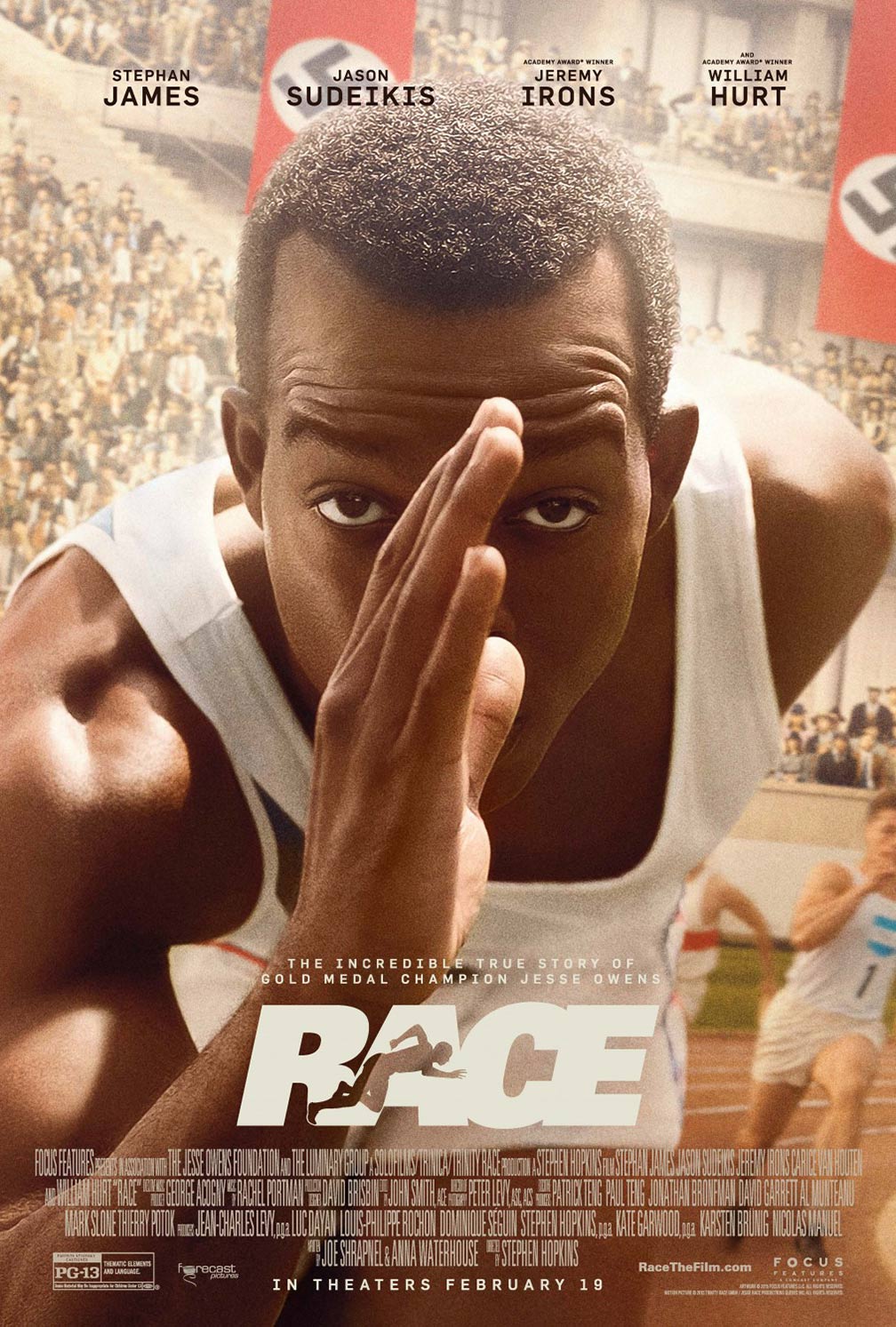
RACE, as far as sports biopics go, is a fairly paint-by-numbers affair in terms of its approach and certainly doesn’t break any new substantial ground in the already crowded genre. The film dutifully covers key aspects of its subject matter’s life – in its case, American track and field athlete and four-time Olympic gold medalist Jesse Owens – in a fashion that would mostly suit the modest needs of a made-for-TV film.
However,
RACE makes up for its lack of innovation in approach in terms of how it
paints a multi-faceted and compelling historical narrative that marries
together several significant social/political events not only in Owens’
life, but also of the larger world around him.
Much like the recent SELMA, RACE hones in on a specific period of
Owens’ rise to track fame, which also happened to coincide with the 1936
Berlin Olympic Games under Nazi Germany.
There’s more to this film than immediately meets the eye.
RACE
– a title that’s a bit too obvious and on on-the-nose for its layered
meaning – does a commendable job of showcasing how Owens’ struggles
with racial bigotry eerily mirrored those of Jews and minorities under
Hitler’s rule in Germany. The
most fascinating moral issue that the film addresses is that, in certain
ways, the racial divide in Germany and their treatment of certain citizens
were not fundamentally different than what could be found in the United
States. Yes, the film
captures what made Owens a relative overnight sporting icon, but RACE also
wisely evokes the crisis of conscience that he went through.
Owens had a choice between proving his worth to his country and the
world by participating in ’36 Olympics or simply staying home to boycott
the games as a form of social protest to the discriminatory policies
of both Germany and his native country.
Even when RACE dramatically falters at times with its melodramatic
handling of some of its material, it remains compulsively watchable for a
myriad of other reasons.
|
|
The
first sections RACE are, to be fair, pretty obligatory in terms of setup
and execution. We meet a
young Owens (played with a headstrong conviction and easygoing charm by
Stephan James) that's proud to be the first in his family to attend
college. However, he faces
multiple pressures on his journey to attend Ohio State University, like
the fact that he’s relatively penniless and struggles to support his
girlfriend (Shanice Banton) and their daughter and the obvious mental
roadblocks in being one of a few black men attending a mostly white
college during a racially segregated time.
Despite his hardships, Jesse is determined to stake a claim for his
athletic supremacy in his new surroundings, and he catches the eye of
track coach Larry Snyder (the wonderfully cast against type Jason Sudeikis),
who sees great potential in Jesse not only for college track and field
glory, but also for the upcoming Olympic Games.
While
Jesse obliterates the college competition and sets multiple records while
doing so, RACE tells a concurrent story thread that explores the dicey prospect
of America participating in an Olympic Games under Nazi rule.
American Olympic Committee President Jeremiah Maroney (William
Hurt) pleads with his colleagues to vote against the U.S. journeying to
Berlin out of protest for Hitler’s treatment of the Jews.
Industrialist Avery Brundage (Jeremy Irons) is his direct
opposition, relaying his case against his country boycotting the games,
citing that it would be a grand opportunity for his nation’s athletes to
reign supreme on Nazi soil and send a clear message of American
superiority. Many scenes
involving the infighting among Committee members – both sides of which
make deeply convincing arguments – adds a much needed layer of ethical
complexity to RACE. Equally
enthralling are scenes involving Brundage making a pilgrimage to Germany
to square off against Joseph Goebbels (a sinister Barnaby Metschurat), one
of Hitler’s right hand men, during which time the men barter back and
forth about what Germany will have to do in order to secure American
involvement in the games.
No
need for a spoiler warning, because history has proven that the U.S. and Owens did go to the games, which represents the third and final arc
of RACE. Director Stephen
Hopkins does a fine job of evoking Jesse’s awe of being in a foreign
world ruled over by an oppressive regime, not to mention his internal and
external pressures of winning gold in multiple events.
Even when the film’s visual effects utilized to re-create
Berlin’s massive 100,000 seat Olympic arena feel unfinished and a bit
messy in execution, RACE is at its most intoxicating best when it shows
Jesse acclimatizing himself to such intimidating surroundings and
cementing his status as the Olympic hero that he became known for.
He develops an unlikely friendship with fellow German track and
field star Carl Long (David Cross), who took incalculable
risks by very publicly supporting Jesse as a fellow athlete.
Celebrating with Owens after he broke the long jump record – in
front of thousands of German spectators and Hitler watching in a country
that harbored toxic opinions of non-Caucasian races – was pretty ballsy
of Long.
RACE
does many things really well. For
a modest Depression-era kid from Cleveland like Owens to journey
into the lion’s den in Berlin and essentially take center stage away
from Hitler and company is fairly awe-inspiring to contemplate.
Again, the film never shies away from asking important questions
about Owens’ times and his participation in the games (would he have
made an even larger statement if he didn’t
attend?).
One of the sadder tragedies of Owens’ Herculean Olympic success
was that his achievements were never acknowledged by the American
government (President Franklin D. Roosevelt refused to publicly
congratulate nor meet him). Hell,
when he returned home to celebrate a dinner held in his honor at the
Waldorf-Astoria he was refused front door entrance because of his color.
He was forced to enter the building through a side-door in a back
alley hidden from sight. What
a shame.
The
performances in the film are resoundingly on point for the most part, and
Stephan James gives a finely modulated, unfussy, yet complex portrait of a
man facing insurmountable odds from multiple vantage points. I really appreciated the casting of Jason Sudiekis as Owens'
sternly pragmatic coach, who had to fight his own battles against
prejudicial colleagues and his country’s intolerance of blacks in
supporting and nurturing Owens’ gifts as a track star.
Sudiekis is much more known for playing obnoxious morons in movie
comedies, which makes his sincerely straight-laced and dialed-in
performance here all the more revelatory.
Complimenting the pair is the stellar supporting work of Jeremy
Irons and William Hurt in the film, especially from Irons, whom had to
play a conflicted man that ultimately had to be in bed, so to speak, with
the Nazis to ensure America’s involvement in the games.
RACE
perhaps suffers from a bit too much narrative bloat as a whole.
Some subplots needlessly distract from the whole, like one
involving Owens' unfaithfulness to Ruth (granted, the film at least
tries to portray him with multiple strokes, some of which are
unflattering). Perhaps even
more questionable is a completely unnecessary narrative thread regarding
Nazi propaganda filmmaker Leni Reifensthal shooting the games to help prop
up Hitler’s Third Reich. RACE’s
handling of Riefenstahl overall is highly contestable, mostly because it
sort of presents her as a Nazi-defying rebel, which seems a bit too
simplistic to take credibly. That,
and her documenting Nazi Germany deserves its own film altogether,
not to mention a much more textured and layered account than what’s
presented here. Scenes with
her – among many others – are sometimes presented too simplistically
and broadly to be taken with any level of plausibility.
Nevertheless, and despite my many reservations, I’m giving RACE a somewhat reserved recommendation, mostly because I appreciated its historical focus from a multitude of viewfinders, not to mention that the uniformly good performances help elevate the film’s lackluster handling of some story material. I’ve seen countless – and forgettable – sports biopics over my years as a critic, but the stakes in RACE felt a bit more consequential. Yes, the film rightfully champions Jesse Owens as an indelible and inspirational sporting pioneer that laid the paths for innumerable athletes that came in his wake, but RACE also wisely reminds viewers that there was more on the line on a global level for Owens and his country than simply winning gold medals.
A lot more.
