A film review by Craig J. Koban
THE REAGANS
 ½
½
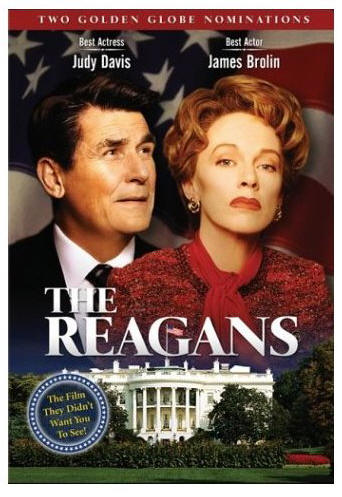
James Brolin (Ronald Reagan) Judy Davis (Nancy Reagan)
Directed by Robert Allen Ackerman / Written by Jane Marchwood, Tom Rickman, and Elizabeth Egloff
According to polls conducted a year ago, the late Ronald Reagan has surpassed Abraham Lincoln as one of the most popular presidents in US history. Considering his questionable past and history in politics in the White House, I felt like I should demand a recount.
This was
the same President that sold weapons to a known terrorist country in the
exchange of US hostages that would erupt into the infamous Iran/Contra affair.
He also occupied a Presidency that provided billions in aid and weapons
to Iraq to assist them in their battles with Iran…not even gonna dignify
this problem any further.
Question: How
could such a man occupy so favourable of a position in so many people's minds?
The new mini-series, THE REAGANS, attempts to answer that question. The series gained much notoriety in 2003 for being pulled off the air for being too controversial. Viacom originally scheduled the series to run on CBS, but moved it to Showtime after protests by the Republican Party and a threatened boycott over its portrayal of the Reagan family. The film has finally arrived on a special edition DVD.
What’s
truly shocking and largely surprising is what a moving and sympathetic portrayal
of the former President it really is. As
a matter of fact, what makes THE REAGANS such a strong biopic is the fact that it does not place a
lot of emphasis on the large controversies, but rather on the smaller and more
intimate details of Reagan’s life. The
film is not so much a scathing hatchet job as it is a sensitive and sincere
portrayal of a man and family that was clearly not perfect.
The film clocks in at nearly three hours and it's quite an
expeditious narrative indeed, covering the family from Reagan’s days as a
Hollywood actor and President of the Screen Actor’s Guild, to Governor of
California and his eventual election as President in 1980.
It's quite amazing how dense the narrative is and the sheer number of
characters that occupy it (all members of the Reagan family are dealt with
appropriately and have real emotional weight given to them).
Full credit should be given to director Robert Allan Ackerman. He does an
expert job of handling the dense subject matter and makes it into something
cohesive, uniform, and always watchable.
THE
REAGANS is a stirring watch right from the beginning and works on
the level of being a tight drama about two people who really, truly love each
other. The film begins to chronicle
Nancy and Ronald’s days as actors in Tinseltown. Ronald at this time is
portrayed as a straight arrow - likeable, charming, and fiercely American and
religious. I like how the film has
time to develop the smaller aspects of his life, like how during World War II he
made movies in Culver City for the Army, and later had trouble finding work,
finally winding up as GE's spokesman for Death Valley Days on Television (a job
that was especially difficult to swallow, considering his disdain of the
television format). It is here
where the film’s great irony resides, as if there was ever a President that
used TV and his charisma and easy-going orator skills to win the favor of the
public, it was Reagan.
Moreover, we witness (amazingly) how Ronald’s contempt for
the IRS grows as his income skyrockets. As
his resentment of the Federal Government increases, we also see how the shadowy
rich figures in the background seduce him into becoming their tax-cutting
puppet. This, of course, leads him
right to the Governorship of California, but even Reagan himself, at the time,
had his doubts. “Run for
Governor?” Reagan asks his aids, “But I never even played one before.”
Of course, his Governorship was not all wine and roses.
He’s hated by the students on campus across the state, and in one of
the film’s most powerful scenes, he mentally breaks down with a priest when
faced with the painful realization that a decision he’s made has caused a man
on death row to be executed. Yes,
he does not stay the execution, but he is nevertheless torn by it, and pleads
with the minister for some sort of confirmation that he did the right thing.
The scene is crucial because it establishes Reagan as an intense man of
faith that would later materialize in many of his decisions in the White House
(after he was shot by John Hinkley, he politely tells Nancy, “He was just part
of God’s plan, and God wanted me alive to serve my term.”)
The film is political to a large degree, but it’s easy to
forget about the intense human drama that occupies it.
The real heart of the film is not Reagan’s Presidency or Governorship,
but his relationship to his wife and family.
This is the cornerstone of the film, and it does not so much show the
Reagans as a clean family corrupted by a life in politics as a family that had
problems to begin with. Make no mistake about it, Nancy and Ronald are devoted to one
another, and their love is real. It
has been said that Nancy was the only person Ronald would confide in on any
intimate level. The film is very
open with presenting their relationship and sincere in showing the couple for
what they probably were: two people that loved each other and stood by each
other’s side…no matter what the cause, even in moments of intense crisis.
THE
REAGANS is also refreshing in how it fleshes out the rest of the
family and gives them perspective on their mother and father.
Nancy and Ronald started off as regular parents, but it was with their
political ambitions that lead to the near estrangement of several family
members. Especially sad and
poignant is the story of daughter Patty, played well by Zoe Palmer as a child
who feels misunderstood and largely forgotten by her parents.
She is the emotional crutch that often holds together the other children.
What’s revealing is how much she both loves her dad and hates what he
does.
THE
REAGANS is nearly told through the eyes of Nancy, as is portrayed
in an Emmy nominated performance by Judy Davis. If the film was heavy-handed with one person it most
certainly was with Nancy. But she
is not really an easy target as she is a rather complex woman. She oftentimes is portrayed as a spoiled, egotistical, and
remarkably selfish and uncaring woman (especially towards her children).
She also is seen as a woman that is sometimes paralyzed with
procrastination and neurotically nitpicks over the smallest of details.
She is also a fiercely independent woman with determination and drive and
a keen sense of where she wants her husband to go.
I never, however, got the sense that she did not do anything for Ronal
that was not out of love for him. She
could be a cast iron bitch a lot of the time, but she was the poster girl for standing by
her man. Davies handles this
complex portrayal seamlessly and effortlessly and maintains that uneasy level of
intensity and sensitivity throughout the film.
Kudos also has to be given to Josh Brolin for his great performance as Ronald. He captures his mannerisms so effortlessly, but he is not doing a one-dimensional caricature. Brolin shows Reagan as a largely decent and moral man. Reagan is further presented as a person that believed in right and wrong, and he believed that if he made a mistake he should own up to it, (kind of like the good guys in the movies from his era). Reagan was not gifted at being extroverted with the people he worked with, but he was clear and adamant about what he believed in. He felt like he wanted to do the right things for the country and the world.
On the flipside, the man had an obtuse mind, which was permeated by
overly simplistic ideals, coupled with his black and white sense of right and
wrong. This of course led him to
make broad and silly conclusions that lacked in any serious exploration of the
problem. He was a man that
surrounded himself with the right people to make decisions for him, and he was
often lead around by his often manipulative and domineering wife.
Yet, he’s really likeable, affable, and old fashioned (something that
our modern pessimistic view of politicians sometimes fails to see) and has a
casual sense of humor about him (“If you don’t mind, this administration
would like to pee,” he tells an antagonistic advisor).
Brolin, like Davis, captures his essence so well and his Emmy Nomination
is equally deserved.
I guess I came out of
THE REAGANS really not understanding what all
the fuss was about. The Republicans
can make all the protests they want about the film, but it’s not the cinematic
lynching that it has gained a reputation for.
What it’s really, at its core, is an engaging and taut drama that
feels, overall, like an accurate portrayal of the Reagan family.
What I came out with is not hatred for the Reagans but an acknowledgement
of the family as real people with real issues and problems. The controversy that
the film elicited has no real merit. It’s
balanced, fair, and does not generalize. The
film’s only real shortcoming is that it could have been longer and gone even
deeper. Yet, the film is a great
vehicle at showing us a deeply flawed President in a world that he felt was in
need of fixing. He was not a
memorable President because he was a dirty politician.
As the film shows, he was a man that spoke with conviction and vigor and was
sincere in his convictions. He was
old fashioned in his manners and had an “aw shucks” attitude about the world
around him. People listened and
responded to him and, even after the impeachable fiasco of Iran Contra, they still
liked the man.
Maybe that's why the man was so popular?
