A film review by Craig J. Koban
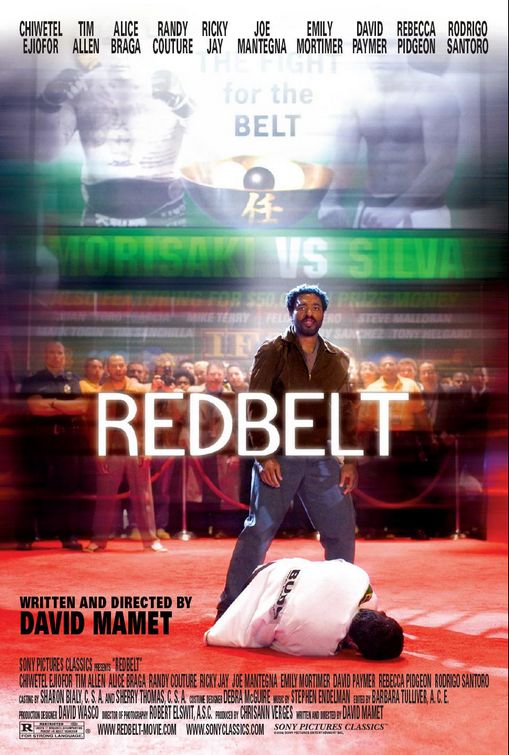
REDBELT

Mike Terry: Chiwetel Ejiofor / Sondra Terry: Alice Braga / Chet
Frank: Tim Allen / Snowflake: Jose Pablo Cantillo / Jerry
Weiss: Joe Mantegna / Marty Brown: Ricky Jay / Laura Black: Emily
Mortimer / Joe Ryan: Max Martini / Richie: David Paymer
Written and directed by David Mamet.
 REDBELT
is one of the strangest hybrid films that I’ve seen.
It’s not exactly a martial arts action film, nor is it ostensibly
a thoughtful drama…although it contains elements of both.
The film could aptly be described as having copious elements of
film noirs like NIGHT AND THE CITY, a modern samurai film in the vein of
Kurosawa, a sports underdog tale akin to ROCKY
and
THE KARATE KID,
and characters and situations out of lurid pulp fiction.
Some of these ingredients work marvelously whereas others fall kind
of flat, but kudos to writer/director David Mamet – one of the
greatest American literary and screen voices – for making all of the
differing ingredients of REDBELT coalesce with reasonable fluidity.
REDBELT
is one of the strangest hybrid films that I’ve seen.
It’s not exactly a martial arts action film, nor is it ostensibly
a thoughtful drama…although it contains elements of both.
The film could aptly be described as having copious elements of
film noirs like NIGHT AND THE CITY, a modern samurai film in the vein of
Kurosawa, a sports underdog tale akin to ROCKY
and
THE KARATE KID,
and characters and situations out of lurid pulp fiction.
Some of these ingredients work marvelously whereas others fall kind
of flat, but kudos to writer/director David Mamet – one of the
greatest American literary and screen voices – for making all of the
differing ingredients of REDBELT coalesce with reasonable fluidity. Mamet
has always been one of my truly favorite writers.
His work – whether it is in literature, plays, or the silver
screen – will forever be legendary for their inclusion of clever, tense,
and colorfully vulgar dialogue. When
his characters speak the important thing to consider is that, at times,
the exchanges are not realistic, per se, but have a cynical flavor, a
peculiar cadence and flow, and are aggressively concocted for impact and
visceral effect. His
personas’ verbal exchanges are quick and razor sharp, and often their
rhythms cut each other other and overlap.
When
it comes to dialogue and exploring the mindsets of his characters, Mamet
is an undisputed master. This
makes his very atypical choice of making – at face value – a martial
arts film all the more intriguing. All
of Mamet’s aesthetic trappings and esoteric fingerprints are all over
REDBELT, and the film’s chief asset is…well…the presence of the
artist behind the camera. Even
more so, the film works efficiently for the way it’s both an engrossing
modern noir about morality and corruption (take away the modern locales
and the sport and the film could occupy the 30’s and 40’s).
As
much as it works as a seedy contemporary noir, REDBELT also feels
comfortable with some of its otherwise B-movie traits.
Being a sports film, there is the obligatory final “big match”
between hero and villain, and it certainly plays up to our expectations of
such a third act. Even if the
conclusion of the film follows a predetermined course, it’s the journey
towards it’s ending – and Mamet’s staunch willingness to take
familiar material and cultivate it differently – that allows for REDBELT
to rise above the mediocrity of the martial arts genre.
Mamet is clearly out of his element when it comes to staging the
action in the film (which are its least inspired set pieces), but
what he does with flawless precision is to craft edgy dialogue and
virtuoso performances. In a
way, REDBELT almost becomes an anti-mixed martial arts flick and one that
paradoxically holds up many of its norms and conventions.
As an exercise in experimentation, the film is too inspired with its
handling of the material to deem it a failure.
Like
all great noirs and tales of sports underdogs overcoming all odds is the
vigorously idealistic hero, and REDBELT certainly has one.
He is Mike Terry (played in a thanklessly great performance by the
reliably great Chiwetel Ejiofer) who runs a martial arts dojo that
specializes in teaching self-defense.
Mike is a fairly humble protagonist, but he is more talented
than typical underdogs of similar sports genre films.
His philosophy of martial arts is simple:
There is simply no situation that does not have a form of escape or
defense against it. He is a
master of ju-jitsu and arguably one of the finest mixed martial artists in
the nation, but he constantly refuses to become a part of contests and
tournaments, seeing as they demean the purity and essence of his craft,
not to mention that they would clearly make a mockery of the teachings of
his master, a Brazilian
martial arts sensei that Mike idolizes with a fevered passion.
So,
Mike refuses to sell out his skills, but it’s his soulful pride that
hurts him financially. He
does not have a lot of students and his business, as a result, barely
stays in the black. His only
financial escape is via the profits of the garment business provided by
his wife Sondra (Alice Braga). Despite
his own business’ lack of profits, Mike does have some valued prize
students, like a police officer named Joe (Max Martini), whom he tries to
learn valuable lessons of surviving any physical onslaught while
maintaining discipline and honor in combat.
Mike’s penchant with being a martial artist with high ethics does
not sit to well with his wife, as she is growing listless and tired of
funneling her business profits into his failing school.
It’s
from the film’s simple beginnings where Mamet takes the story into
murkier and more convoluted waters. One fateful evening will forever change Mike:
A distraught woman (Emily Mortimer, very decent here) shows up one
night as his school looking for some help, but she misreads Joe’s
attempts of assisting her with an attack and grabs the officer’s gun
and accidentally shots out Mike’s front window.
This evening in question is the catalyst for the rest of the
film’s dense subplots. Early
on Mike’s despair turns upside down when he befriends and defends a
Hollywood action film star, Chet Frank (Tim Allen, uncharacteristically
and refreshingly giving a solid dramatic performance) in a bar fight.
Chet, in return, showers Mike with lavish gifts, like a Rolex and a
chance to serve as producer and fight choreographer for his new war film
he’s acting in.
Mike’s relationship with Chet will indirectly lead him to some shady dealings with Chet’s dubious manager (Joe Mantegna, playing this part effortlessly), not to mention a showdown with an unscrupulous, martial arts PPV promoter (Ricky Jay, who inhabits this very small role with such a calculating sleaziness). The labyrinth-like plot then takes some naturally Mametian surprises and twists - some genuinely captivating, others dolefully predictable – as Mike becomes the victim of double cross upon double cross, which threatens him to look at the sport that he cherishes with a whole new nihilistic worldview. Of course, this is still martial art sport film, which allows for Mike to inevitably find himself part of a lavish $50,000 prize mixed martial arts tourney, but the manner with which the tourney is regulated and handled leaves him jaded. Feeling utterly betrayed and worthless, Mike makes an attempt to do the "right thing" and fight not for money, but for what’s right.
Again,
I think that the film’s final “big fight” scene is both unavoidably
conventional alongside being an interesting twist on the notion of a big
climatic showdown. Yet, I was
less enthused about action in REDBELT than I was about characters and
dialogue. True to form,
Mamet is a lackluster filmmaker when handling scenes of martial arts
mayhem, but he’s an unqualified ringmaster of crafting and staging
intelligently developed characters and their relationships to one another. On the whole, Mamet’s real success with tackling this
martial arts genre is the way he sort of legitimizes and radically
re-interprets it for his own purposes.
The film sparkles with more great dialogue exchanges that will make
Mamet enthusiast proud, not to mention that the film makes reasonably
successful attempts to infuse an otherwise routine sports picture with
complicated turn of events, nifty twists in the plot, and with characters
and well tailored performances.
And
speaking of performances, just how great is Ejiofer in this film?
Alongside Mamet’s distinctive handling of the genre, it is the
actor’s virtuoso performances that also elevate REDBELT far above the
perfunctory nature of these types of films.
Ejiofer is such a calmly commanding screen presence that never
needs to scream a line for powerful, dynamic impact.
He has a sort of serene and calm charisma, which I think
essentially, demystifies his martial arts master status and grounds him
much more in reality. Weaker films would have made Mike a one-dimensional drone at
the service of the story. Certainly,
Mike is a lethal adversary, but it is his poignant emotional struggles
with allure of the growing industry of big money Martial arts extravaganzas
- while dealing with maintaining the decorum of sport - that makes
Enjoiner’s performance all the more captivating.
It
could be easily stated that REDBELT is an enormously different stylistic
and thematic choice for Mamet. Yet, the film could also be discretely labeled as a small
passion project for the filmmaker: Mamet himself has earned the rank of
purple belt under the teachings of Renato Magno, who also served as
REDBELT’s ju-jitsu consultant. Not
all of REDBELT works entirely successfully, but the collaboration of
Ejiofer in the lead role combined with Mamet’s deconstruction of the
staples of the martial arts genre that makes the film worth seeing.
The only real dilemma of REDBELT is that it has the best aspects of
Mamet cinema at odds with the more hokey and habitual aspects of the
martial arts/sports underdog picture.
These two elements go the distance in REDBELT, exchanging blows
throughout its 99 minutes. Yet, in the final round, it’s Mamet’s voice
that wins the split decision.
