A film review by Craig J. Koban

Rank: #24
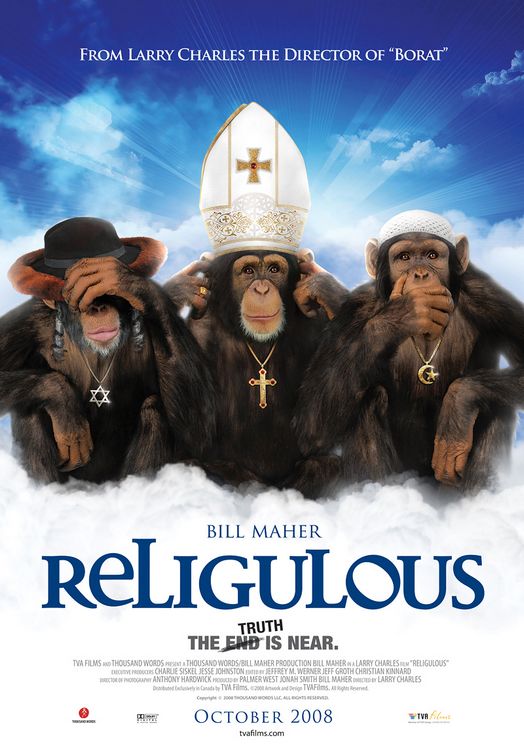
RELIGULOUS
 ½
½
A Documentary directed by Larry Charles and written by Bill Maher
“I’m telling you, anyone that defends religion is going to sound like a crazy person.”
- Bill Maher, in a recent magazine interview
I was born into a
largely Ukrainian Catholic family…without much of a choice in the matter
(honestly, as a baby, it certainly is hard to voice your own opinion on
whether or not you wish to be baptized).
I attended church most of my childhood until adolescence and
then – poof – God was sort of out of my life.
Maybe raging hormones, hair growing in awkward places, and my then
awakening appreciation with the feminine form was preoccupying too much
of my time.
I guess that I have always been a proud agnostic (or, as one comedian once put it, an "atheist without balls”). I do consider myself a tolerant chap: I have friends that are wholeheartedly believers in the almighty Himself, and although I can respect their inexhaustible and undying devotion of an omnipotent deity, I very rarely find myself truly understanding it. Hmmm....believing that the world was created in days and is only a few thousand years old, that there once was a man that walked on water and could turn water to wine, that someone once lived in a whale, etc.. I dunno...am I that batty to question these impossibilities?
I don’t like the term “non-believer”, which sounds a bit too
scathing and spiteful. Being
a person that is empirical to the point of obsession, I would rather label
myself as a “rationalist” – I believe what I can see with my own
eyes. I consider
validating a belief in
God to be much akin to being on a jury: If you have a reasonable doubt in
any way on His existence, than there’s no way you can honestly claim to entirely
believe in Him.
I am a man of doubt that has gone well beyond the point of it being
“reasonable”.
Am I that nuts?
I don’t think so, and the new documentary, RELIGULOUS, certainly
does not think so either. Now,
before anyone criticizes me, I will be quick to point out that the appeal
of this film is not just in how it shares my worldview, nor does my
support of it make me a hate-monger of all religious themed films (I have
always liked biblical epics, like BEN HUR
and THE TEN COMMANDMENTS).
I appreciate how RELIGULOUS goes out of its way to point out that 16 per
cent of Americans admit to having no religion, which is a great
unappreciated minority. The
self-anointed “voice of reason” in the film is comedian Bill Maher,
whose soul mission here is, ironically, to enlighten viewers that 16 per
cent is actually an enormous minority that should not be nearly as silent
as they have been. Maher
himself, an unyielding atheist, does not buy anyone's – and I mean
anyone’s – belief in God because he feels that no one could possess
concrete proof on the matter. As he humorously states early on in the film when he
addresses the camera, “You know how I know you don’t know?
Because I don’t know.
And you do not possess mental powers that I do not.”
The best satirists go for the jugular and never feel impeded by any level of maintaining decorum. They take a strangle hold of their subject matter with a feverous, vice-like grip and go on the acerbic and sarcastic offensive. That’s precisely what Maher does throughout every waking minute of RELIGULOUS (an amalgam of the words religion and, yes, ridiculous). This film will greatly offend many, that much is true, and Maher’s rather pointed attempts at indirectly and directly labeling all Jesus/God loving people as…weird and irrational…is constant.
Yet, the film is a facetious documentary in the way that
it's
simultaneously hilarious, shockingly brazen, cleverly constructed, and –
most crucially – endlessly thought-provoking and debate inspiring.
Those that would cast Maher into the pits of hell for his
sacrilegious imperative kind of miss the point: This documentary is a
monologue; an editorial about one man with nail-biting doubts and what he
does – and does so splendidly – is to use his razor sharp wit, a
surprising knowledge of scripture, and his unique brand of mordant and
irreverent humor to engage in a clear eyed analysis on spiritual matters
that he feels most religious people never are willing to do.
Throughout the piece, Maher’s position is “don’t drink the
holy water infused Kool-Aid.”
The film opens and
concludes in Megiddo, Israel, which is Ground Zero for the battle to end
all battles, the end times, according to the Book of Revelations.
“The other guys are selling certainty,” Maher initially
discusses in regards to obstinate fundamentalists, “but not me” he
concludes. He has doubts…big ones…and he feels that organized
religion is not only foolish endeavor, but also a dangerous one (a belief
that certainly has more than a grain a truth in our post-911 world).
To be fair to Maher, he’s not out to mercilessly attack just
Christians: he’s out to mercilessly attack most religions as being
hollow and shady in the “proof” department. To show how he believes that a world with religion is a
ridiculous and hazardous place, he hones in on Christianity, Judaism, Islam,
Mormonism, TV evangelism, and even Scientologists in his satiric
crosshairs. Because of this,
the film is kind of joyously blunt and euphorically lacking in restraint,
which is to its ultimate acclaim. RELIGULOUS
is a rant film that will enrage as much as it entertains, but below the
radar it’s also disarmingly hilarious and thoughtful with its themes.
This is not film that
involves a spiritually uneducated man.
No, Maher himself grew up Catholic (on his father side) and Jewish
(on his mother’s side). The
family was raised Catholic until he was thirteen (and until his mother and
father had a fall out with the church over the issue of birth control) and Maher even
interviews his own mother throughout the film to help emphasize his
points. At one juncture he
asks her what the family believed and did not believe
after they stopped going to Church regularly, to which she responds, “I
don’t know what we believed.”
Maher is not
biblically illiterate. Throughout
RELIGULOUS he often displays a surprisingly keen understanding of the good
book, oftentimes with much greater authority to those that profess to be
experts in it. He often is quick to slam down his “targets” especially
when it appears that they are being stubborn, but it’s important
to understand that he is not being overly mean-spirited, nor is he being
too unfair with them. Like
Michael Moore, Maher is able to let his interviewees embarrass
themselves by the frequently silly and inane things they say in response
to his logical queries. His
targets are emphatically faithful, which has led to many people
criticizing Maher’s approach to being akin to shooting fish in a
barrel. Yet, why wouldn’t
he interview common folk with a passion for God?
I don’t think that the responses they give would be any different
from the ones prominently religious people would give.
Maher travels
everywhere, from holy places in Italy, Israel, the UK, Florida, Missouri,
and Utah, where he tries to engage in frank conversations with various
supporters of religions in hopes of them answering many of his reasonable
questions. Oftentimes, he
easily refutes what they tell him and, even when he can't do that verbally,
he juxtaposes interviews with funny movie and TV clips and subtitles.
Perhaps the most uproarious cut away occurs after Maher tries to
get some insight as to why the Bible glosses over Jesus’ teen years and
makes a comment as to what the son of God probably looked like as an awkward
adolescent: an image of actor Jonah Hill is then shown.
There are many
memorable and lasting stops in Maher’s travels.
Early on he visits a chapel that is actually in a semi-truck in North
Carolina where he argues with a former Satanist that is now a born again
Christian. He also visits
some very peculiar people, like Mark Pryor, democrat senator from
Arkansas, who shows why certain men should in no way be elected as
Senators in America. He’s
not the sharpest knife in the drawer, from a religious and even common
sense standpoint. The
politician struggles somewhat when asked whether he actually believes that
the earth is only a few thousand years old and that the End of Days is
imminent. When his attempts at
answering simple and direct questions are unmitigated failures, he stumbles
even further.
When Maher explains why it concerns him that his country is being
run by people that believe in ethereal things, Pryor pitifully responds, “You don’t have to pass an IQ test to
be in the Senate” The look on his face, after he realizes what he
has said, is
priceless.
More and more of
Maher's
interview subjects and tour stops emerge as even...creepier.
He interviews a former homosexual that reverted back to
heterosexuality and Christianity that feebly attempts to rationalize why
gayness is a problem that can be corrected.
He visits a man in the Netherlands that is leading a cannabis
religion (a verbal jab Maher lashes out at this inebriated stooge about how
marijuana affects short term memory is ingeniously played).
He even goes as far as the Vatican (predictably, he is not granted
access to the Pope), but he does speak with a few Vatican religious
scholars, one of which, Reginald Foster, who candidly speaks out at the
needless opulence and lavishness of the Pope's lifestyle (Jesus, no doubt,
would not have approved). Maher
then visits a wise Vatican astronomer, an odd man of God and science, who
thinks that a creationist perspective that puts dinosaurs and mankind on
the earth together, cohabitating in peace, is kind of inane.
To further embellish
this, Maher then visits a Creationist museum in Kentucky that, among
all things, has displays that show caveman-like children living peacefully with
velociraptors and has passion plays that involve Jesus getting the holy
tar kicked out of him (hmmmm...don’t have that at Disneyland).
He then goes as far as to speak to the actor playing Jesus at the
show and, in a purely head scratching episode, he tries to get some
answers from the museum’s curator as to why he thinks dinos and people
lived harmoniously together.
His
travels then take him to Utah and Mormonism (some of the actual Mormon
videos and cartoons that are, I believe, used to train and recruit Mormons, are
kind of shocking in their own right).
Perhaps even more shocking is Maher’s discussion with a rabbi
that certainly has a difficult time explaining why he met with the leader
of Iran at a Holocaust denial conference (this is the only interview
where Maher
is shown walking out of in disgust).
To really nail it home, Maher visits a few TV evangelists (the
biggest crooks and losers next to oil and tobacco executives) that
shamefully profess to not getting salaries from their respective
ministries, but willfully pimp themselves up with lavish jewelry and
clothes via donations. One
evangelist has to be seen and heard to be believed:
He is Jesus…yes…that one.
Jose Luis de Jesus Miranda, who actually believes that he is the
second coming in our time. He
explains how he is the product of centuries old Christ bloodline that traveled
from the holy land and eventually to...Puerto Rico.
Astoundingly, he has over 100,000 followers.
Oh, but wait,
Scientologists are not off the hook.
In the film's single funniest moment, Maher impersonates a zealot like
Scientologist preacher that pontificates on London Hyde Park’s Speaker’s
Corner about how an alien race several trillion years older than the
universe are born within us, which can be detected by an E-meter.
Now, his point here is not subtle (Scientologists are kind of
nutty, we get that), but he uses this angle to point out a bit of a
theological hypocrisy that exists: Millions of people in the world pray to
an invisible god everyday and believe that He (as Maher puts it) "murmurs"
in their ears with advice and words of wisdom all the time…but they are
often seen as "sane" compared to the "insane" Scientologists.
What is all of this boiling down to? Well, Maher does what many celebrities (or comedians, for that matter) would never do publicly: He is vocally skeptical and challenging religious issues and beliefs that many people hold very dear. The heart of the film is how Maher is able to puncture through the seemingly endless menagerie of pretensions that true believers steadfastly adhere to, often while showing their inability to deal with him dishing out question after question that demands an answer more satisfying than “that’s simply what I believe.” RELIGULOUS is frequently profane, diligently sharp witted, illuminatingly provocative and scandalous, and equally offensive and riotously funny. Great satires need to roar like lions and feel uninhibited with the material, and RELIGULOUS is no exception. Maher’s anti-every-religion efforts here rarely, if ever, pulls its punches. It sticks to its principles and never lets go, and that's why the film works.
If the film has one weakness it occurs in the last sequence, where Maher preaches in an endlessly long and tired monologue as to why religion must "die" in order for mankind to live. Certainly, fanatical religion has made the world exceedingly dangerous, a valid point, but the manner Maher sermonizes here is a bit counterproductive: he spends the film chastising people for preaching their beliefs, but concludes the film by engaging in the same behavior. Yet, Maher and director Larry Charles (who helmed the equally funny and shocking documentary, BORAT) painstakingly craft an expose that mocks the idea of global religions in general because of the way they bring about pointless and dangerous tribulations in the world. Religion is ridiculous, according to the comedian, and RELIGULOUS is brilliantly incisive and appallingly evocative because of that. Not too many American comedic voices would have dared to touch this highly divisive material, which is why I left the theatre respecting Maher’s guileless convictions: He’s not trying to win any popularity contests here, but rather he digs deep and expresses his extreme spiritual doubts without worrying about offending anyone.
This is one of 2008’s
ballsiest…and hellishly funny…films.
