A film review by Craig J. Koban January 5, 2010
SHERLOCK HOLMES

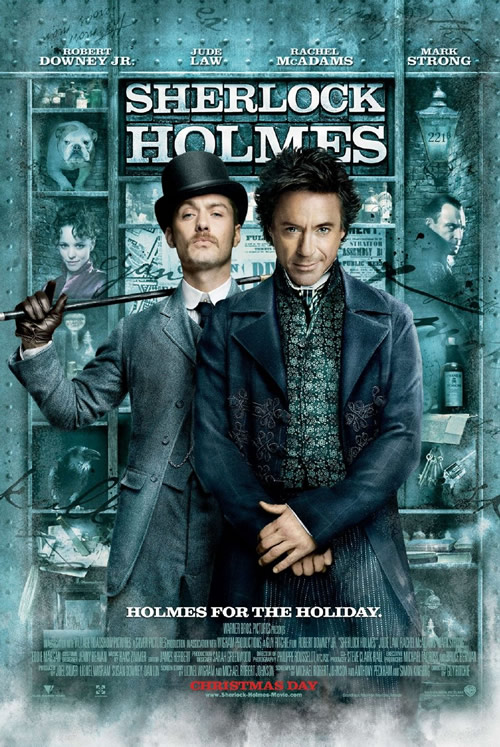
Holmes: Robert Downey Jr. / Watson: Jude Law / Lord Blackwood:
Mark Strong / Irene Adler: Rachel McAdams / Mary: Kelly
Reilly
Directed by Guy Ritchie / Written by Michael Robert Johnson,
Anthony Peckham and Simon Kinberg / Based on the stories by Arthur
Conan Doyle.
 Okay,
I am going to come out front here and calm all of the concerns of the Sir
Arthur Conan Doyle fundamentalists out there that have been frothing at
the mouth ever since trailers for Guy Ritchie’s SHERLOCK HOLMES went
online.
Okay,
I am going to come out front here and calm all of the concerns of the Sir
Arthur Conan Doyle fundamentalists out there that have been frothing at
the mouth ever since trailers for Guy Ritchie’s SHERLOCK HOLMES went
online.
Yes,
I will acknowledge that when Doyle published his first Holmes yarn - A
STUDY IN SCARLET, in Beeton’s Christmas Annual in 1887 – that he did
not quite envision his master sleuth as a kick ass, trash talking, and
gravity defying action hero. The
enduring popularity of this legendary pulp character derives largely from
his cerebral powers, not his brawn.
In Guy Ritchie’s unflinchingly bold and revisionist HOLMES, there
seems to be a larger focus on both his intellectual aptitude and
his physical might.
That
is not a bad thing, nor is it an act of bastardizing a literary
icon. If anything, this new
SHERLOCK HOLMES is an entertaining amalgam of lavish, large scale,
Hollywood action epics and the more thoughtful detective procedural that
is paramount to Doyle’s canon. The
trailers, if anything, have completely misrepresented the film: Ritchie
does not inanely dumb down the legacy of this character, nor does he feel
completely slavish to him either. His
HOLMES is far, far more respectful to the
lore and popular mythology of Doyle’s most famous creation than the
previews would otherwise let on. What
struck me the most about this new HOLMES adventure (and I emphasize “adventure”)
is that it is brimming with reverences to the famous – and not-so-famous
– traits of this iconic detective, but it also allows the character to
breathe with a bit more flair and a sense of newness; this is not easy
task for a persona that, according the Guinness Book of World Records, has
been the most portrayed character in the history of the movies: 75
actors over 211 films.
Anyone
that doubts Ritchie’s authenticity to the source material, just
consider the traits that Doyle himself overtly - and sometimes subtly –
described in Holmes: a brilliant intellectual and master of deductive
logic and reason; an eccentric bohemian with little regard for manners,
tidiness, and respect of others; a base of operations at 221B Baker
Street: a strong aptitude for disguise and acting: an occasional user of
addictive drugs (legal by 19th Century English standards)
that were used to free his mind to tackle tough cases; a semi-fanatical
and self-indulgent ego that frequently alienated those close around him; a
genuine disdain for seeking fame and/or for being in the public spotlight;
a willingness to bend the truth and/or break the law to get the crack the
case; and, yes, a pistol carrying tough guy that was a formidable fighter
and adept user of the martial arts.
All of these attributes are here in loving abundance in
Ritchie’s film, especially the latter physical qualities that
many readers seem to have forgotten about or ignored (there are ample
references in the Holmes novels and short stories of the detective’s
ability to handle himself, not to mention his aforementioned socially stunted behaviour
and eccentricities).
SHERLOCK HOLMES opens with an action-packed bang as we see him (Robert Downey Jr.) and his trusted sidekick, Dr. John Watson (Jude Law) apprehending their serial killing arch nemesis, Lord Blackwood (Mark Strong) before he can finish off his latest victim. Blackwood is a vile, sneering, and wholeheartedly contemptuous antagonist that seems to be dabbling in strange, occult-like powers, which has befuddled the police, but not Holmes. Blackwood is indeed taken away and is abruptly hung for his crimes against humanity, but just before the noose is put around hid neck he creepily professes to the detective that his death will not end his killing ways and that the mayhem will continue past the grave. After he has been “executed” it does in fact appear that Blackwood has cheated death and is now gathering up all of his supernatural abilities to unleash a nasty, world dominating plan that is the stuff of James Bondian villain lore: he will eradicate Parliament, secure England for his own nefarious purposes, and will from there eventually reclaim the colonies in America that are “rightfully” England’s to secure a new, larger nation as the ultimate power on Earth.
Hmmm…a
foreign power invading the U.S. without probable cause…how
doubly ironic.
While
Holmes and Watson attempt to make some sense of the sinister reappearance
of Lord Blackwood, Holmes finds himself knee deep in other personal
dilemmas. For starters, he
seems to take great ravishment in attempting to sabotage Watson’s
impending nuptials to the love of his life, Mary (which is highlighted in
the film’s most wryly written and acted scene where he deduces all of
the skeleton’s in Mary’s closet just by glancing her over, much to the
deep charging of her and Watson). Beyond that, Holmes must also deal with an old flame
returning into his life in the form of an American criminal named Irene
Adler (Rachel McAdams), who appears before him with a prospect of a simple
case that needs to be solved. What
bothers the sleuth to no end is that the case seems too easy, thus,
there must be some sort of catch to it all.
His fears are confirmed when – while investigating Blackwood’s
evil scheme – it also appears that another villainous fiend is
manipulating Adler.
SHERLOCK
HOLMES is the best looking Holmes film to date, and Ritchie has
gathered together top-notch artisans to make 19th Century London feel
impressively tactile and grungily lavish.
Production Designer Sarah Greenwood and supervising Art Director
Niall Moroney (both of whom worked on the impressively immersive ATONEMENT)
and Visual Effects Supervisor David Wickery (who worked on THE
DARK KNIGHT, CHILDREN OF MEN,
and some of the HARRY POTTER films) have all combined to make London feel
grimy, ominous, and thoroughly lived in.
This is not a claustrophobic, backlot presentation of Holmes’
famous home town, but rather a sprawling, Victorian metropolis in the
making that becomes a tertiary character in the film.
SHERLOCK HOLMES, as a result, is brimming with a vivacious,
cobblestone atmosphere and luster. The visual effects too are kind of thankless, as they
integrate and transport the actors to a London physically removed from any
London we know today.
Of
course, this new HOLMES is very heavy on death-defying action,
frenetic gun fire, bare knuckled fisticuffs, fiery explosions
aplenty…and that’s okay, because Ritchie’s version, as
stated, is loaded with the canonical allusions that should keep Doyle
purists very satisfied. Ritchie’s
Holmes – despite his raw, animal and comic book-like physicality that
would easily rival Batman – is still shown as an absolute surgeon when
it comes to the art on sniffing out the most minute of clues that are all
but elusive to everyone else. Ritchie
even finds a rather ingenious manner of balancing Holmes’s prodigious
deductive superiority with his equally commanding self-defense skills: A
remarkably inventive montage early on – during which Holmes is involved
in a sweaty, bloody, and winner take all fist fight – shows the shrewdly
analytical detective engage in quick inner monologues where he literally
thinks out a dozen punches, kicks, and countermoves in his mind before actually
engaging in them…then we see the results in blistery fast real time.
There is also an equally sly and thrilling action sequence later
where Holmes – while trying to fight off a substantially larger opponent
– discovers how to make what just might be the world’s first taser
gun.
Yet,
as much gusto and testosterone as Ritchie infuses in his action sequences,
he still manages to hone focus on the central relationship between Holmes
and Watson, and the script is smart and savvy in terms of making these
characters feel like tangible, lifelong comrades.
Of course, this is greatly assisted by the likes of Downey and Law,
who fit into their respective roles like proverbial gloves: Law’s
portrayal of Watson in particular is a welcome sight: he’s not a
bumbling, one-note sidekick character forever in the shadow of Holmes: Law
and the screenplay suggest a more interesting, pragmatic foil to Holmes:
Watson is a man that was a former soldier, a doctor, and perhaps just as
equally tough and rugged as Holmes himself.
He’s also a charismatically self-actualized sidekick,
often trying to act as Holmes’ moral compass, which fleshes the
character out that much more than I was expecting.
Yet,
this SHERLOCK HOLMES is Downey’s to harness and utterly command, and it
is the actor’s gifts for flirting with and embodying the mischievous,
impulsive, arrogantly intelligent and witty aspects of his characters that
makes him a perfect choice for the detective (his accent is also spot-on). Gone are the deerstalker hat, the cape-like trench coat,
the large magnifying glass and pipe (although the latter element is there,
in smaller form), and heavy usage of the word “elementary” and
instead emerges a Holmes that is edgier, sexier, more aggressively rugged,
whimsically impulsive and coldly logical than ever before.
And he’s a cocky and smug bugger too, a man that is not weary of
engaging in petulant insolence if it means getting the upper hand over
friend and foe alike. It’s
clear that Ritchie and Downey are attempting to make this Holmes less a
prim and proper Basil Rathbone protagonist and more of a modern day,
sardonic and acidic tongue SOB that knows how smart he is and frequently
boasts about it. Make no bones about it, when Downey is on screen, he is a
magnetic and devilishly capricious Victorian super hero.
The other performers are wonderful too: Mark Strong can play seductive and sinister edge perhaps better than anyone (as he did in BODY OF LIES) and the sparklingly fetching Rachel McAdams creates an assured and spunky – albeit somewhat underwritten and perfunctory – heroine/love interest. The actual love story between Holmes and Adler is the least satisfying element of HOLMES (it's sketchily defined, but Downey and McAdams have a palpable chemistry on screen together), not to mention a conclusion that inopportunely feels like the first ten minutes of the sequel (Ritchie does not seem to know when to say, er, “when” and get the film satisfactorily to the end credits), but this re-imagining of Sir Arthur Conan Doyle’s greatest character is boldly and rambunctiously entertaining. Making a New Age Holmes that both appeases literary diehards and modern blockbuster film aficionados is no easy task. However, Ritchie not only infuses much adrenaline-pumped thrills and spectacle here, but he also gratefully pays homage to the character and never heartlessly misrepresents him.
It’s
quite elementary, dear readers: This is a Holmes that feels
simultaneously old and new, and it’s a revisionist cocktail that's
surprisingly well stirred.
