


 A
film review by Craig
J. Koban June 6,
2019
A
film review by Craig
J. Koban June 6,
2019

RANK: #14
STARFISH
 ½
½
2019, R, 99 mins.
Virginia Gardner as Aubrey / Christina Masterson as Grace / Eric Beecroft as Edward
Written and directed by A.T. White
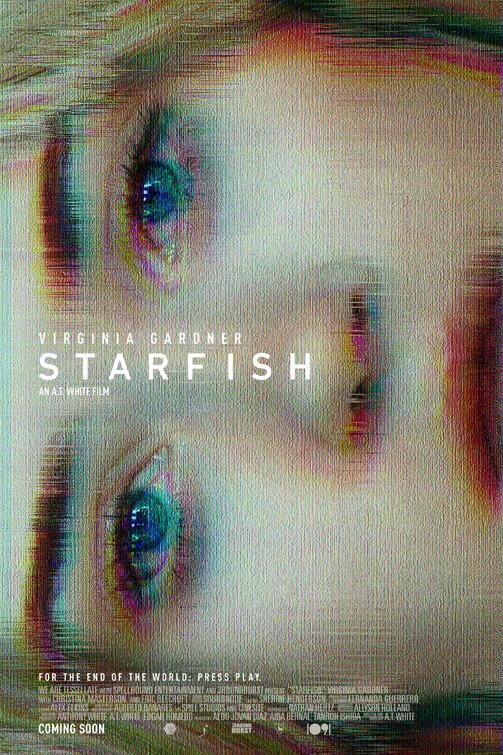
STARFISH is an endlessly compelling, ambitious, and audacious cinematic cocktail: Part scavenger hunt mystery, part meditation on grief and mourning, and part avant garde post apocalyptic sci-fi, all thanklessly held together by musician turned first time feature film director A.T. White.
Unlike so many
witless and disposable works of movie science fiction that exist primarily
for splashy visual effects, mayhem and action, STARFISH is a different and
rarer breed of genre effort that hones in more on ideas and themes that
have universal appeal. The
movie is like a grand jigsaw puzzle to deconstruct and put meaningfully
back together again, and contains individual moments of haunting,
dreamlike potency, which may leave audience members looking for a more
traditional narrative approach scratching their heads.
But White's debut is more of a visceral experience than a
dramatically engaging plot driven one, and there's simply no questioning
this rookie director's supreme confidence in executing his unique vision
here.
A never been
better before Virginia Gardner plays Aubrey, who in the opening stages of
the film is returning home for the funeral of her friend, Grace (Christina
Masterson). Even though she's
offered up warm condolences for her loss from others in attendance, Aubrey
remains emotionally distant and aloof, yearning to process her feelings on
her own time and terms. Intriguingly,
she decides to break into Grace's apartment later that evening and begins
to take stock of everything that that was a part of this deceased woman's
life. Aubrey leisurely scans
through Grace's personal belongings, which includes two pets: a turtle
and, yes, a bowl of starfish.
As she rummages through Grace's most cherished heirlooms, Aubrey
tries, as only she can, to come to grips with the fact that her beloved
friend is no more and is not coming back, not to mention that it forces
her to look at her own life and indiscretions as well.
|
|
After spending the night, Aubrey awakens and makes a rather unnerving discovery: The small snow covered town outside of Grace's apartment is mysteriously empty and, worse yet, it appears that humanity hating creatures of unknown origin have been feasting on the townsfolk, leaving Aubrey in a state of desperate shock. She does manage to make quick radio contact with someone else on the outside, and the enigmatic man solemnly and calmly instructs the anxiety plagued Aubrey to locate and listen to a secret mixtape left by Grace, which is a part of a larger collection of other mix tapes scattered throughout the town that all, in their own special way, contain signals that open up portals, allowing anyone that listens the ability to travel through them into various states of varied consciousness.
It should also be
noted that the mixtapes are the key to saving the world.
There's an
intoxicating interpretive aspect of STARFISH that's all about thrusting
viewers into the headspace of Aubrey as she makes her extraordinary
physical and cerebral journey throughout
the story, which leaves the fantastical premise that White has conjured up
here feel all the more crazily novel.
The director displays great respect for the patience of his
audience, taking his time to set up Aubrey as a fragile and troubled
character that's on a journey of diving into her dead friend's past and
her ties to these mixtapes that let people transcend normal boundaries of
time and space. It's an astoundingly ambitious concept for a feature film
director's first work, and White shows an unimpeachable level of focus and
persistence of vision here. And
he gets the film's most intimate details just right, like Aubrey's early
exploration of Grace's dwelling and how every little personal effect she
gazes at and interacts with has some level of profound meaning for her.
The quiet and unhurried nonchalance of these exploratory moments
are crucial for the gut punch reveal that Aubrey later finds herself in as
a potential lone survivor in what could be a worldwide apocalypse. So many sci-i thrillers intolerantly want to plunge viewers
into one massive VFX laden set piece to the next, but White's restrained
approach in the film's earlier sections is refreshing in relative
comparison.
That's not to say
that STARFISH doesn't have VFX and action.
Considering that it was made on what I'm assuming is a micro budget
that wouldn't cover the cost of catering on a Michael Bay movie, White
nevertheless makes his cheap costing debut feature look expensively
pristine. Even though STARFISH
is more insular in focus and psychologically character driven, White and
his wonderful cinematographer Alberto Banares fills the film with
painterly and carefully chosen compositions that add tremendously to its
rich and immersive atmosphere.
White also finds remarkable innovation in stretching his budget to
the max with many surprisingly convincing effects shots (one revealing a
horrific facial wound comes to mind), as well as a genuinely awe inspiring
moment involving Aubrey gazing up a Godzilla-sized behemoth that slowly
lumbers through the town. There
are a couple of fleeting shots, unfortunately, that feature smaller scaled
monsters pursuing Aubrey that White somewhat frustratingly cuts away from
mid chase, which may or may not have something to do with budgetary
restraints.
But STARFISH
doesn't primarily exists as a technological showreel as to what White can
imaginatively conjure up with limited resources.
It's more about creating a hallucinatory kaleidoscope of beguiling
images that reflect Aubrey's increasingly convoluted and trippy journey
into the unknown recesses of her corporal and spiritual world.
The film generates a visual style that echoes, I think, how
memories and nightmares work on us by giving us fractured glimpses of
objects that allow Aubrey to remember her ties to Grace or, more grisly,
stomach churning visions of the apocalypse that creep up on Aubrey in her
very dreams. There are times
when White perhaps gets a bit too creatively showy for his own good, like segueing
into an anime inspired chase sequence that reminded me considerably an
equally incongruent stylistic moment in KILL BILL.
Yet, White's supreme assuredness as a craftsman and his spunky
level of showmanship kind of overrides any scrutiny of its inclusion here.
Plus, this animated sequences is quite spectacularly pulled
off.
The cinematic
influences that punctuate STARFISH are readily there, but not obtrusively
so. White's style and
execution has echoes of the mind bending approach of Shane Carruth's work,
and his female driven sci-fi thriller blueprint that deals with the
emotional center of the lead character reiterates Alex Garland's recent ANNIHILATION.
Even the scenes like the aforementioned one showcasing that
gargantuan otherworldly creature pays like a homage to Gareth Edwards'
equally low budget MONSTERS (White even thanks Edwards in the final end
credits for inspiration). Like good world builders, White doesn't come off as slavish
to past filmmakers and their films, but manages to homogenizes his love
for them to help craft his own distinctive vision here.
Noteworthy is the fact that White pulls quintuple duty here as writer,
director, editor, creature designer, and for musical score, the
latter of which plays like a stirringly beautiful and frightening take on
Bernard Hermann's most iconic string heavy symphonies of dread.
I haven't frankly
said enough about Gardner's empowered and deeply committed performance
that goes down every single emotional rabbit hole that White throws her
into. She essentially has to
carry most of the film on her shoulders, acting off of essentially no one
(minus a few human characters early on and a pet turtle later) in a tour
de force solo performance that's the real emotional glue that keeps all
the film's eccentric madness together. A lesser actress would have capsized STARFISH's main goal of
dealing with one woman's internalized personal anguish and how she learns
to deal with loss on multiple fronts.
Like the mixtape hunt she finds herself on throughout the story,
Aubrey has to pick up and put the pieces of her own life back together in
the process of also saving the world.
Thankfully, she also has music to assist her.
STARFISH is an undeniably inspired creative juggernaut for White, and his debut film commendably grasps for greatness throughout, sometimes achieving it, whereas sometimes falling a tad short. The labyrinthine-like aesthetic nature of the piece is wonderful to engage in on a primal level, but sometimes feels a bit cold and distancing when it comes to emotionally connecting with it. That, and I believe that White sort of writes himself into a corner as the plot careens towards an ending that doesn't pay off as strongly as I would I appreciated. Yet, its the bold and unorthodox journey that STARFISH takes viewers on that matters most, and trying to make sense of Aubrey's predicament, her dead friend, and the quick onset of the apocalypse after her demise as it's tied to a series of cassette tapes kept me genuinely enthralled throughout. And like great sci-fi thrillers, this film uses the genre to explore universal truths about the human psyche as it tiptoes into an odyssey of the vast and untapped unknown. STARFISH is equal parts hypnotic and confounding, but it creates a memorable cinematic dreamscape worthy of being lost in.
