A film review by Craig J. Koban
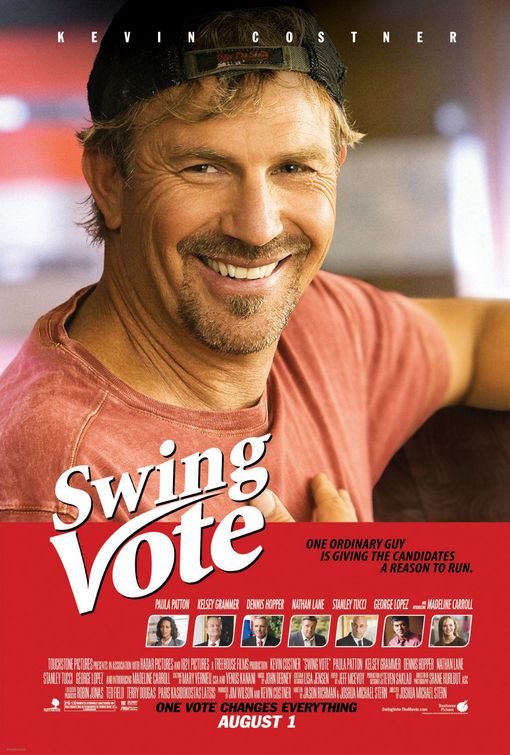
SWING VOTE
 ½
½
Bud Johnson: Kevin Costner / Molly: Madeline Carroll / President Boone: Kelsey Grammer / Donald Greenleaf: Dennis Hopper / Martin Fox: Stanley Tucci / Art Crumb: Nathan Lane / Sweeney: George Lopez / Larissa Johnson: Mare Winningham
Directed by Joshua Michael Stern / Written by Jason Richman and Stern.
 I
am a real sucker for sweet tasting, sugar-coated Frank Capra-corn, and the
new political comedy SWING VOTE is agreeably digestible through and
through.
I
am a real sucker for sweet tasting, sugar-coated Frank Capra-corn, and the
new political comedy SWING VOTE is agreeably digestible through and
through.
The film concerns
a Presidential election that – as highly improbably as it seems – is
deadlocked at an electoral tie and can inevitably be resolved with one man
(yes…one man) casting his ballot. Alongside
its silly and whimsical façade is its nourishing Capraesque vibe, which is
why I found the film to be so refreshingly entertaining.
In our inordinately nihilistic and apathetic times it’s nice to
see a film that has an amiable heart alongside having a sly and sardonic
comic edge. At it’s core,
SWING VOTE is about a deeply flawed and troubled - but good natured - person
that finds a way to change himself and those around him.
What’s even better is the fact that the film never browbeats its
wholesome vitality over audiences' heads to the point of exhaustion.
Even more crucial is the fact that SWING VOTE is neither a stinging and ostentatious indictment of the two major political parties, nor does it take great pains to criticize the social malaise that many listless voters experience come Election Day every four years. Hell, the film never really places any real importance on which person will win its election. The point of SWING VOTE is that it’s a light, calmly satiric, frequently funny and moving, and genial morality parable about an unlikable slob who becomes a somebody when he faces the establishment and wins a moral victory by proving to himself and to others that he is a somebody.
Frank
Capra would definitely approve.
The
casting here is absolutely crucial, and Kevin Costner’s low key charisma
and affable wit and charm are on display here is mass quantities.
Yes, he is not an actor of significant range, per se.
I have always found him to be in the vein of a modern day Gary
Cooper, possessing an understated stoicism, an off kilter slyness, a
modest cynical edge, and, most importantly, a plausible earnestness.
That’s perhaps why I found him hopelessly miscast as a serial
killer in last year’s MR. BROOKS, where I rightfully commented that he
seemed about as out of place portraying a homicidal maniac as Cooper would
have been playing a Nazi. Thankfully,
Costner's true, confident form is playing the parts that defined his
career in films like BULL DURHAM, TIN CUP, and recently THE UPSIDE OF
ANGER - the likeable rogue. Very
few actors can maintain a grove in these types of parts, but Costner
always spotlessly encompasses them. He’s
not playing a character that’s genuinely a “good guy” in SWING VOTE,
but not many can convincing play an unsentimental part with such
simplicity and sincerity: Costner’s work here completely anchors the film.
His
daughter, Molly (played by 2008’s best new child actor find, newcomer
Madeline Carroll) is everything her dad is not.
She’s incredibly smart, well spoken, politically savvy, and
fiercely proud of being an American.
She is also, on a negative level, a psuedo-babysitter for her
dumbass, inebriated father, and she is close to leaving him once and for
all. She is tired of Bud
embarrassing and letting her down at every corner and is growing fatigued
by being a tired social worker for him day and night. She hopes that he will at least bolster up enough prideful
civic duty within himself to meet her at the polling stations so he cast
cast his ballot to choose the next US president.
Bud, alas, lets her down when he is fired from his job for
intoxication and, to drown his sorrows, gets hammered at the local bar and
completely forgets about meeting his daughter to vote.
It’s
here where the film introduces its shaky premise that later securely
grounds the rest of the proceedings. Being staunchly civic minded – and not wanting her dad’s
right to vote be squandered – Molly sneaks past the lackluster polling
station security, takes a ballot, and proceeds to caste Bud’s vote for
him. However, a technical
glitch spoils the ballot. This,
in Molly’s mind, is not that much of a big deal as getting caught
attempting to vote for her dad. Clearly,
one single vote in a country of hundreds of millions would not
matter…right?
Wrong.
Because
this is a fairy tale morality play, the story then shows how the
Presidential election between the Commander In Chief, Andrew Boone (Kelsey
Grammer, in a well oiled performance) and the Democratic challenger,
Donald Greenleaf (Dennis Hopper, equally refined) is so minutely narrow that
the race will be decided by five New Mexican electoral votes, meaning that
one vote will call the election…Bud’s botched vote.
Initially,
Bud’s identity as the person that will be responsible for choosing the
next President is a secret, and both candidates have political muscle on
their campaign teams that will do anything to discover his identity.
On Greenleaf’s side is Art Crumb (Nathan Lane) and on the
Prez’s side is Martin Fox (Stanley Tucci), and both are willing to go to
any length to get Bud on their side. When
Bud’s is revealed to the world as the soul voter to decide the fate of
the election to a local reporter (the luminous Paula Patton), he becomes
embroiled in media frenzy and becomes an overnight sensation.
More critically, he becomes a puppet of the manipulative efforts of
the Greenleaf and Boone campaign juggernaut, which desperately will flip-flop on any issue to get Bud’s
approval.
I liked
how the satire in SWING VOTE does not agonize us by sermonizing, nor is it
cheaply conniving. For a
political film, SWING VOTE neither chastises the Democrats and Republicans
nor does it hold them up for hero worship.
What’s paramount to the film is chronically the theme of a
intolerably apolitical man trying to come to grips with his instant
celebrity status and how, in turn, he is forced to deal with his sense of
low self worth and significance to rise to the occasion to make an
incredibly significant choice that has world wide ramifications.
The story is essentially an emotional odyssey for Bud who must go
from total voter apathy to the point where he realizes the magnitude of
the predicament he’s in. Even more important is Bud’s displaying to Molly that he is
not the bum she thinks he always appears to be – choosing the next most
powerful man in the free world is not as pressing as ensuring that he does
not disappoint his daughter one more time.
The
performances are key here, especially with allowing the film to strongly
resonant beyond its fanciful and unbelievable premise.
Costner, as stated, is so relaxed and assured playing his
below-average-Joe anti-hero at just the right level.
He is more than convincing playing an American everyman. The whole
arc of his character is uplifting for how he manages to overcome his
slobby and disheveled appearance by morphing into a sober and – as luck
would have it – fairly articulated man when it comes to dealing
with the two candidates.
What’s
really interesting is how Bud’s forthrightness and genuine, blue-collar
frankness acts as a catalyst for the two politicians to rethink their
strategies. I appreciated how
both Grammar’s and Hopper’s characters do not degenerate into witless
political caricatures: Yes,
they do a lot of shameful manipulation of Bud to curb his favor at first,
but they too have made emotional changes for the better largely because of
their growing respect for Bud’s dilemma.
Of course, we get a big speech near the end of the film that echoes
MR. SMITH GOES TO WASHINGTON, which shows a man once demonized as witless
white trash by the press who suddenly is able to command dignity and
respect for how he talks about large issues with a common vernacular.
This moment is handled with the right balance of poise and tact,
which is also assisted by Costner’s not playing the scene up for
phony schmaltziness.
SWING
VOTE also benefits from a variety of strong supporting performances.
Stanley Tucci and Nathan Lane have field days playing sharp and
fiendishly clever campaign managers that have a deeply emotional stake for
seeing their respective candidates to the White House.
Paula Patton - who shares one of those radiating smiles that
ignites the screen like that
of a Jennifer Garner or a Rachel McAdams -
has a nice turn as the reporter facing a crisis of conscience.
But the real standout here is Madeline Carroll, who has such a
natural and easy-going screen presence that maintains a real symbiotic
chemistry with Costner at every turn.
Molly is the emotional center of the film’s story that involves
Bud’s spiritual reawakening. A
stilted and wooden child actor would have ruined the effect, but Carroll
is eloquent, affable, sharp witted, and has good instincts, traits that
more mature actors often fail to grasp.
SWING
VOTE is not perfect; it’s running time is too long for its own good, not
to mention that a key sub plot involving a moral choice made by Patton’s
conflicted reporter seems a bit cockamamie for its own good.
Yet, the resulting film is such a wonderfully effective and endearingly
noble-minded Capra-fable that it sure is hard not to be taken in by its
modest charm and simple-minded enthusiasm.
“Feel Good” cinema often lacks restraint and delicacy, often to
the point where the proceedings are so deplorably saccharine that you want
to throw things at the screen in disgust (ahem, PATCH ADAMS).
SWING VOTE anchors down this tricky genre by establishing a proper
tempo and cadence without feeling like it’s engaging in thematic
overkill. And at its
epicenter is Kevin Costner, an actor that seldom gets the credit he
deserves. He certainly is not
a performer of variety, but he is a wholesomely iconic, sardonically
cagey, and an amiably charismatic presence in the movies.
And as shown in SWING VOTE…a strong one at that.
