


 A
film review by Craig
J. Koban September
20,
2022
A
film review by Craig
J. Koban September
20,
2022
WHERE
THE CRAWDADS SING

Daisy Edgar-Jones as Catherine 'Kya' Clark / Taylor John Smith as Tate Walker / Harris Dickinson as Chase Andrews / Michael Hyatt as Mabel / Sterling MacEr Jr. as Jumpin' / David Strathairn as Tom Milton / Garret Dillahunt as Pa / Eric Ladin as Eric Chastain / Ahna O'Reilly as Ma / Jojo Regina as Young Kya
Directed by Olivia Newman / Written by Lucy Alibar, based on the book by Delia Owens
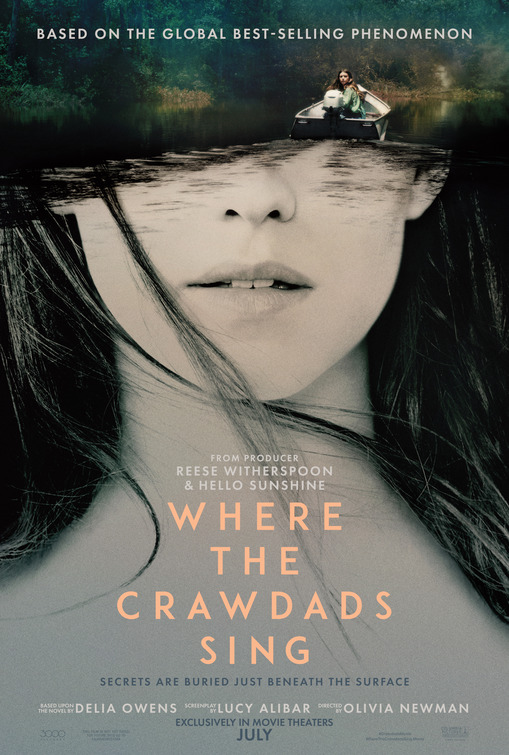
If one looks past some of its more logic straining elements and a final act that simply doesn't work really well at all, then it'll be easy to get lost and invested in the Southern period mystery thriller WHERE THE CRAWDADS SING, based on the 2018 best selling novel of the same name by Delia Owens.
I would aptly
describe this drama as a kitchen sink affair, seeing as it has so many
elements thrown in: Family secrets, child abandonment, three way love
triangles, backwoods sex, and, yes, murder and a subsequent investigation
and court case that looks to slowly reveal whether or not the main female
protagonist committed it out of malice or self-defense...or whether she
did the crime at all. As a
legal potpoiler and murder mystery, WHERE THE CRAWDADS SING (and yes,
crawdads - or crayfish - don't actually sing...the title is a
metaphor, people) is pretty underwhelming and mostly on genre autopilot,
but on a performance level and in terms of immersing us in its time and
place, this Olivia Newman directed affair is robustly realized and becomes
a reasonably engrossing piece of Southern Gothic.
The main thrust
of the narrative - which awkwardly seesaws between past and present
throughout - concerns a young girl named Kya that was abandoned by both
her abused mother and later the perpetrator of that abuse in her father in
the North Carolina marshland, leaving this poor kid to fend for and
essentially raise herself into adulthood.
The film opens in the fall of 1969 in the fictional Barkley Cove
and has a couple of local boys spotting a decaying dead body lying face
down in the dirt. The deceased is
revealed to be Chase Andrews (Harris Dickinson), who's a well known
fixture in his parts. The
prime suspect of the murder is his ex-lover in, uh huh, the adult Kya (the
wonderful Daisy Edgar-Jones, a remarkable new find), who becomes an easy
target for arrest based on her ties with Chase, but also because of her
long ostracized status of being a petty "Marsh Girl" that the
town has treated with the same respect as a feral child over the years. Since most of the community is no friend of Kya's at all,
everyone seems to be absolutely sure that she is indeed the killer, even
though she steadfastly pleads her innocence to authorities. The only one that seems drawn to her appeals and case is
retired attorney Tom Milton (the always cool and refined David Strathairn),
who's the Atticus Finch lawyer hero of the film that tries to piece
together the evidence at hand and represents a client that's all but
despised and deemed guilty before proven innocent.
In many lengthy
interviews with her, Tom is able to discover much of Kya's depressing
upbringing and childhood, which then takes the form of multiple flashbacks
within flashbacks. We learn
that her mother was so beaten and battered by her monstrous and alcoholic
husband (Garret Dillahunt) that she had to leave him and Kya.
Being left to deal with her toxic father at such a young age proved
to be a nightmarish task for Kya, leading to her being suddenly abandoning
by him at elementary school age and forcing her to live and support
herself. She has a childhood
BFF in Tate (played as an adult by Taylor John Smith), who gives her some
much needed home schooling about reading and writing, but as the two
blossom into adulthood Tate is forced to say goodbye to his childhood pal
and later lover by tending to his own scholastic dreams that take him
away. Kya unfortunately
rebounds with Chase, who seems like the proverbial bad boy and bad news
that this girl should have avoided like the plague.
After an initially budding romance, Kya begins to see the error of
her ways and tries to distance herself from the ever increasingly
domineering Chase, and she tries to escape into her art and transcribing
everything that she witnesses around her in the natural world.
She becomes such an intuitively gifted naturalist when it comes the
North Carolina marshland that she's even spotted and offered a lucrative
book deal, but impeding her way towards independence and financial freedom
is that vile and possessive minded Chase, and when his corpse is found all
eyes point towards Kya.
|
|
The atmosphere
present in WHERE THE CRAWDADS SING is one of its chief selling points, and
under the watchful eye of cinematographer Polly Morgan the film maintains
a stunning sheen of environmental verisimilitude throughout.
You can feel and taste the humidity of the beautiful and sometimes
intimidating marshlands that surround these characters and essentially
becomes a secondary character in itself.
The compositions, lightning choices, and lingering shots of the
vistas contained within make WHERE THE CRAWDADS SING an early Oscar
contender in this category, and this is undeniably one of the most
sumptuously shot films of 2022. Complimenting
this is the resoundingly fine performances permeating this film, with most
notable exception going to the British born Edgar-Jones, who not only
flawlessly inhabits the southern drawl and mannerisms of her troubled
protagonist, but manages to make her a multi-faceted character of intense
interest. She's a timid and
deeply guarded figure (no doubt born out of her tortuous upbringing and
fending for herself apart from a town that hates her), but she's also
convincingly driven and determined and is hell bent on not plea bargaining
in her case; she wants her innocence proven beyond a shadow of a doubt. Edgar-Jones is stellar in this complex role, and she's finely
complimented by her partner in crime (no pun intended) in Strathairn
ultra's straight arrow attorney, who may not have much of an overall
character arc here, but nevertheless brings a certain level of soft spoken
gravitas and conviction that only he can effortlessly muster.
I also latched on
to some of the thematic terrain covered here, like how Kya is a borderline
hopeless underdog that's been disrespected by not only her father, but
local townsfolk and has to overcome supreme obstacles in her coming of age
story to achieve some level of self-actualization.
That, and her character not only has to persevere against class
discrimination and resentment, but also through abject poverty and while
being forced against her will by multiple abusive men that want to have
their way with her. That
precluded her to grow up the hard way in the wild and all on her own, and
seeing her journey is an intrinsically compelling one.
However, this all ties into some of the aforementioned
hard-to-swallow elements in the film that distract away from the whole,
like, for instance, that Kya is simply too attractive to be
credible. This is a person
that lived in a ramshackle cabin buried deep in the wetlands of a very
harsh and hot climate and spent a majority of her childhood and teen years
segregated from just about everyone and everything...yet she's so
unbelievably clean cut looking and pristine.
Even though she has been aggressively dubbed "The Marsh
Girl," she looks like she'd have no problem whatsoever gracing the
cover of Teen Vogue, and with minimal pampering or fuss.
Trust me when I say that no recent film has presented a mostly
feral girl (with no virtually no education, family support, social contact
or financial aid) as spiffy clean looking as what's shown in WHERE THE
CRAWDADS SING.
Two other things
taint this film, like how the story jumps back and forth between Eya's
childhood in the 50s to her adolescence in the 60s and to her arrest later
on...and then haphazardly bounces through those periods again and again as
she recounts her tumultuous life to her lawyer.
There's a genuine lack of editorial rhythm and cohesion to the
overall narrative flow here, and those not paying acute attention may
easily get lost as to what time period the film is in and what's happening
chronologically, how the players figure in, and so forth.
Also, WHERE THE CRAWDADS SING is a bit soft-pedaled and lacking
sensual edge for what the makers think is an erotically charged
romance. More often than not , the film has the veneer of an
achingly safe PG-13-ified young adult soap opera
versus truly embracing its adult themes and content as a steamy
backwoods murder mystery noir. Lastly, the final sections of the story - set decades in the
future and building towards a would-be shocking plot twist - come off as
simultaneously forced fed and rushed and ends on a flimsy, anticlimactic
note. There's two basic
possibilities as far as Eya's case goes - she's either guilty or she's
not. I won't spoil the reveal, other than to say that the manner
that it's quickly tied up and not nurtured properly for a satisfying
dramatic payoff is a deep letdown.
