A film review by Craig J. Koban September 7, 2011

Rank: #11
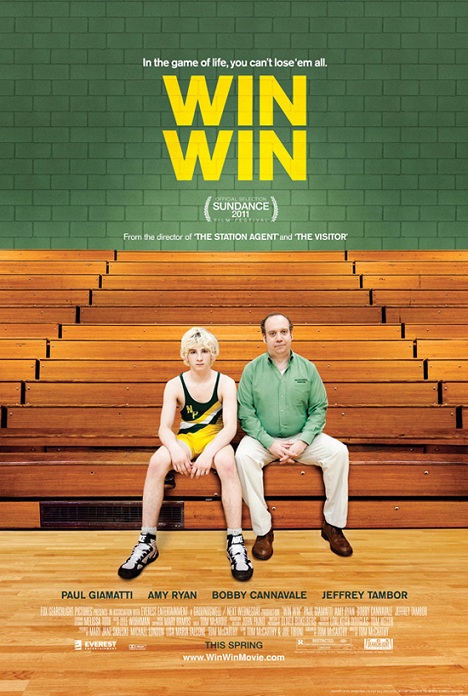
WIN WIN 
Paul Giamatti: Mike Flaherty / Amy Ryan: Jackie Flaherty / Bobby Cannavale: Terry / Jeffrey Tambor: Vigman / Alex Shaffer: Kyle / Burt Young: Leo / Melanie Lynskey: Cindy / David Thompson: Stemler
Written and directed by Tom McCarthy
 Tom
McCarthy’s WIN WIN is one of the more delectably unconventional sports
dramedies that I’ve seen. It’s
still a sports film in many superficial aspects, but what separates
it from just about all other recent examples of the genre is how both the
act of winning and the obligatory and climatic “big match” at its
conclusion are almost redundant; being triumphant almost doesn't really matter here at
all. What WIN WIN does with a low-key and observant eye is to
record the fragilities of its characters.
It’s not a perfunctory rah-rah motivational sports film at all:
it shows how losing – in many forms – can often make people behave in
self-centered and regretful ways.
Tom
McCarthy’s WIN WIN is one of the more delectably unconventional sports
dramedies that I’ve seen. It’s
still a sports film in many superficial aspects, but what separates
it from just about all other recent examples of the genre is how both the
act of winning and the obligatory and climatic “big match” at its
conclusion are almost redundant; being triumphant almost doesn't really matter here at
all. What WIN WIN does with a low-key and observant eye is to
record the fragilities of its characters.
It’s not a perfunctory rah-rah motivational sports film at all:
it shows how losing – in many forms – can often make people behave in
self-centered and regretful ways.
If
anything, McCarthy – a character actor that you most certainly have seen
before in movies without perhaps really knowing his name – has fully
materialized with WIN WIN as a uniquely perceptive
and deeply humanistic filmmaking voice.
He made two of the best films I’ve seen in the last few years
with 2003‘s THE STATION AGENT and really won me over with 2008’s THE
VISITOR, which was a deeply heartfelt human drama that made its
characters and the larger issues around them relatable and important. The
overwhelming theme from McCarthy's films are how people from seemingly
different worlds come together and manage to form their own unique
kinships with one another. Those
films also had wonderfully understated direction, which allowed for the
actors and their relationships to really shine through; they had a sort of
simple and forthright veracity.
McCarthy
brings all of that to the table again for WIN WIN, which is a modest crowd
pleaser, to be sure, but it’s also kind of eccentrically complex and
off-centered as a human comedy: you never really gain a sense of where its
headed, which is a tough order for most sports films.
Mike Flaherty (a terrific Paul Giamatti) is a New Jersey attorney
that is cash-strapped and at his occupational wits' end.
He specializes in dealing with the elderly and when he is not
meeting with various clients in his somewhat rundown offices he is a high
school wrestling coach at New Providence High School, a job he shares with his accountant, Vigman (the
always funny Jeffrey Tambor).
The two would love to make their young team one of champions, but
it may be a hopelessly impossible task considering the lack of talent and
drive they see before them.
Mike
is starting to really get disenchanted with just about…everything.
He is becoming seriously cash-strapped and the economy has began to
really wear down on his practice and family, even though his wife,
Jacque (an unfailingly solid Amy Ryan) steadfastly stands by her husband.
Perhaps ever more frustrating, though, is that damn annoying hot
water heater in his practice’s basement that emits a low humming and
vile noise that is an exacerbating distraction for both his employees and clients. He just
does not have any extra cash to fix it, and it becomes a hellish and
soul-crushing symbol of his hard times.
Things
change, however, for Mike, but perhaps not for the better. Through
some highly questionable and self-serving dealings with one of his more
dementia-plagued elderly clients (played briefly, but memorably by Burt
Young), Mike finds himself serving as his legal guardian and places him in
a long-term care home, during which he benefits financially from it, a
fact that he keeps secret from just about everyone else.
Occurring almost simultaneous to his dirty dealings with his
client, Mike has a chance meeting with the man's grandson, a star athlete
named Kyle Timmons (Alex Shaffer) that just happens to be All-American
material as a wrestler. Mike
finds himself not only profiting from the teen’s grandfather, but he now
seems to emotionally profit by getting Kyle to join his beleaguered high
school wrestling team, which really seems to get Mike, Vigman, and their
new coaching partner, Terry Delfino (a hilarious Bobby Cannavale) excited.
Just when things seem to be going every which way in the right
direction, along comes Kyle’s mom (Melanie Lynskey), fresh from rehab
and dirt poor, that becomes a threat to everyone involved.
|
|
As
was the case with McCarthy’s last two aforementioned films, WIN WIN is
at its most confident when dealing with its well-intentioned, but often
blemished and in-over-their-heads personas: the film is like a merciless,
but honest documentation of middle class American melancholy.
Mike is not really an evil and reprehensible figure in the film as
he is just one that becomes so jaded with his lack of good fortune and fulfillment
as a coach that he just goes to questionable methods to secure some much
needed self-respect. That’s
where Giamatti’s contribution here is key: he seems to just effortlessly
modulate his character’s level of quiet spoken despair so well while
ironically suggesting him as as sincere and duplicitous at the same
time. It’s real thorny dichotomy to successfully pull off, but
Giamatti is just the right actor to do so; he’s so marvelously
watchable here.
The
film benefits from its litany of other great and richly drawn characters
and the memorable performers behind them.
Amy Ryan, an actress on a serious role as of late, gives a
performance that is perhaps much more textured than as written on the
page, and she does a lot with an otherwise perfunctory wife role.
Melanie Lynskey seems to be growing as a performer as well
(especially after unyieldingly good work in last year's THE
INFORMANT!) who finds a thankless balancing act of making her drug
addicted mom both vulnerable and sad while being pathetically selfish.
Tambor and Cannavale are a splendid one-two punch combo as the
film’s chief comic relief, especially the former (is there a better
on-screen comic than Tambor for making misery so hilarious?).
The
real find in the film is Alex Shaffer, and McCarthy shows his exemplary
skill with him at using fresh and off-centered casting to fill his roles.
It could have been all the more easy to just sign another bland,
hunky, and mannequin-like heartthrob in the part of Kyle, a jock-savoir to
Mike and his downtrodden team. Yet,
Shaffer is just so unusually and hypnotically natural, raw, and authentic that it makes you kind of forget for a couple of hours how
needlessly eccentric and full-of-themselves so many other adolescent
actors are today. Shaffer’s
no-nonsense demeanor gives WIN WIN a deeply felt lived-in
resonance, which in turn makes the film's oftentimes-tenuous cocktail of
pathos and laughs feel that much more rooted in reality. More films
need to be released like this one that feel so refreshingly removed from
Hollywood conventions.
As a
director, McCarthy does not have a flashy or obtrusive camera. He’s more enraptured with the subtler nuances of
performance and story, which unfortunately hurts him, I think, when it
comes to people acknowledging him as the authoritatively skilled director
that he is. He has a shrewd
and easy-going manner of chronicling his noble-minded, but imperfect
characters to the point where they do win us over while not
cheapening themselves to loathsomely sappy soap opera extremes.
It’s also kind of amazing, in retrospect, just how little
importance is placed on the sport of wrestling and the big showdowns in the
film; it’s actually inconsequential when compared to the larger things
happening to the characters. Such
is life.
WIN
WIN does so much right: it’s hilarious and heartfelt, unpredictable and
unpretentious, impeccably acted, selflessly directed, and tells what could
have been a dime-a-dozen “sports” film story, but instead subverts our
expectations of the genre. It
does not repugnantly scream out - like so many other recent Oscar-bating
melodramas – for award consideration.
The fact that it never demands attention to itself makes the film
feel like a looser, freer, and more naturalistic crowd-pleaser that repels
genre clichés. That’s what
makes it a real gem and one of the best films of 2011.
