


 A
film review by Craig
J. Koban October
5,
2020
A
film review by Craig
J. Koban October
5,
2020
ANTEBELLUM

2020, R, 105 mins.
Janelle Monáe as Veronica / Jena Malone as Elizabeth / Robert Aramayo as Daniel / Kiersey Clemons as Julia / Jack Huston as Captain Jasper / Gabourey Sidibe as Dawn
Written and directed by Gerard Bush and Christopher Renz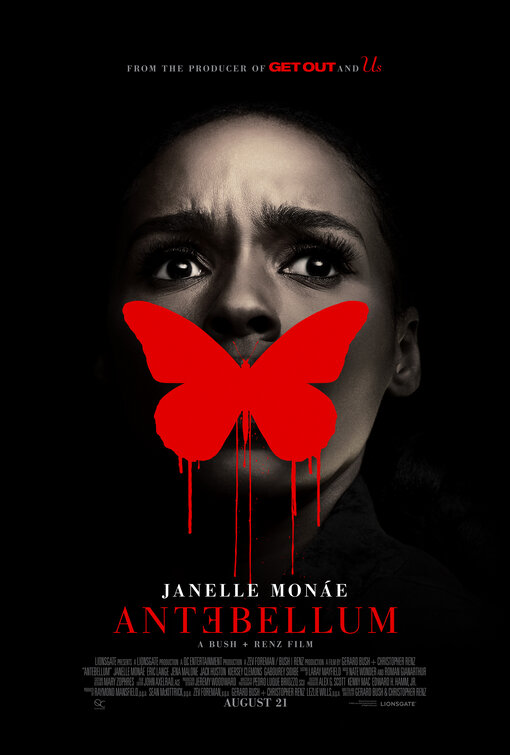
|
|
I'm going to find it next to impossible to discuss this film in any detail without going into some of its twists and turns.
|

ANTEBELLUM is, on
a basic level, a psychological horror thriller that - much like GET
OUT before it - uses the trappings of the genre to speak out about
how racial tensions and the horrors of systemic bigotry affects the modern
world. Where this Gerard Bush
and Christopher Renz effort does manage to one-up Jordan Peele's Oscar
winning film is in its fairly ingenious plot twisty premise (which I'll
get into in a bit and won't shy away from discussing, seeing as the
marketing campaign for the film went out of its way to tip it off).
ANTEBELLUM emerges as something even more unsettling when more is
revealed about, shall we say, the film's internal reality.
Not all of it works as well as the makers here think it does, but
it's undeniably a potent and compelling watch, despite some of its
creative mistakes.
At least as far
as its sensationally well realized opening sections are concerned,
ANTEBELLUM seems like it's going to be a period drama set on a Civil War
era plantation, and one that chronicles the daily physical and emotional
trauma that slaves face while there. There's an introductory tracking shot that's as good as any
that I've seen, which swoops in and out of what appears to be a Southern
plantation and residing mansion. It's
all presented in one fluid take (granted, with some editorial tricks here
and there to hide the cuts) that gives viewers a rose-tinted and heavily
romanticized portrait of slave owner life, replete with playing white
children, incredibly well maintained front lawns, and a sprawling mansion
so clean and manicured that you could eat off of the walls.
Then the camera begins to slowly and meticulous descend into the
moral abyss of the times as we see multiple slaves tending to the fields
and picking cotton while nearby soldiers begin to prep for combat. When the shot finally ends we witness the tortuous beating of
one slave by his handlers, which leads to a brutal murder.
From here, we're
introduced to a slave named Eden (Janelle Moane) who is new to the
plantation in question and is forced against her will to give up
everything she once had in life...even her name.
One Confederate soldier (Eric Lange) ruthlessly decides to take
Eden as her own, resorting to branding her as a display of possessive
force. While trying to deal
with the daily, hellish grind of slave life, Eden comes in contact with
Eli (Tongayi Chirisa), who has experienced his own form of loss in having
witnessed his wife being gunned down by Captain Jasper (Jack Huston).
Eli desperately wants to launch an escape plan, which is with its
obvious risks, and he even tries to enlist in Edin's help, but she's so
traumatized by fear of her owners that she can't possibly contemplate ever
leaving safely. She simply sees no way out of the plantation and refuses
Eli's assistance whenever he offers it.
|
|
Then...ANTEBELLUM
takes a very, very weird turn.
The film then
sharply - and without much warming - segues to the modern day as we meet
Veronica (also played by Monae), who's an extremely successful author and
sociologist that partakes in many a conference that involves motivational
speaking that she hopes will empowered her largely minority audience. She has a loving husband and daughter and lives in an ultra
swank high-rise apartment, obviously experiencing the spoils of being an
influential civil rights activists and social media sensation. Not everything is cheery for Veronica, though, as she's being
cyber stalked by a woman (an unnerving Jena Malone) for unspecified or
revealed reasons. One trip to
New Orleans to hang out with her BFFs in Sarah (Lily Cowles) and Dawn (Gabourey
Sidibe) turns bad awfully quick, as she's cornered and trapped by her mad
stalker, who incapacitates her. When
Veronica wakes up...she discovers that she has been time warped back to
the same plantation described earlier and is very much a slave.
Paging Rod
Serling.
Now, okay, just
what in the h-e-double hockey sticks is going on here with this
absolutely bonkers, TWILIGHT ZONE-esque film?
What reality here is genuine?
Edin's or Veronica's?
Moreover, is Edin actually Veronica?
And if so, how did she get zapped from 2020 back to the mid-19th
Century? The tantalizing
questions that begin to unfold in ANTEBELLUM's latter half are indeed
enthralling, and the makers here do a remarkably stellar job at
introducing us to both worlds of the past and present and then colliding
them two thirds of the way through without providing much in the way of
explanations until the final gut punch of a third act reveal. There's some clear WTF levels of overt audience
manipulation here (especially when the story radically departs Edin's
story and jumps to the present day without anything in the way of any kind
of rationalization, which throws audiences members - myself included - for
a real loop). There was a
point in ANTEBELLUM where even an astute viewer like myself was wondering
if I got haphazardly dumped in a whole different movie altogether, which
all but shows how well the misdirection works here in the scripting
department.
And again, the
intro sections of the film are so grimly effective that you legitimately
feel like ANTEBELLUM is going to unfold as a period slavery drama.
For the first thirty-plus minutes, Bush and Renz pull absolutely
zero punches in terms of cementing us within the futile ghastliness of
Edin's situation, who not only has to face the arduous toil of being slave
labor, but also the burden of being nightly raped by her owner.
In one terrifying sequence involving a plantation dinner, one of
Edin's newest confidants is offered up as a sacrificial lamb to one
soldier, who's instructed by his superior to pick any slave he wants to
have his way with. In moments
like this and many more, ANTEBELLUM is heartbreaking and savage in its
barbarism. Much of this is
held together by the commanding performance (or...dual performance) by a
mesmerizing Monae, who has a very tricky acting challenge here of playing
two roles (or...one), with one showing intense levels of Edin's paralyzing
fear and the other showcasing Veronica as an empowered woman of her time
that ends up in what has to be described as every black person's nightmare
scenario. The camera lingers on Monae's face at various stages of
mental distress throughout, which is a wise creative choice. You gain an immediate sense of the sheer hopeless magnitude
of the predicament that these characters find themselves in with the most
simplest of close-ups.
I can easily
understand, though, how this film might confuse and polarize some viewers.
The lightning quick transition from past to present - and with
seemingly incongruent characters apparently out of time with one another
and without much in the way of a tangible correlation outside of being
played by the same actress - may be too much for some tastes (it's
staggeringly jarring). And
there's most definitely some sections of the film that work better than
others. Based on its three act structure, I'd say the first and last
act work the finest - with the first being close to masterful - and the
middle passages tending to bounce around from scene to scene without much
of a purpose (that is until it eventually pays off and segues into the
reality breaking twist of the plot).
I also thought that some of the supporting characters (especially
the white villains) are presented as broad, one note antagonists (Malone
in particular hams it up to semi-campy levels that sometimes betrays the
solemnity of the underlining material).
I will also concede that for as well oiled as ANTEBELLUM's final
climax is, it still involves some pretty obligatory action involving a
daring escape, horse and foot chases, and physical altercations.
Granted, Bush and Renz end it all on one powerful shot that sums up
everything quite well while tying the sins of yesterday with other sins of
today.
And, yeah, the gangbusters premise and the way the directors take malicious glee in completely subverting our expectations, (not to mention their overall execution of this very timely material) is to their credit. ANTEBELLUM is the kind of real world horror thriller that works so much better if one has seen next to no promotional material (or even its teaser campaign) for it (in our day and age, that's next to impossible for most). The relevance of its themes are unquestionable, especially for how there exists (even today for some ungodly reason) a social-political debate about the necessity of still having statues and monuments erected in the U.S. that celebrates the Civil War and Confederate leaders in far too uncomfortable of an aura (which has spawned a newfound intensifying of the racial divide in the country). That, and ANTEBELLUM works well as a sobering and haunting juxtaposition piece that shows the differences between slave and master life and how elements of that still seep their way into contemporary culture. Is the film too on the nose with its parables? Maybe. I've seen some reviewers lambaste ANTEBELLUM for being ruthlessly exploitive of one of the worst institutions in human history. Hmmmm....I'm not sure I'd go to that extreme. I think Bush and Renz's film is far too well acted, scrupulously constructed, and well shot to devolve into B-grade grindhouse fare. But it's certainly a chillingly provocative genre piece that works overtime to ruthlessly pull the rug out from under viewers and thrown them off in unexpectedly and genuinely disturbing ways.
