A film review by Craig J. Koban June, 2004

BATMAN
 ½
½
1989, PG-13, 126 mins.
The Joker/Jack Napier: Jack Nicholson / Batman/Bruce Wayne: Michael Keaton / Vicki Vale: Kim Basinger / Alexander Knox: Robert Wuhl / Police Commissioner Gordon: Pat Hingle / District Attorney Harvey Dent: Billy Dee Williams / Alfred: Michael Gough / Alicia: Jerry Hall / Carl Grissom: Jack Palance
Directed by Tim Burton / Screenplay by Sam Hamm and Warren Skaaren
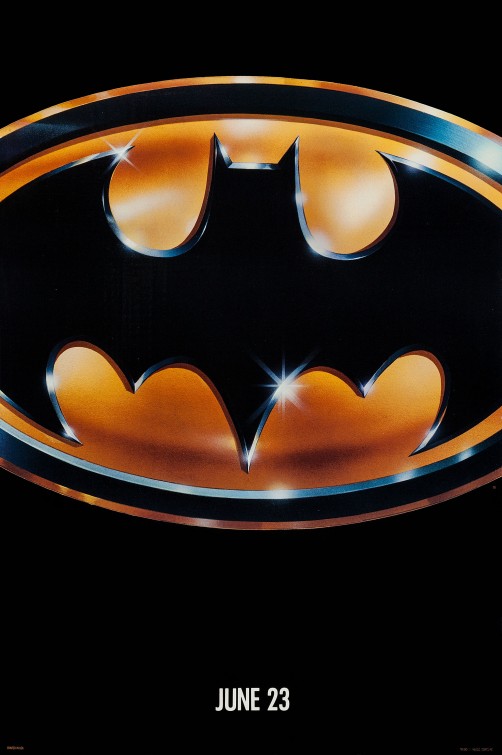
Was there ever a comic book film adaptation that was more controversial than 1989’s BATMAN?
I still can’t think of another bit of casting that inspired more anger,
resentment, and overall confusion and puzzlement than director Tim
Burton’s choice of Michael Keaton to play the Caped Crusader. Fan outrage would be a tremendous understatement when
defining the casting. Clearly,
the only other exposure that the general public had with Batman was with the
hugely popular 1960’s TV series, whose campy, tongue-in-cheek style was the
complete antithesis of what the Batman character was really envisioned as
by creator Bob Kane.
Kane himself even had huge
concerns about Keaton, as he explained in his autobiography BATMAN
AND ME,
“Whereas my hero was muscular and 6’2’’ tall and granite jawed, Keaton
was…far from the classically handsome and debonair image…I had envisioned
for Bruce Wayne and Batman.” With
even the creator expressing serious misgivings, the film, even as it was in
pre-production, was garnering tons of free publicity.
Everyone knew there was a Batman film on the way, and were
ever-so-curious as to whether a former stand-up comedian who starred in films
like MR. MOM,
NIGHT SHIFT, and GUNG HO could do justice to Kane’s creations and appease the
public everywhere.
In short,
BATMAN was one of the gutsiest cinematic gambles in recent memory.
The film did have a long history
coming to the screen even before the controversy was a glint in anyone’s eye.
In the wake of the enormous success of the first SUPERMAN film
in 1978, that film’s co-writer Tom Mankiewicz wrote an early draft of the
BATMAN screenplay in 1980. It told the
story of Batman and Robin's origins and included the villains the Joker and Penguin. It was going to be
released in 1985 with a proposed budget of $20 million (high for a mid-eighties
film). When the producers of that venture were booted off of the production, the
script lay dormant for years. Several
years later, producer Jon Peters picked it up and began fresh. Unfortunately, he did not like the script.
He would need a new writer and a director.
Then came the announcement of the casting of Mr. Mom.
Burton stood his ground with the press, and validated his
concept of Batman as a real person with complexity at his heart; someone that
tries to do good, but inevitably fights with his own inner neurosis.
Batman was not an invincible superhero, but one with flaws and problems
who has an arsenal at his disposal to become a super hero.
Keaton’s casting, in retrospect, was a real coup.
BATMAN
was announced for release in the summer of 1989, perfectly in synch with the
character’s 50th anniversary of first appearing in Detective Comics.
The pre-release controversy and anticipation reached heights unheard of
at the time. A new wave of Batmania
was ushered in. BATMAN
was not just a film; it was an event
in the making. The media, both
national and international, was ballooning up the hype from the moment the
production started in England’s Pinewood Studios.
Months before the film opened, Batman merchandise was
everywhere…absolutely everywhere. This type of merchandising frenzy had not been seen since
RETURN OF THE JEDI opened four years earlier.
BATMAN
- which was the most anticipated film of the
1980’s, and probably second behind THE PHANTOM MENACE as being one of the most
hyped and eagerly awaited films of the last quarter of a century - finally opened
in June of 1989. It was the first
major summer smash in years, and became the first film to make $100 million
dollars in ten days.
BATMAN
is
a dark, haunting, poetic, and action packed noir of a film, and a magnificent
vision come to life. From the very
first shots of Gotham City - envisioned by designer Anton Furst (who
would later win an Oscar) as New York from hell - the viewer soon realizes that this is
not the light hearted and bright world that Superman or Spider-Man occupy.
Burton’s Gotham is a city of urban decay where around all of its gothic
architecture emerges the seediest of humanity.
It’s a powerful jolt to the senses, and Gotham in BATMAN is one of the
most unique film environments I've ever seen, a place that
draws you in until it becomes more real, in some sort of weird, abstract way.
BATMAN is surely a triumph of art
direction, and its Oscar win in that category was much deserved.
After the film opens with its disturbing look at
Gotham, the
film settles more or less into its narrative. Gotham approaches its 200th-birthday celebration and is in
the grip of a brutal crime wave, orchestrated mob boss Carl Grissom (Jack
Palance) and his head henchman, Jack Napier (Jack Nicholson). Napier is a
flamboyant and dashing crook who secretly sleeps with the boss’s wife on the
side. Things then go dangerously south
for Napier.
The Joker takes a huge amount of personal pride in the chaos
and corruption that he leaves in his wake, and Nicholson portrays him as a
singing and prancing serial killer. Nicholson
is terrifically and absolutely bonkers in the film, and every scene he’s in
shines with his manic energy as he brings such a dangerous and caged intensity to his
hijinks. Oftentimes, you're
left wondering whether to laugh at him or be scared at him.
You laugh at him when he gleefully destroys works of priceless art in a
Gotham art gallery (in a scene that’s funny and macabre at the same time), but you may
not like him after you see what he does to a mob boss with his trick joy buzzer.
As for
Keaton? He
may not have been (and still is not to many) everyone’s idea of a super hero,
but he all but redeems himself with his dual performance and essentially, in the
process, silenced many of his critics (and there were many).
The Joker may be the maniacal energy of the film, but its Keaton’s
cool, collected, and underplayed performance that keeps the film working on its
levels. Burton never loses sight
on the fact that beneath the supernatural aura that is the Batman character is a
meager man that wears glasses, has trouble with women, and is more neurotic that
he’ll ever admit. As Bruce Wayne,
Keaton is nearly a schizophrenic man with deeply imbedded personal scars caused
by watching his parents gunned down as a child.
He’s a complex alter ego who has no real idea of what he does
or why he does it. He’s one of the
more internally conflicted heroes, and Keaton portrays it smoothly.
When he becomes Batman, all in black and covered in body armor, he
becomes a true dark “knight”. Some
criticized Keaton for not being more charismatic and emotional.
Far from it, he’s playing a character of detachment and ever-forceful vigilance. He’s not for
“truth, justice, and the American way” like his Kryptonioan cousin.
Conversely, Batman's prime directive is to achieve
reciprocity for his deep emotional wounds.
His first appearance in the film spells this out perfectly.
Burton directs the film with a sure-fire grasp of the
material and never looks back. He
was aided in this process by the terrifically realized art direction and
costumes. The film’s look is
highly stylized, often combining elements of 1930’s fashions and styles with a
sort of a post-modern, BLADE RUNNER feel. It
simultaneously feels old and futuristic, and it’s these
timeless qualities that have allowed the film to age so well over the last
fifteen years. The film also boasts
a brilliantly realized score by Danny Elfman that rivals John William’s work
in SUPERMAN.
His brooding, edgy, gothic, and operatic style embellishes the world of
Batman beautifully, and consistently maintains the film’s tone.
BATMAN
is not a complete success. The
film’s narrative has an energy and spunk and is well paced, but its
punctuated by a few scenes that seem perfunctory and redundant (many which
feature the Joker). Whereas Keaton
and Nicholson are great, the rest of the characters are inconsistently realized. Michael Gough as Wayne’s butler and surrogate father –
Alfred – is quietly played with a light, sarcastic charm, but the characters of
Vicki Vale (Kim Bassinger) and Commissioner Gordon (Pat Hingle) are weak
entries. Vale has beauty and charm,
but she does not have the spunk and energy that, say, Margot Kidder's Lois Lane has, and emerges
as more of an obligatory and screaming damsel figure in the film. Gordon is also painfully underwritten, and as one of the more
integral figures in the Batman mythos, he’s terribly underdeveloped.
Overall, BATMAN is a film that holds up magnificently and is a small masterpiece of gritty, dark film noir storytelling and style. Looking back, with all of the anticipation eliminated, BATMAN still remains one of the better comic book film adaptations. It’s more of a violent urban fairy tale with firmly planted archetypal roots than an enlightening super hero film. Nevertheless, BATMAN remains an impressive achievement. Its influence also can’t be contested and it arguably lead to the super hero film boom we now see it (SPIDER-MAN achieved its success in BATMAN’s wake). BATMAN did spawn three sequels (the inferior BATMAN RETURNS, the overstuffed BATMAN FOREVER, and the cinematic rape of the senses that was BATMAN & ROBIN). Yet, there really is no question that the first film remains the best and most defining film of one pop culture's most enduring figures. Ironically, it is Keaton and not his successors that remains the best Batman.
CrAiGeR's
other

REVIEWS:
BATMAN: THE MOVIE - 40th Anniversary Retrospective
Review  1/2
1/2
And, for what it's worth, CrAiGeR's ranking of the BATMAN films:
1. THE DARK KNIGHT (2008) 
2.
BATMAN BEGINS (2005)
3.
THE DARK KNIGHT RISES (2012)
1/2
4. BATMAN (1989) 1/2
5. BATMAN: THE MOVIE (1966) 1/2
6. BATMAN RETURNS (1992)
7. BATMAN FOREVER (1995)
 1/2
1/2
8. BATMAN & ROBIN (1997)
 1/2
1/2
