


 A
film review by Craig
J. Koban November
20,
2018
A
film review by Craig
J. Koban November
20,
2018
BOHEMIAN
RHAPSODY

Rami Malek as Freddie Mercury / Gwilym Lee as Brian May / Ben Hardy as Roger Taylor / Joseph Mazzello as John Deacon / Lucy Boynton as Mary Austin / Aidan Gillen as John Reid / Tom Hollander as Jim Beach / Mike Myers as Ray Foster
Directed by Bryan Singer / Written by Peter Morgan and Anthony McCarten
 Freddie Mercury
came an awfully long way in his relatively short life from his time as a
college student that worked as a baggage handler at Heathrow Airport in the
early 70s.
Freddie Mercury
came an awfully long way in his relatively short life from his time as a
college student that worked as a baggage handler at Heathrow Airport in the
early 70s.
Of course, I'm
referring to the legendary frontman of the British rock group QUEEN, whose
music was responsible for nearly a quarter of billion records being sold,
which cemented their status as one of the best selling artists and
greatest bands of all time. More
importantly, Queen's tunes frequently defied simplistic genre labeling,
which, in turn, made the group one of innovation when the rock world
shunned anything that wasn't conventional.
An examination of their unlikely rise to musical power - not to
mention exploring the headspace of the band's iconic lead singer, who
tragically died of AIDS in 1991 - would seem like fertile ground for
cinematic exploration.
This takes me, yes, to BOHEMIAN RHAPSODY, which takes its name from one of Queen's most unorthodox, yet memorably epic singles and chronicles Mercury's emergence from relative unknown obscurity to joining his bandmates that would ultimately form Queen and usher in their meteoric ascension in the industry. The making of this film would make for an engaging documentary all on its own, seeing as it was plagued with production issues, such as Sacha Baron Cohen taking the role of Mercury, only then to back out due to creative differences, followed by more on-set turmoil (director Brian Singer was terminated as the film neared completion due to reported absences and issues clashing with cast and crew, only to be replaced at the last minute with Dexter Fletcher, who only received an Executive Producer credit).
Despite all of
this, the main question remains this: Did the problematic shoot lead to
a problematic film? The
short answer is...not really.
BOHEMIAN RHAPSODY is a genuinely entertaining, albeit formulaic
music biopic that could have benefited from a more unique creative
handling. Queen bucked music
conventions, which makes it sort of disappointing that the film of their
lives is pretty troupe laden overall.
That doesn't make BOHEMIAN RHAPSODY bad, though, which is saved by a sensational lead performance and - pardon the pun -
rock solid reproductions of their most memorable songs.
|
|
Actually,
BOHEMIAN RHAPSODY is really a Freddie Mercury movie through and through,
seeing as the overreaching narrative concerns his musical origins, leaving
most of the other members of the band not being as fully embellished.
Still, the film crafts a modestly intriguing snapshot of Mercury
(played in a career making movie performance by Rami Malek), who was born
Farrokh Bulsara of Parsi descent in Zanzibar (he grew up in India and
moved to England in his late teens).
The opening sections of the film showcase how this closeted young
man from Middlesex came to meet the other members of what would eventually
form Queen - comprised of John Deacon (Joseph Mazzello), Roger Taylor (Ben
Hardy) and Brian May (Gwilym Lee) - and how they started performing gigs in low rent
London night clubs before striking it big in the industry.
Realizing that they must do something bold to make a name for
themselves, the group sells their van to help produce their debut album,
and the success of that leads to a contract with EMI records.
As the group hits massive levels of popularity in both their native
country and the US, Freddie becomes engaged to a store clerk named Mary
Austin (Lucy
Boynton), but right from the get-go she senses something off
about Freddie, who eventually would start to struggle with his sexual
identity while on tour.
Tragically,
Mercury died of AIDS related pneumonia when he was in his mid-40s, and
BOHEMIAN RHAPSODY doesn't shy away from dealing with his homosexuality
nearly as much as it's been falsely reported.
Of course, Freddie's professional life was one of success, yet
isolation, seeing as he mightily struggled with the sexual politics of his
industry of the day, which led to a rather dicey relationship with Mary,
who would later remain close friends with him until he passed away. BOHEMIAN RHAPSODY doesn't ignore the fact that Mercury was a
rock star with a ravenous sexual appetite and penchant for drinking and
partaking in drugs, but it never really explores its logical darker
underbelly because of a somewhat sanitized PG-13 rating.
The resulting film lacks the dramatic complexity and edge that a
more suitable R-rated effort would have had.
That's not to say
that BOHEMIAN RHAPSODY isn't ambitious in terms of narrative arcs.
It has an awful lot of historical ground to cover in a relatively
tight two hours plus, which during that time sets to establish the band's
roots, their rise to fame and wealth, their downtime, and their
complicated professional relationship.
I appreciated that the film does tap into the casual racism of the
times Mercury grew up in (which essentially forced a name change
on his part), but it also showcases the stifling influence of his
conservative father, who never fully understood his son's leanings in the
musical arts. It's argued
that Mercury's evolution as an artist was born out of family rebellion and
a burning desire to simply follow his creative passions.
The dramatic arc of his early life provides some level or irony,
especially in knowing that this somewhat shy and introverted kid would
eventually become one of the most joyously and infectiously flamboyant on-stage
performers in the annals of rock music.
Obviously, the
foot stomping and fist pumping delights that are Queen's song catalogue -
which served as a rallying anthem for multiple generations of rock fans -
is of supreme importance here, and BOHEMIAN RHAPSODY pays reasonable
levels of respect to them, especially in the frequently stunning concert
re-enactments. The movie's
overall script is bookended by Queen's bravura near-30 minute show at
1985's Live Aid benefit concert, playing to hundreds of thousands of fans
in attendance. Utilizing some
magnificently immersive visual effects and a meticulous on-stage
re-creation of the concert itself, this sequence captures the band's
everlasting appeal and Mercury supreme powers of captivating unfathomably
huge crowds by the power of his angelic voice and raw charisma.
The sequence is roughly 15 minutes long, and it certainly adds to
the length of the film, but it nevertheless allows for it to end on a
gargantuan feel-good high point. It's
also of utmost importance to highlight Mercury's ethereal and intimate
connection with fans during his live shows.
This man had power over people.
For as awe
inspiringly awesome as these re-creations are, BOHEMIAN RHAPSODY has been
dogged by criticism - some of it fair - that it plays ultra fast and loose
with established historical facts, like, for example, how the group never
broke up (as this film implies)
before Live Aid, not to mention that Mercury never learned of his HIV
positive status until after the concert. The film twists details (Mercury got his diagnosis in 1987,
not 1985), which allows for the makers to manufacture some dramatic
urgency in the material to make that aforementioned Live Aid concert in
Wembley pack an added punch as their one last on stage hurrah (they would
actually continue to tour on for years).
I understand how some feel this to be a betrayal of truth, but
BOHEMIAN RHAPSODY - like countless other biopics over the years - is not a
historical documentary of Queen's life and legacy; its a dramatic
recreation of it, with obvious abridging of their existence being required
for a movie's running time. Changing chronological details about this group doesn't
fundamentally alter Queen's importance in music, nor does it taint Mercury's status as a significant figure in AIDS awareness of the era of
his death. I don't think the
intentions of the makers here were manipulatively impure.
That, are they are no more or less guilty of committing the same
levels of dramatic license sins of an innumerable number of other biopics.
There's a
definitive case to be made that BOHEMIAN RHAPSODY's bigger issue it not
historical accuracy, but rather in its prosaic execution.
There are moments of legitimate intrigue to be had here, especially
in scenes showcasing the frankly bizarre process that Mercury stood firmly
in to create the six minute Bohemian Rhapsody.
This also leads to one of the film's drollest moments featuring
EMI's head boss (played by an unrecognizable Mike Meyers), who grumpily
insists to the band in his office that the song is such a nonsensical
disaster that no teenagers in cars in the future will ever bang their heads
to it (this references the famous sequence in WAYNE'S WORLD, which
featured, uh huh, Meyers' titular character and his friends doing just
that). Still, BOHEMIAN
RHAPSODY feels too much like a greatest hits patchwork of Queen's life,
which arguably has something to do with covering an awful lot of terrain
over the course of its 135 running time. I could have watched, for example, an entire movie about the
group's arduous creation of BOHEMIAN RHAPSODY itself.
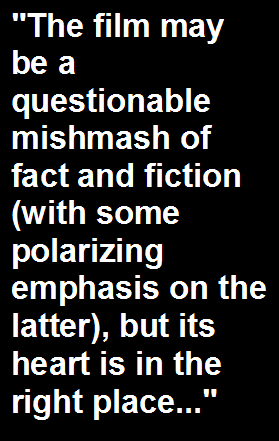
Two things save this film, I think, from being a troupe riddled and ultimately forgettable musical biopic: (1) It's stellar production values and period design (which transports us to the multiple decades of Queen's prominence in the industry with unflinching confidence) and (2) and Rami Malek's Oscar worthy turn as Mercury. Trying to provide a reasonable facsimile of the singer's rock god visage is, no doubt, a daunting performance challenge, but Malek does an authoritative and eerily convincing job as a physical Mercury mimic on and off stage. That, and he fully inhabits all of the nagging contradictions and complexities of one of the most well known superstars in performance history, showing Mercury at both his upper echelon levels of performance magnetism while also showing him as a lonely and sad figure that eventually isolated himself from so many people that he loved. It's a full bodied performance of raw energy that single-handedly makes BOHEMIAN RHAPSODY unmissable in my book. The film may be a questionable mishmash of fact and fiction (with some polarizing emphasis on the latter), but its heart is in the right place, and despite its clichéd and slavishly adherence to the rock biopic playbook. But every scene Malek occupies is intoxicating (he's the ace up this film's sleeve) and when BOHEMIAN RHAPSODY unleashes itself in revisiting Queen's greatest concert moment...the film becomes pure electrifying rock and roll.
