A film review by Craig J. Koban January 21, 2010
THE BOOK OF ELI

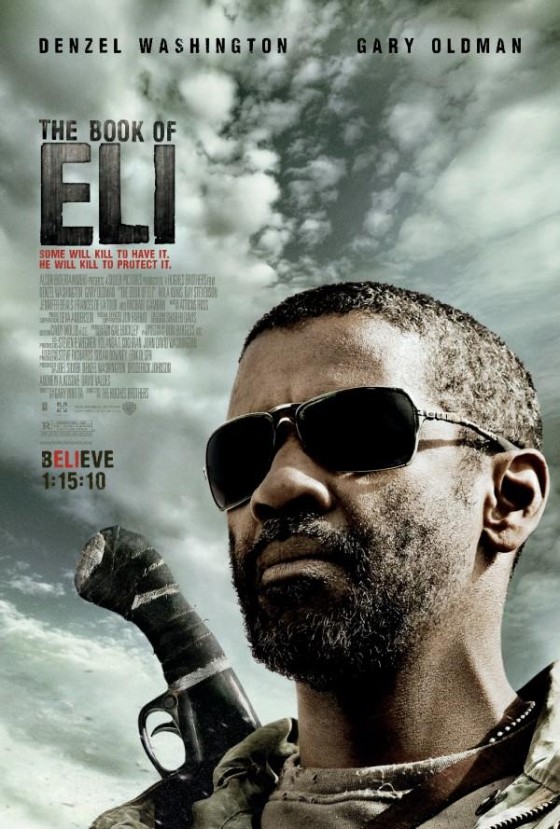
Eli: Denzel Washington / Carnegie: Gary Oldman / Solara: Mila
Kunis / Redridge: Ray Stevenson / Claudia: Jennifer Beals / Engineer:
Tom Waits / George: Michael Gambon
Directed by Albert and Allen Hughes / Written by Gary Whitta
 THE
BOOK OF ELI’s overall success hinges on one very late, game breaking
plot twist that is destined to polarize viewers for a long, long time. I came out of the film thinking that people will either (a)
just need to go with it and accept its improbability and sheer,
unhinged audacity or (b) absolutely detest it to the point where they
think, under simple scrutiny, that it all but undermines the entire logic
of the film and story.
THE
BOOK OF ELI’s overall success hinges on one very late, game breaking
plot twist that is destined to polarize viewers for a long, long time. I came out of the film thinking that people will either (a)
just need to go with it and accept its improbability and sheer,
unhinged audacity or (b) absolutely detest it to the point where they
think, under simple scrutiny, that it all but undermines the entire logic
of the film and story.
There
is a dialogue exchange between two main characters during the
proceedings that, I think, cuts to the heart of the debate: "How do you
know you are walking the right way?” she asks him, to which he directly
responds, “Faith.” One thing is for sure: if you fancy yourself a nitpicky and cynical
filmgoer then you may need faith by the buckets in order to swallow THE
BOOK OF ELI’s conclusion and big reveal, but I found myself oddly
accepting it the more I thought about it.
It just seemed almost too hopelessly unbelievable, but the entire
film built around it is so finely tailored, so well performed, and so
exemplary directed that I was willing to throw logic out the window.
The twist is simultaneously unpredictable and not at all credible,
but the journey towards it was entertaining and thoroughly
involving.
THE
BOOK OF ELI – on top of its many narrative surprises – is also a
fairly compelling hybrid film that constantly intoxicates audiences with
how many different levels it works on:
At face value, it’s a dreary and desolate post-apocalyptic sci-fi
film with echoes of past genre efforts like MAD MAX and THE
ROAD, but it also works as a futuristic western that pays homage
to many of its basic motifs (the drifter, man with no name anti hero, the
vengeful and cruel villain that wants to enlist him, and many a slow
motion shot that shows the hero sauntering through the town of
bloodthirsty ruffians that the villain rules with an iron fist).
Beyond that, THE BOOK OF ELI also manages to be a deeply felt
parable about the power of Christianity and faith and how the preservation
of it during times of bottomless moral uncertainty is an impulse of both
righteous and nefarious men. Make
no bones about it, THE BOOK OF ELI primarily exists as a kinetic action
thriller with a fantastically assured despotic, scorched earth aesthetic,
but the way it also squeezes in themes of resonating
significance is one of its strongest traits, which is what ultimately
helps elevate it beyond most other disposable post-apocalyptic efforts.
30
years after a hinted-at, global nuclear war that has left the earth an
ash-filled no-man’s land, we are introduced to Eli (Denzel Washington)
that endlessly wanders what’s left of the United States.
The opening shot of the film that introduces us to the character is
brilliant in terms of its execution and economy: In one long, fluid, and
single camera move, we see a lifeless corpses that has apparently
committed suicide, a hairless cat that wanders beside it to take a nibble
out of it, followed by a long pan where we see Eli hidden and prepped to
kill the feline for his next meal. The
bleakness of the atmosphere of this future dystopia is immediate, and the
fact that the first 15 minutes or so have virtually no dialogue and relies
solely on stunning and evocative imagery does wonders to immerse viewers
in this putrefied and hopeless world.
Eli seems like he has little purpose outside surviving the hellish and bombed out landscapes void of food and drinkable water, but he has a very heartfelt and determined mission: For reasons unexplained at first, Eli has anointed himself the enterprise of heading as far into the western US as he can (apparently a much safer and cleaner area of the country) where he can help to replant a seed of hope and compassion in the last remnants of humanity there. He has a very, very special book with him that seems to be the key to not only his spiritual journey, but also to imparting a renewed faith and integrity in many people feel has all but been destroyed.
I
don’t think it takes a genius to know which book I am talking
about, but I will give you a hint: it has the words “Jesus”, "Christ,"
and “Our Lord” in it a lot, and it also is the last
know copy of it left on the planet.
Eli
is on a peaceful “mission from Gawd," but that is not to say that this
humble prophet will not unleash a biblical-sized can of whoop ass on
anyone that stands in his way. Along
his travels he crosses paths with the filthiest and most vile
cannibalistic scum that would like to feast on his flesh, which he manages to super
humanly subdued and murder with Ninja-like dexterity and speed (and with
the assistance of a ridiculously large and sharp scimitar).
His ferociously violent travels eventually find him to an Old West-ish
town in the obligatory middle of nowhere, populated by the kind of
reprehensible outlaws, thieves, and killers that certainly don’t like
strangers proficient with swords and guns.
The town, as is the case with all Wild West towns in the movies, is run and
overseen by a man named Carnegie (Gary Oldman, in a wonderful and
refreshing turn playing pure, unadulterated villainy with a sniveling and
boisterously over-the-top flair) who essentially owns the hearts and minds
of the people under him.
Of
course, Carnegie is instantly impressed with the relative ease that Eli
has with slicing and dicing through his lackeys during one hyper-bloody
standoff at a local bar, but Eli, being solemnly introverted loner, just
wants to be on his way. However,
things get complicated when it’s revealed that Carnegie has long sought
after the very “Good Book” that Eli has in his possession, mostly
because he believes that, once he has it, he can use its teachings for his warped
agenda and, in turn, will then have power over just about anyone.
Understanding that having his sacred text anywhere close to this
dictatorial lunatic would be a disaster, Eli manages to flee the town, but
he is a bit encumbered with the accompaniment of a new sidekick of sorts
in the form of Solara (Mila Kunis), an unusually attractive young woman (unusual considering the elements she was born
into and was raised in) that seems
compelled to follow Eli and help him after he has saved her life.
A
simplistic critical approach would be to inevitably compare THE BOOK OF
ELI to the very recent THE ROAD, another post-apocalyptic film.
John Hillcoat’s film is infinitely more moving, wretchedly bleak,
and tenderly humanistic with its story about a father and son struggling
to survive and live an ethical life in a world void of a moral code, but THE BOOK
OF ELI could not be any more different.
Whereas it does share THE ROAD’s impeccable, immersive, and
remarkable attention to production design (they both use location shooting
and visual effects trickery to provide an astonishing evocation of a harsh
and cruelly ravished world shaken by past calamities) and its willingness
to suggest the causes of the apocalypse without slavishly wasting time
with unnecessary exposition, THE BOOK OF ELI is more concerned with making
its post-apocalyptic tale one more akin to a stylish and aggressive
graphic novel come to life: It's
more about sustaining its wondrous visuals, its suspenseful mood and tone,
its crisp and kinetic action scenes, and its reverence of its western film
antecedents.
ELI was directed by the Detroit-born Hughes Brothers, Albert and Allen, marking their directorial return after a near 10-year absence, and they have developed a very strong reputation with their very sparse resumes as being filmmakers with a fine attention to sleek, consummate visuals combined with engaging stories (their first film, 1993’s low budget gangbanger indie effort, MENACE II SOCIETY, was an astoundingly authoritative debut effort, and their last film, the stupendously underrated gothic horror thriller FROM HELL from 2001 showed off their range and willingness to tackle any time period and genre). Now with ELI you could not have three vastly different films, but what does remain is the brothers' virtuoso abilities to create ample visual interest with setups and camera moves that are stunning and exhilarating in their minimalism.
Using
digital cameras, dark and foreboding cinematography, familiar landscapes,
and ample visual effects ingenuity, the duo are kind of unsung when it
comes to making conventional scenes and action set pieces
feel so much fresher and new than they would have been under less
imaginative and resourceful eyes. Just consider an early battle scene – involving Eli and
countless armed marauders that is done with one simple camera set up and
set in stark and eerie silhouette – where they do what so many other
action directors fail to do by letting the action play out with a precision
and clarity (unlike, say, the Michael Bays of the world). The Hughes avoid
the trap of cutting every millisecond and barraging viewers with
hyperactive visual-auditory noise. And
look at another late scene in the film where one key character is shot and
left for dead: the way they juxtapose and edit images and sparingly dial
sound in and out of the montage creates such a hauntingly surreal sense of
dread and pathos. In lesser
director’s hands, moments like this would fall flat with a mechanical
thud.
The
performances are also rock solid: Washington’s prophet/messenger/shotgun-pumping,
sword slashing super hero with the Lord as his co-pilot is nicely underplayed,
which makes the character feel all the more credible despite that twist at
the end that may or may not have you question the veracity of the
character. Gary Oldman, who has been so deliciously malevolent playing
remorseless sociopaths in the past, returns to splendid villainous form
here in a performance as the evil town ringleader that manages to
confidently and adeptly segue in and out of low key and soft spoken
antagonism and outright, salivating and histrionic madness (Oldman is one
of the very few actors that can ham it up to mesmerizingly scary levels).
Jessica Beals also has a nice supporting role as a blind wife to Carnagie
that proves to be much more valuable to him than he otherwise comprehends
early on. A pair of cameos by
the great Michael Gambon and Frances de la Tour as two secluded and aging
outlanders that Eli comes across are a hysterical hoot despite the dark
secrets and "tastes" that they harbor.
Mila
Kunis is fetching and decent as the young woman the befriends Eli, but, as
stated, her flawless cover girl luminosity is a bit too fetching and attractive
to be taken literally in a post-apocalyptic wasteland.
She appears to have ample access and supply of makeup, teeth
whitener, and mascara for a woman living in a world decimated by nuclear
warheads.
