


 A
film review by Craig
J. Koban October
5,
2020
A
film review by Craig
J. Koban October
5,
2020
ENOLA
HOLMES 
2020, PG-13, 123 mins.
Millie Bobby Brown as Enola Holmes / Sam Claflin as Mycroft Holmes / Henry Cavill as Sherlock Holmes / Helena Bonham-Carter as Mrs. Holmes
Directed by Harry Bradbeer / Written by Jack Thorne, based on the young adult series of novels by Nancy Springer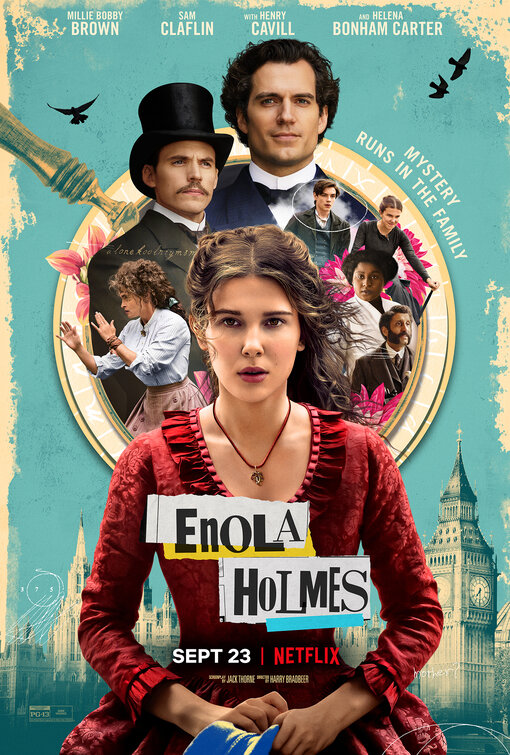

ORIGINAL FILM
Sir Arthur Conan Doyle's legendary sleuth Sherlock Holmes holds the Guinness Book of World Records distinction of being the most portrayed character of all-time on film and TV.
I don't doubt that in anyway, but it does leave me in a somewhat hesitant state to explore yet another film featuring this iconic detective.
Granted, well
known and utilized characters are always ripe for modern reinterpretation,
I guess, which takes me to the new Netflix film ENOLA HOLMES, which - if
one simple goes by the title - is a gender swapping take on Doyle's
established material, albeit with some nifty twists here and there
(Sherlock is still here, but he serves as a semi-estranged brother to the
titular heroine). Despite
some inconsistent narrative momentum and a far too long winded running
time, I was quite taken in with ENOLA HOLMES, mostly because it's a very, very
charming movie and clever spin on Holmes mythology.
That, and it's all held confidently together by an effortlessly
charismatic and winning turn by young Millie Bobby Brown, who indeed is
every which way a movie star as much as her male supporting players.
Based on the
young adult literary series by Nancy Springer, ENOLA HOLMES honors Doyle's
source material by still being set in Victorian England and - as
mentioned - featuring the most recognizable puzzle solver in all of
fiction. But this film pushes
the men refreshingly to the sidelines and hones in on Holmes' younger
sibling in Enola (Brown), who is a young lady far ahead of the standards
of the era. She's limitlessly
intelligent, intensely independent minded, strong willed, and can even
defend herself thanks to being adept at various forms of self defense. Her one weakness is the art of bicycle riding, which she
observes (in the film's recurring fourth wall breaking narration track) as
"not one of my core strengths."
Most crucially, the 16-year-old defiantly fights against the
backwards minded norms of the day in terms of what's expected of women,
which has stemmed from her mother, Eudoria (Helena Bonham-Carter), who has
taught her daughter everything she has known. Very few Victorian era girls
are raised to conduct explosive science experiments and are trained in the
art of jujitsu. Most girls
Enola's age are being sized up for corsets and dresses in order to be a
future wife.
|
|
Poor Enola's
whole world is turned upside down with the sudden disappearance of her
mother, who has seemingly vanished into thin air.
The only thing that Eudoria has left is some birthday gifts for
Enola as well as some well planted clues that may or may not tip off her
whereabouts. Enola's two
older brothers show up in the form of Sherlock (a stoically commanding
Henry Cavill) and Mycroft (a delightfully hammy Sam Claflin), but they've
been so apart from her for so bloody long that they don't even recognize
her when she tries to pick them up at the train station.
Sherlock, being a man of keen deductive reason and logic, sees
potential in the crafty minded Enola, whereas Mycroft has more domineering
plans for his younger sibling, which he plans to capitalize on while
serving as her legal guardian in Eudoria's absence.
Not wanting to be thrown into a suffocating boarding school by her
own flesh and blood, Enola decides to escape from his clutches and
ventures out to London in search of her lost mother.
Along the way she hooks up with another young person on the run
from his family, Tewsbury (Louis Partridge), and the pair try as they can
to navigate the troublesome world of London that was once foreign to Enola.
As far as origin
stories go (let's face it, that's what this really is as a hopeful
franchise establisher), ENOLA HOLMES does a solid job with character
introductions and the core relationships between everyone, and Harry
Bradbeer's nimble footed direction and Jack Thorne's equally spirited
screenplay doesn't waste any time of expositional particulars.
They really thrust you into Enola's world with lightning speed,
part of which is assisted by the aforementioned fourth wall breaking by
the main protagonist. Whether
it be in the form of dispensing key story particulars or just her mindset
at any given moment, Enola speaks to us in a largely inviting and trusting
tone, giving the whole enterprise a definitive FERRIS BUELLER vibe (yeah,
this technique is derivative and hardly novel, but it's handled so
playfully that you can hardly fault it throughout). It also helps with giving ENOLA HOLMES an early sensation of
propulsive energy. We're taking her journey with her almost as a
fly-on-the-wall observer, which makes the whole enterprise so endearingly
cheeky.
But, make no
mistake about it, ENOLA HOLMES isn't played broadly for the purposes of
high camp. Most of the film
is handled in a fairly straight, deadpan manner, which requires an actress
of thankless range to pull off effectively and credibly.
This is where Brown comes in, and the STRANGER THINGS breakout star
is called upon here to play a teenager that's unfathomably wise and
mentally and physically dexterous. She thrusts herself into any
predicament with a steely eyed gumption, but all the while relaying her as
a wide eyed and vulnerable young woman that is having things opened up to
her far quicker that even she was expecting.
Brown also has a wellspring of boundless energy in the role, and
she's able to careful calibrate her performance between moments of ultra
dry comedy alongside some of the
more darker dramatic undercurrents of the script.
With a weak adolescent actress at the helm, ENOLA HOLMES might have
made for an insufferable watch, but Brown is so effervescent and pitch
perfectly cast here that you genuinely want to explore more films set in
this side-Sherlock Holmes universe with her leading the charge.
Her supporting
cast is as uniformly decent as well, and Superman himself in Cavill is
arguably the most granite jawed and physically imposing of all of the
movie Sherlock Holmes, but it's nice to see the British star play a
British character, even if it's one of such a large stature that's
essentially delegated to second bill status in a minimal role.
Claflin has more mischievious fun playing Sherlock's power hungry
brother, and much of the film's humor comes at the expense of Mycroft's
incredulous reactions to what
he perceives as all of the uncivilized wrongdoing by his sister.
This ties neatly into the core messages of ENOLA HOLMES, especially
when it comes to the actual plight of women during the period in question.
Emotionally and mentally, Enola wants to live a liberated life that
her gender is simply not afforded in her time, and she loathes the
aggressive strong-arm tactics of men like Mycroft wanting to shape her in
the way society deems proper. Of
course, Mycroft laughs at the notion of a women existing in a world for
anything other than being a nurturing and devoted wife, but Enola has
other grand ideas and plans ("A corset is a symbol of oppression for
those forced to wear it!" she explains to us at one point).
There's a strong feminist thematic epicenter to ENOLA HOLMES, and
considering the mostly iffy quality of so many young adult franchises
featuring woman, this one scores points for actually trying to be about
something that its young viewers can relate to. "You have no interest in changing a world that suits you
so well," she blasts out at Mycroft during one altercation.
She's on to something.
ENOLA HOLMES could have been that much better with a more appropriately truncated running time. It goes on about 15-plus minutes more than it really should have considering the established liveliness of its opening sections (it got a little too watch checking for its own good in the latter sections for my taste). Plus, some of the characters, like Partridge's Tewsbury, aren't all that interesting or well rounded as they could have been. And maybe the film contains one too many surprisingly violent scenes of adult men pummeling the high school aged main hero in various confrontations (to be fair, Enola gallantly attempts to defend herself during them, sometimes successfully, sometimes not, but the creepiness factor always remains). I'm engaging in minor quibbles, though, because ENOLA HOLMES succeeds in doing what all good series launchers should do: It makes you like the world and its characters enough to want to see continued adventures in more sequels. And I'd follow Enola into detective mode battle again any day of the week. Maybe just not while on a bicycle.
