A film review by Craig J. Koban March 30, 2011
LIMITLESS
 ½
½
Eddie Morra: Bradley Cooper / Carl Van Loon: Robert De Niro / Lindy:
Abbie Cornish / Gennady: Andrew Howard / Melissa: Anna
Friel
Directed by Neil Burger / Written by Leslie Dixon, based on a
novel by Alan Glynn
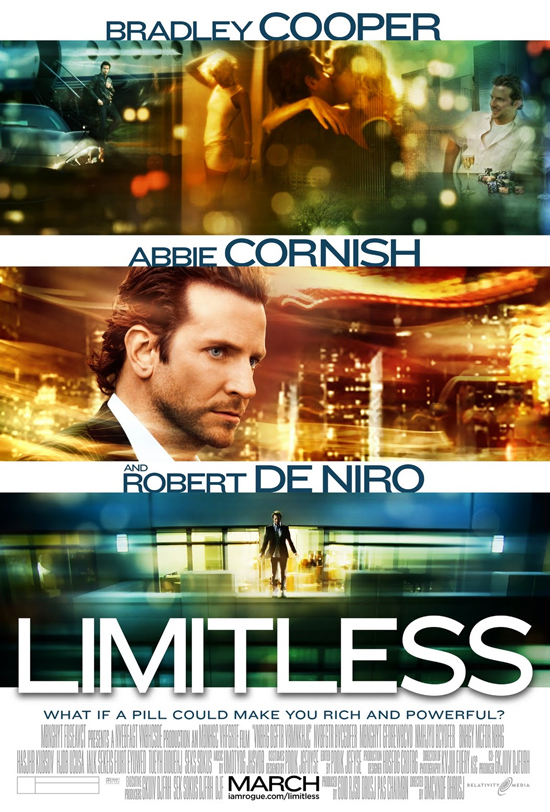
LIMITLESS
is a somewhat frustratingly dumb film about a man that has drug-enhanced
super intelligence. It is
based on a Alan Glynn 2001 novel called THE DARK FIELDS (unread by me) and
concerns a largely down-on-his luck schmuck that – via the power of a
mind-altering new drug – is granted the ability to access “80 per
cent” of the unused brain that we never seem to access.
As a result, he begins to think like a super computer and becomes a
hyper intellectual and aware.
Okay, if you excuse the myth that people only ever use 20 per cent of their brains (neurochemistry and science has proven that, under some circumstance, people use far more than the 20), then there is much to admire in the basic premise of this mental rags to riches drama. The real problem with LIMITLESS, though, is that it’s unevenly written, avoids logic at key moments, and contains moments of head scratching incredulity: it's sometimes too stupid for its own good.
It
also really suffers when it comes to being a thoughtful parable about the
dangers of using drugs – FDA approved or not – for the purpose of
personal enhancement. Just
when LIMITLESS appears like it will turn fascinatingly cautionary about
the perils of using untested drugs, it all but avoids the issue altogether
to focus on lame and contrived subplots involving Russian gangsters,
mysterious killers, and corporate crooks that, in turn, delegates into
routine sequences involving shootings, killings, double crosses, and so
forth. Films about smart people should not be written so
idiotically.
I
will say this for the film: (1) it has a sly and enthralling opening act
as we see the main character’s life take a radical 180 degree turn for
the better as he uses his new mental might for personal empowerment and
betterment and (2) it has a charismatic and star making turn by Bradley
Cooper (whom many viewers will remember from THE
HANGOVER) and he demonstrates a range not seen before in a mainstream
film as he has to portray a transformation from a semi-witless and scruffy
nobody to a ultra-cool, lightning fast talking, and inordinately clever
mega mind whose limitless aptitude is matched only by his enjoyably cocky
bravado. Cooper has had a
field day playing deplorably arrogant a-holes in past films, but here he
has to play up to his role’s weighty self-importance and emotional
vulnerability, and he commands himself nicely with that tricky dichotomy
Cooper
plays Eddie Morra, a very ambitious, but largely unsuccessful New York
writer that is desperately trying to churn out his first novel. His main problem is that he really has no idea what his story
is about (he can’t even distil it into a few sentences for his
friends) and he has crippling writer’s block.
To make matters more personally dire, his long-term girlfriend,
Lindy (the attractive and decent Abbie Cornish, doing what she can with a
perfunctory love interest role) has left him.
Most of his days Eddie finds himself a prisoner held within the
confines of his tiny and shabby apartment…but mostly he feels
constricted by his own nagging inability to write anything meaningful
worthy of publishing.
Things
irrecoverably change for Eddie when he has a chance meeting with his
former brother-in-law, Vernon
(Johnny Whitworth) who seems to have cleaned up his act since the last
time they spoke. The clean
cut, well dressed, and well spoken Vernon senses Eddie’s unease about
his future, so he offers him a taste of freedom in the form of a drug
called NZT, which he claims is safe and FDA approved and sells in single
form for about $800 a pill. Vernon
is vague on details, but he suggests that Eddie tries the drug and and
then he’ll
know exactly what its powers are within minutes of taking it.
Throwing caution to the wind, Eddie returns home, gulps down the drug,
and eagerly awaits for some results.
He
gets some. Eddie soon
discovers – to his amazement and absolute delight – that NZT has an
almost indescribable affect on the human mind: it allows its takers to
fully access their brain and, with blinding rapidity and effectiveness,
takers become boundlessly smart. After
his first fix Eddie is astounded, but he also learns that the drug has nasty side effects when it wears off (he
not only goes back to being normally
intelligent, but he also become more lethargic and clumsily coordinated) so he goes back
to Vernon to get more. The problem is that he finds him murdered in his ransacked
apartment. Eddie does manage
to locate Vernon’s stash of NZT, which he takes just before the cops
arrive.
With
an endless supply of the medication, Eddie re-creates a newer, bolder, and
more confident version of his past self.
He finishes his novel in days and becomes an overnight sensation
with his editor, but when he finds writing increasingly below his newfound
intellectual abilities, he sets his sights on the stock market, where he
uses his keener and sharper abilities to deduce and notice patterns to
become very rich very quickly. His
success on Wall Street has made him a legend in the city and it catches
the eyes of a very powerful and affluent businessman named Carl Van Loom
(Robert De Niro) who teams up with Eddie on future business deals with
billions of dollars to be made. Eddie’s
life, nonetheless, gets more difficult as he reaches a peak of personal
success, mostly because his supply of NZT is getting scant and he is
beginning to notice some really alarming side effects.
It gets worse when Eddie realizes that some past takers died while
having the same withdrawal effects he has had and things get more complicated when he
notices that a mysterious stranger is stalking him.
LIMITLESS,
as stated, has an intriguing premise that is easily accessible to most
audience members: it’s ultimately an everyman wish-fulfillment fantasy
about utilizing your potential, albeit through artificial means.
I also like how the film’s director, Neil Burger (THE
ILLUSIONIST) gives the film a mind-bendingly innovative visual style
that’s meant to evoke how the induced Eddie experiences time and space
while high on NZT or, in other cases, when crashing off of it.
Alongside cinematographer Jo Willem, Berger creates virtuosos
tracking and dazzling (if not disorienting) forward zoom shots that
traverse over massive stretches of city blocks that create an astounding
depiction of what Eddie's miraculously amplified mind works from his POV. I appreciate when gifted film visualists are able to take
seemingly mundane shots and inject some much needed freshness and
innovation into them.
The
performances as well are in fine form.
Aside from the very decent Cooper, it certainly is nice to see De
Niro return to straight dramatic roles with his turn as the hard-edged,
take-no-prisoners and tough talking businessman. He gives a monologue at
one brief point about what it takes for a man to earn a place in the world
and be successful that might be the finest piece of acting De Niro has
done in years. Watching a wily veteran like him smoothly and dryly intonate
with a quiet menace reminds us of the type of actor he can be when not
degenerating himself to witless and banal comedic sludge like LITTLE
FOCKERS. My request
to De Nero: more, please.
Yet,
a compelling story premise, magnetic performances, and a creatively
envisioned visual palette seem to be lost here when it comes to how the
screenplay stumbles as it progresses.
The more the story evolved, the more it seemed focused on lame, run-of-the-mill side plots, all which distract from the
central dilemma of Eddie’s on-again, off-again addiction to NZT.
When it comes to the notion of addiction itself, the film seems to
lack real nerve in terms of commentating on it.
This is hammered home by a scandalously preposterous conclusion
that feels more like a deceitful bit of bait and switch with audience
sensibilities that it should have. LIMITLESS’
finale feels more like a rejected extra from a DVD supplemental section
that a worthy conclusion to this film’s story.
Then there are the film’s more unintentionally silly moments that even a person not high on NZT could pick apart. Take, for instance, how Eddie is able to use his drug-accelerated ultra-memory to call up Bruce Lee films, which he meticulously processes and instantly uses to turn himself into a one-man kick ass squad against some subway marauders. Sure, Yup. Uh-huh. And don’t get me started on one particularly daft instance when Eddie, needing a very quick jolt of NZT during one life-threatening moment, drinks the spilt blood of a fallen NZT-user, because the drug is “still in the user’s blood stream” and slurping the infected blood will have the same effect as just taking the pill (huh?). Moments like that bend modest logic and made me roll my eyes with too much annoyance, and a dramatic-thriller like LIMITLESS – which started with so much promise - should not later subsist on foolishly rendered scenes and plot developments. Maybe the writer, Leslie Dixon, needed a fix before finishing the final draft.
