A film review by Craig J. Koban October 4, 2012

RANK: #3
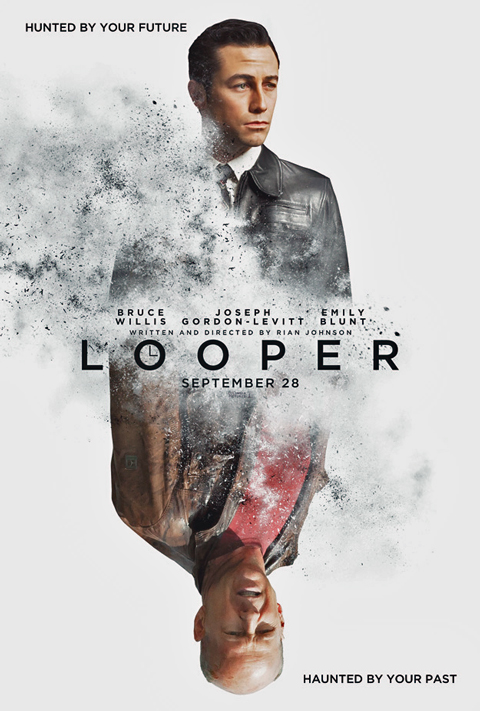
LOOPER 
Joe: Joseph Gordon-Levitt / Old Joe: Bruce Willis / Sara: Emily
Blunt / Seth: Paul Dano / Abe: Jeff Daniels
Written and directed by Rian Johnson
 Time
travel has been literally done to death in science fiction films over the
years, but it has rarely been used - as a main storytelling device - as
cleverly, intricately, and inventively as it is in Rian Johnson’s LOOPER.
In a relative age when we think that we have seen just about all
that a genre like this has to offer, along comes Johnson’s film to
forcibly wake us up out of numbing complacency.
What he does here is not easy: He crafts a futuristic temporal-jumping
and mind-bending science fiction tale that’s unreservedly fresh with its
inherent material and combines that with brilliant and thankless
performances, highflying and breakneck action sequences, Hitchcockian
thrills, and an ingenious climax that packs a resounding wallop and makes
you ponder all that transpired beforehand.
Time
travel has been literally done to death in science fiction films over the
years, but it has rarely been used - as a main storytelling device - as
cleverly, intricately, and inventively as it is in Rian Johnson’s LOOPER.
In a relative age when we think that we have seen just about all
that a genre like this has to offer, along comes Johnson’s film to
forcibly wake us up out of numbing complacency.
What he does here is not easy: He crafts a futuristic temporal-jumping
and mind-bending science fiction tale that’s unreservedly fresh with its
inherent material and combines that with brilliant and thankless
performances, highflying and breakneck action sequences, Hitchcockian
thrills, and an ingenious climax that packs a resounding wallop and makes
you ponder all that transpired beforehand.
LOOPER
is in the great tradition of contemplative, ideas-based science fiction
in that it sets up its premise with a steely-eyed precision and headstrong
confidence and then meticulously executes it to the point where we don’t seem to doubt its authenticity.
Time travel films can often fail when they get too bogged down with
the normal pratfalls of paradoxes, whereas others ignore them so much that
it becomes a headache-causing distraction.
LOOPER miraculously finds a middle ground between the two: it
acknowledges the implications of paradox and deals with them in a
forthright manner, but it also never dwells on them.
Even the film’s characters speak towards this during many of its
self-aware and sly moments, as is the case when one relays to another
“This time travel crap…it just fries your brain like an egg.”
As
for the film’s premise? It’s
a real humdinger. Ostensibly,
LOOPER takes place in the hellish dystopian world of 2044 Kansas, which
looks not too unlike Kansas of today, but just more sprawling with human
decay, mass poverty, homelessness, and sprinkles here and there of
technological innovation. By
the 2070’s time travel becomes a reality, but the mafia solely controls
it. Since it’s seemingly
impossible for them to dispose of a body of a target in the future, the
mafia has concocted a wickedly shrewd manner of getting rid of their
enemies: they bind, gag, and blindfold their prey, zap them back to 2044
where they are instantly met by special assassins known as “loopers”
that immediately kill them and rid the world of any trace of them ever
existing.
|
|
When
loopers finish their assignment – they are paid with bars of silver
strapped to their victims – they await their next job.
When the mafia wants to end a looper’s contract, they send back
the 30-year-older version of the looper back to 2044 to be killed by his younger self, which is known as “closing the loop.”
Since the target is always blindfolded, the looper never knows if he
is indeed killing his older self, but he does find out afterwards: gold
instead of silver bars attached to the target indicates a closed loop
(what a hauntingly convoluted and problematic way of earning a living). One looper in particular, Joe (Joseph Gordon-Levitt) is damn
good at his job. He works for
Abe (Jeff Daniels), who has been sent back from the future himself to
oversee looper operations in 2044 (this leads to the film’s funniest
line of dialogue: When Joe confides in Abe his desire to eventually retire
to France, Abe matter-of-factly retorts, “I’m from the future. Trust me…avoid France and go to China!”).
Joe makes one blunder: he protects a fellow looper (Paul Dano) that
decides to not close his own loop, but after he turns him in Joe discovers
that his next assignment is closing his own loop, which pits him
mano-a-mano with his three-decade-older self (played by Bruce Willis).
Young
Joe hesitates on the hit, and Old Joe capitalizes by knocking young
Joe...or...himself...out
cold. Young Joe knows that if
he does not kill…his older self…that Abe’s goon squad will indeed
exterminate him. Old Joe, at
the same time, has his own plans: The future leader of the time-travel
controlling mafia – known as (paging John Grisham) “The Rainmaker” -
has caused all kinds of
personal pain for Old Joe in the 2070’s, so he deduces that if he kills
him as a boy in 2044 that it will change the future for the better.
Old Joe hones his list of potential targets to three boys, one
being Cid (Pierce Gagnon), who lives with his farmer mother, Sara (Emily
Blunt). Young Joe comes to
meet Sara and the boy, but he initially could care less about them: all he
wants to do is close his loop, but Old Joe’s plans causes great ethical
difficulties.
Imagine
all of the potential complications of meeting and confronting your older self from the
future. Johnson stages a bravura scene in a diner where young and old
Joe sit down and speak to one another, during which they ask each other
questions that just about any of us would if we were in their highly
unique predicament. Ultimately,
though, both are driven by their own pragmatic motives: Young Joe wants to
finish off old Joe, but Old Joe can’t kill his young self because that
would make him cease to exist, even though he must defend himself from
young Joe to
finish his own twisted plan. Gordon-Levitt
may seem like the least likely young stand-in for Willis, but he's caked with remarkably restrained makeup to – over time –
convince us of the credibility of him being a younger version of Willis.
Over time, Gordon-Levitt’s increasingly and deceptively subtle
performance makes him eerily come off as a thirtysomething Willis.
Gordon-Levitt
is as self-assured and compelling as he’s ever been in a film, who has
to evoke a morally dicey persona (he’s a cold blooded killer and drug
user) that has to later – and authentically - morph into a meditative
and protective hero, of sorts, to Sara and Cid (no easy task).
Willis has the trickier role, I think, seeing as he initially comes
across as a deeply melancholic, but inwardly determined man driven by a
past – or should I say future? – love that will do anything –
including murdering helpless and innocent children – to change his
future for the better. It’s
easy to hate Old Joe for his motives, but it only makes for a vastly more
problematic and multi-faceted antagonist for the film, which further
establishes and accentuates the moral ambiguities that typify LOOPER’s
usage of time travel. Old
Joe’s actions seem hellishly cruel, but logically sound at the same
time. After all, just
consider one of the oldest of time travel conundrums: if you could travel
back in time and murder Hitler as an infant…would you?
The
other side performances are just as evocative and strong.
Blunt – superficially at least - may just be the hottest farmer
in film history, but she’s not just here for pure window dressing.
She plays her staunchly independent minded and take-charge
homesteader with a raw nerve and backwoods tenacity that I’ve not seen
from the actress before (she’s never been so simultaneously tough, sexy,
and vulnerable in a role). Sara
is also obsessively protective of her son, not because she knows that
he’s a target for extermination by a driven man from the future or
that she knows what’s to come of her boy, but rather because (a) she’s a
mother and (b) she and her son both have secrets to keep from everyone around
them. It becomes alarmingly
clear as the film progresses to its explosive finale that Cid is not a
completely innocent and defenseless young lad.
One
thing needs to be said of the look of LOOPER.
Too many modern sci-fi action thrillers are wall-to-wall with
eye-popping CGI and splashy visual flourishes.
Johnson is not concerned at all with eye-popping special effects or
ostentatious artifice as he gets by on the power of his cool ideas and ceaseless creativity. LOOPER never lets its visuals and effects crowd and overwhelm
the picture, but rather they shows us glimpse of the two futures with a thrifty
attention to detail that makes these environments feel familiar and
otherworldly at the same time. Johnson
rarely makes the landscapes of 2044 or 2077 sleek, refined, or convulsing
at the seams with opulent technology.
his
less-is-more approach here lets us focus more on the
character dynamics and the thought-provoking issues afoot in the film.
How wonderful is it when a sci-fi film’s production design and
effects compliment the story and acting and not compete with or overwhelm
them?
More
importantly, Johnson can officially join the upper echelon intrepid,
resourceful and highly creative directorial elite with LOOPER.
His first film, BRICK, was a
virtuoso original – a hardboiled detective noir homage set in and around
modern high school characters. His
second film was the stylish, breezy, and inspired conman caper film THE
BROTHERS BLOOM. LOOPER
cements Johnson as a filmmaker of remarkable imagination and fearless
ingenuity. He delivers
an infectious and refreshing hodgepodge of futuristic sci-fi with old
school action intrigue and further marries that to a time travel narrative
that revitalizes the premise in ways few other similar genre films have.
LOOPER is easily the best sci-fi film since INCEPTION and is far
and away the best film of 2012 thus far.
