A film review by Craig J. Koban November 21, 2009
THE MEN WHO STARE AT GOATS

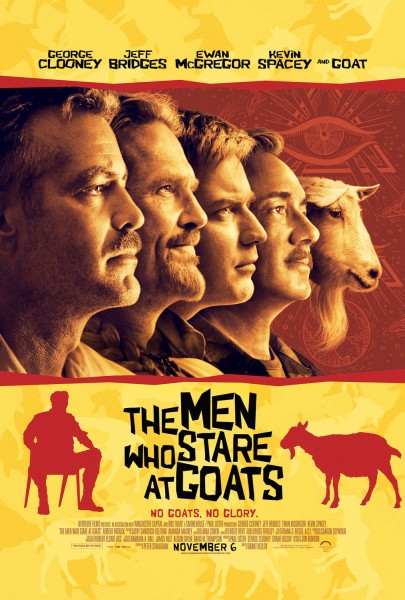
Lyn Cassady: George Clooney / Bill Django: Jeff Bridges / Bob
Wilton: Ewan McGregor / Larry Hooper: Kevin Spacey / Todd
Nixon: Robert Patrick / Gen. Hopgood: Stephen Lang / Gus
Lacey: Stephen Root
Directed by Grant Heslo/. Written by Peter Straughan, inspired
by Jon Ronson's 2004 book.
 I
love this title. THE MEN WHO STARE AT GOATS. It elicits quite a few incredulous
giggles, as it should, because as a film it’s as frequently
howl-inducing as it is deeply and madly absurdist.
I
love this title. THE MEN WHO STARE AT GOATS. It elicits quite a few incredulous
giggles, as it should, because as a film it’s as frequently
howl-inducing as it is deeply and madly absurdist.
The film also successfully traverses along some highly divergent tones and themes: It’s a perversely uproarious, loony tunes farce; a Hope/Crobsy-esque road comedy; a somewhat thoughtful satire and dissection of how the modern military works within its own self-described rules and structure; and, yes, a true story about how the army actually engaged in research and development into turning special candidates into psychic warriors with a Buddhist mentality of making peace, not war. To say that the last element was the hardest pill to swallow from this film is an understatement, but inspired by actual events this film was, which is revealed in the film’s single funniest line…it’s opening title card…
“More of this is true than you would
believe.”
Few satires have such a supreme grasp of the bizarre as THE MEN WHO
STARE AT GOATS, and it does so with a dexterity and simple economy.
Jokes and gags – which are many and extremely funny – hit their
marks with relative ease: I was often laughing too hard to focus on how
ridiculously unbelievable the events seemed.
What’s interesting, though, is that the film – with all of its
zany, go-for-broke energy and gusto – is done without going to fanatical
over-the-top theatrics, which is assisted greatly by the individual
performances. Weaker actors
would have all but buried the film by making its personas histrionic and
zealot-like caricatures, but the ensemble here in THE MEN WHO STARE AT
GOATS neither overplay their roles to annoying levels nor are they
against broadly playing individual moments.
Most of the actors here play scenes with a straight-laced
sternness, but do so with their tongues-in-cheek, acknowledging that they
are both a part of - and understand - the type of film they are in, which
helps nourish the film’s quirky and offbeat humor.
And,
again, the film is reality based, as unbelievable as it is.
It is based on a 2004 book by Jon Ronson about how the Army explored New
Age concepts and training for potential military applications of the
paranormal, like, you betcha, walking through walls, using your mind to
disarm enemies, psychic predictions, and being able to stare a
person (or goat) to death. They also
researched psychological warfare, like – the horror! – using the theme
from the children’s show BARNEY AND FRIENDS to agonizing levels to get prisoners
to talk. The book traced the evolution of all of these highly covert
– and highly weird – activities since the early 1980’s and addressed
how some of them are still alive today in a post-war-Iraq.
The
portal into this too-strange-to-be-believed real story in the
film adaptation is Michigan-born journalist Bob Wilton (the dependable
Ewan McGregor, wisely and suitably playing the straight man to all of the
film’s craziness). In 2002
he, after a nasty divorce and break-up from his wife, is looking for the
story of his career to occupy his time, mostly to assert himself, bur even
more so to impress his ex in order to get her back.
He decides to venture to Kuwait where he hopes to become a war
journalist knee deep in the middle of the intense action.
Instead, he crosses paths with Lyn Cassady (George Clooney,
perfectly self-deprecating and oozing goofy, oddball charm), an ex-special
ops military officer who claims to be a key member and one of the many
founders of the “New Earth Army,” or more simply a secret group of
psychic spies that have trained their minds and bodies to use their brains
as weapons and mental powers as the ultimate WMDs.
At one point Cassady describes himself as his brethren as “Jedi
Warriors,” which gets one of the film’s slyer laughs, seeing as
it’s a more-than-obvious reference to one of McGregor’s most famous
recent movie roles.
Cassady describes the ideology and teachings of his order of paranormal, super soldier grunts, which largely involves all of the ways they can be used as the ultimate stealth weapons (in theory, they can spy on enemies from afar, kill people by willing it, and so forth), but when the highly skeptical Wilton begins to ask Cassady how this is all possible, he retorts that usually “alcohol and narcotic" consumption helps...as well as listening to the music of Boston. In the film’s numerous (but sometimes clumsily handled) flashbacks we see the inception of this Jedi squadron of mind-over-matter soldiers, which began modestly with the experiences of a soldier in Vietnam named Bill Django (a terrifically kooky Jeff Bridges, harnessing the cheekier aspects of “The Dude” persona he perfected in THE BIG LEBOWSKI).
Django
is one of the strangest military men I've ever seen in a film.
During his tour in 'Nam he began to notice that certain soldiers were not
being used to their full potential while in the conflict (in short: they
were not killing people as readily as they should have).
His alternative was to convince the military to invest in his
pacifist-centric plan to train specific soldiers in the secret art of Jedi
Warriordom, seeing as the rough and tough training these soldiers were
getting was not working. This
is shown in one of the film’s most hilarious sequences, where Django
uses his hippie, peace-loving charm to whip these men into shape: His
exercises involve dancing, fire walking, driving vehicles around an
obstacle course while blind-folded, and, big surprise, experimenting with
all sorts of mind alternating hallucinogenics (at one point - when dealing
with a concerned party - he utters the film’s best throwaway line,
“Don’t worry about me. Over the years I have developed a
complete tolerance to all known narcotics”).
Two of Django’s best pupils were Cassady and Larry Hooper (a
dryly funny Kevin Spacey, playing his a-hole character with considerable
relish and spiteful delight), but only Cassady adopted Django's truer and lighter
teachings, whereas the nefarious Hooper wished to only adopt the darker
side (another funny STAR WARS
reference). Hooper is,
indeed, an unfathomable prick, especially during one moment where he
shakes hands with a bride and groom on their wedding day and, using all of
his physic abilities, tells them, “Sorry it does not work out for you
both.”
Back
in the present Cassidy decides to allow Wilton to be his wingman on one
last covert mission, which involves the pair becoming stranded in
the middle of the desert and then being kidnapped by a criminal gang.
Not to worry, because Cassady tries to use all of the
mental powers in his New Earth Army playbook to get they out safely.
Through a series of outrageous events, both Cassady and Wilton do
make it out alive so that Cassady can complete his last mission to
discover the whereabouts of his mentor Django, as well as deciphering what
has happened to his fellow Jedi warriors.
This brings him back face-to-face with his old nemesis Hooper, who
has hatched out a fiendish plan of his own. While matching mental
wits with him, Cassady also must come
to grips with an infamous altercation he had with a goat several years
ago, which signified everything that the New Earth Army is against. Note: killing goats with your mind is definitely not cool in
their spaced out ideology.
THE MEN WHO STARE AT GOATS was directed by Grant Heslov, an actor you may have spotted in bit-parts here and there in the past, but who recently has been making a name for himself as a producing/writing partner of Clooney (he was an Oscar-nominee for co-writing GOOD NIGHT, AND GOOD LUCK with Clooney and recently produced the Clooney directed LEATHERHEADS). His approach to the material is clever, whimsical, lightweight, and sometimes a bit unpredictable, but he pulls all of the film’s elements together to create an interrelated whole. Even when the film’s script (provided by Brit writer Peter Staughan, who wrote the very funny HOW TO LOSE FRIENDS AND ALIENATE PEOPLE) zig-zags between the past and the present with too much haste and confusion, Heslov always maintains the demented, sublimely preposterous and infectious spirit of the whole enterprise.
The
film’s offbeat premise moves by briskly during its 93 minutes, often
being typified by some terrific one-liners, inspired and ridiculous
physical comedy, and, most compellingly, an analysis of how the modern
military goes to extraordinary lengths to use methods that are pure
science fiction in order to secure the results they need.
It would take a Herculean Leap in faith and logic to accept that a high ranking military officer
could see the validity of using such
paranormal/counterculture-inspired methods and practices to radically
change the army .
Yet, there apparently were men that thought that
telepathy and telekinesis were viable options for the army’s money and
time. Even as deranged as
that prospect seems, THE MEN
WHO STARE AT GOATS also sheds light on how the military often will go to
any length to discredit those that they have put faith in, especially when
they feel there services are no longer required.
Even though the veneer of this film is a purely absurdist and wacky
farce, there is a slightly bleak and sad undercurrent to its story.
The film really shines with the paring of Clooney and McGregor, who are a finely tailored comedic dynamic duo: McGregor has the tricky task of looking like the sane and sensible voice of nature in the film that ultimately begins to drink the New Age Kool-Aid that Clooney’s madcap Cassady spoon feeds him. Actually, Clooney’s role just may be as delicate, seeing as he has to play up to his Cary Grant-like hunky charisma and bumbling charm without coming off completely as an insane buffoon. I liked how he plays his role with an integrity, dedication, and confidence, but not without a hint of madness (not an easy dichotomy to pull off). Jeff Bridges is letter perfect too as his alcoholic/drug laced war vet-turned-hippie that deeply believes in all of his LSD-infused mysticism, and Kevin Spacey – albeit in a disappointingly limited capacity – deliciously chews up scenery as the vengefully acidic-tongued Hooper. Best of all, the performers here are smart enough to acknowledge the type of film they are in without smugly winking to the audience at every waking moment. With utterly ham-infested and histrionic performances, THE MEN WHO STARE AT GOATS could have been an unbearably obvious military parody and satire, but with the slyness of the actors on parade here, they hit just the right beats to help sell this gargantuan tall tale with a morsel of truthfulness. You are almost willing to believe in their otherworldly powers and abilities.
Well…almost.
