A film review by Craig J. Koban September 28, 2011

Rank: #9
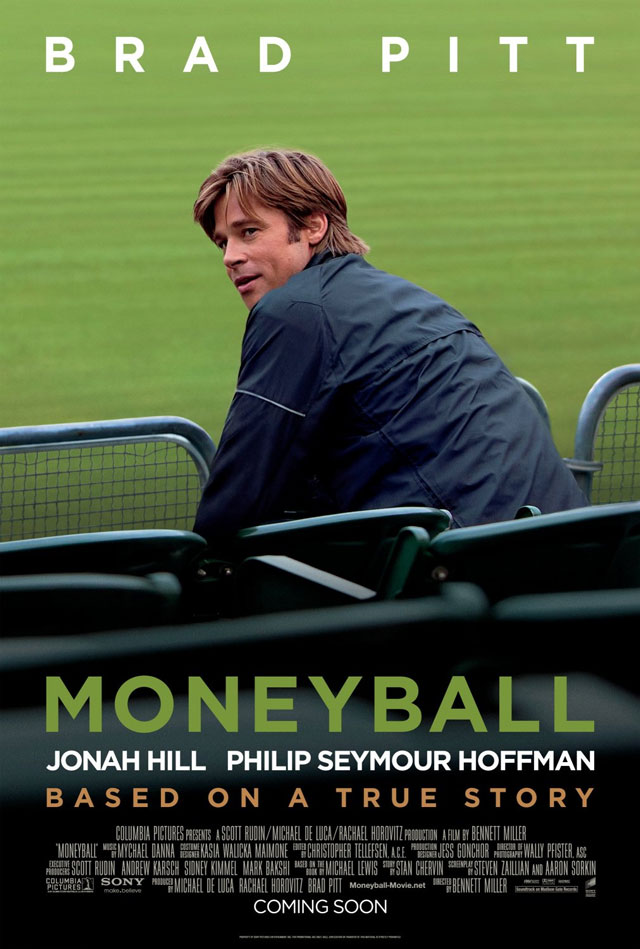
MONEYBALL 
Brad Pitt: Billy Beane / Jonah Hill: Peter Brand / Philip Seymour Hoffman: Art Howe / Robin Wright: Sharon / Kerris Dorsey: Casey
Directed by Bennett Miller / Written by Steve Zaillian and Aaron Sorkin, based on the book by Michael Lewis
 The
genius of MONEYBALL is that it’s an unconventional and unexpected real
life inspirational sports film. It has the down-on-their-luck players, the insurmountable
opponents, the proverbial “big games”, and so forth, but MONEYBALL is
not really all that compelled with those elements.
Perhaps more refreshingly, the film is not even a traditional
sports film at all, nor does one have to be an aficionado of Major League
baseball to enjoy it. Like MIRACLE,
MONEYBALL is more about the behind-the-scenes personas and the politics of
baseball than it is truly about the actual athletes themselves and the
fundamental dynamics of the individual games.
The
genius of MONEYBALL is that it’s an unconventional and unexpected real
life inspirational sports film. It has the down-on-their-luck players, the insurmountable
opponents, the proverbial “big games”, and so forth, but MONEYBALL is
not really all that compelled with those elements.
Perhaps more refreshingly, the film is not even a traditional
sports film at all, nor does one have to be an aficionado of Major League
baseball to enjoy it. Like MIRACLE,
MONEYBALL is more about the behind-the-scenes personas and the politics of
baseball than it is truly about the actual athletes themselves and the
fundamental dynamics of the individual games.
Hmmmm…maybe the film is not
really about baseball. Like ROCKY,
the film is about having the opportunity for second chances, both in
sports and in life. It also
works brilliantly, as so few other sports films have, as a portal into our
own recent financially strapped times.
MONEYBALL's main theme is about finding that discrete and oftentimes
hidden value in things that so many other people can’t find and how
those that do find it are personally redeemed for believing in its value.
More crucially, the film explores how money and value do not
necessarily work together to predicate performance and relative worth.
Something that’s cheap and seemingly disposable has value in ways
so few can perceive.
That’s what makes
MONEYBALL such an unqualified triumph: it explores the fascinating
business side of baseball that we rarely get glimpses of and it also
provides viewers with a fly-on-the-wall look into the provocative and
intrepid personalities that don’t play the game that lead to a team’s
ultimate success. In a way,
it’s kind of a perfect sports film for our fiscally uncertain
times. It
almost works as a metaphor for lower-middle working class strife; sometimes, we
have to exploit the little intangible things for maximum and efficient
gain.
The film – directed by
Bennett Miller (CAPOTE) and written by the
dream team pairing of Oscar
winning screenwriters Aaron Sorkin (THE
SOCIAL NETWORK) and Steven Zaillian (SCHINDLER’S LIST) – is
based on the 2003 book MONEYBALL: THE ART OF WINNING AND UNFAIR GAME by
Michael Lewis, which in turn deals with the Oakland Athletics and their
general manager, Billy Beane, in the early 2000’s.
The book and film explore the massive and, yes, unfair gulf that
exists between rich and poor baseball teams while competing for World
Series glory and how Beane, with some help, used modern advances in
analytics to create a sabermetric approach to develop a productive and
winning team on a dime store budget.
By using more empirical means of fielding a team (primarily using on-base
percentages), Beane and his small entourage spat in the face of
collected baseball wisdom of the last 100-plus years, which they saw as
antiquated and flawed.
The film opens with largely
archival footage of the 2001 post-season game between Oakland and the New
York Yankees: The A’s had a payroll of around $40 million, whereas the Bronx
Bombers had one well north of $125 million.
Oakland loses the game and, in the off season, they loss their key
star players, Johnny Damon, Jason Giambi, and Jason Isringhausen to free
agency waters. GM Beane (played with rock solid and steady poise by Brad Pitt) is
both depressed and angered at the loss, and he’s perhaps more upset that
the owner will not fit the bill to get the necessary replacements he needs
to take the team into the 2002-2003 season.
Beane’s meetings with his well over-the-hill scouts are some of
the film’s finest, which seem joyously saturated with loose and
improvisational
rapid fire exchanges; these moments just as well could have been from
documentary, as these guys talk like real baseball insiders.
The problem for Beane, though, is that within a few minutes of
dealing with them he knows that his upcoming season is in jeopardy.
One day with a visit with the
brass of the Cleveland Indians changes Beane’s life forever.
There he meets Peter Brand (a more quiet, reserved, and understated
Jonah Hill), a young Yale graduate that impresses Beane with his intimate
knowledge and radical ideas of baseball and how to pick players to win
games. As a gauge of trust,
Beane asks Brand if he would have drafted him in the first round (Beane
began his career as a once promising, but ultimately doomed player), to
which Brand sheepishly responds, “Ninth round.”
Beane likes his brash honesty, so he hires him as the A’s
Assistant GM.
|
|
Of course, Beane and Brand’s
new approach to picking undervalued players that other teams have
forgotten does not sit well with the scouts or the team’s manager, Art
Howe (played with a menacing and detached calm by Phillip Seymour
Hoffman), but Beane is insistent that they give their new and highly
unorthodox system a try, which does fail miserable at first.
Yet, Beane and Brand persevere, and the A’s do, in fact, come out
of a rather large hole in the standings to win an unprecedented 20 games
in
a row, a league record. The
team and Beane’s new fangled approach to fielding a secessful club becomes the
talk of the league, but it still remains to be seen whether the A’s will
have any success in the 2003 post season.
Again, the greatness of
MONEYBALL is about what’s said and who says it in the locker rooms, the
front offices, and off the field than it is about the players and games
themselves. This leads to
some of the film’s more surprisingly funny moments, as is the case where
Beane and Brand make calculated and shrewd deals playing phone tag with
multiple teams; the odd-couple interplay between Pitt and Hill is
infectious: they’re like kids in a candy store trying to secure the best
deal for the best sweets. The
players almost become commodities to be dealt rather than human beings,
and MONEYBALL is spot-on with how its personalities wheel and deal like
grizzled poker sharks. The
look of the film also lends greatly to its sense of gnarly verisimilitude: Oscar winning cinematography Wally Pfister (INCEPTION
and the recent BATMAN films) gives all of the team’s backstage clubhouse
and office interiors a suitably drab, claustrophobic, and cold sheen.
The performances in the film
are its chief assets, and Brad Pitt gives one of his most deeply textured
and introspective performances of his career playing the deeply
conflicted, self doubting, lonely, but perpetually determined and
tenaciously daring GM. It’s easy to overlook Pitt’s movie star magnetism and aging, but still boyish good looks, but beneath that façade lurks an
actor that knows how to submerge himself into a delicately multifaceted
character like Beane, who is a figure that’s constantly out to prove
himself despite deep worries that he will fail.
The film provides flashbacks to his failed pro-career, which led
to failures in his marriage, but the only thing he has left is his
relationship to baseball and his daughter (played with a natural
playfulness by Kerris Dorsey). He’s
an ordinary, kind and gentile dad to his daughter, but when in the locker
room or office, he’s an edgy cauldron of fortitude.
Jonah Hill’s atypically relaxed, submissive, and soft-spoken
intonations in the film are an effective foil to Pitt. Brand is equally fascinating,
though: he’s never played a baseball game in his life, but he knows the game
arguably better than Beane.
Some of complained that
MONEYBALL makes Beane into a needless messiah-like figure in a struggling
game. There’s a debate as to whether the film perhaps sidesteps
the notion as to whether he was an overrated GM.
Consider this: despite the A’s winning 20 games in a row they
very quickly lost to the Minnesota Twins in the 2003 post-season in the
first round. Plus, no team
has ever won a World Series with Beane as a GM.
There is a really intriguing prologue to the film where Beane,
disappointed by the A’s playoff loss, has a meeting with the owner of
the Boston Red Sox for the GM position there.
The Sox’s owner wants to use Beane's approach for the A’s to forge
a winning club. Of course,
history shows that he turned down $12.5 million contract and stuck with the A’s,
a contract that would have made him the highest paid GM ever.
Oakland never won a championship and the Sox, using Beane and
Brand’s pioneering statistical methods, created a team that broke the
Curse of the Bambino in 2004.
Whether Beane is an overrated
GM in the annals of pro-sports is not the point of MONEYBALL.
Beane was certainly disappointed by the failure of Oakland in the
playoffs in 2003, but the real victory of the film is that he proved all of his
countless skeptics wrong, which makes MONEYBALL such a deceptively unique,
perceptive, and ultimately winning entertainment.
Beane has not won the “big games”, but he was undeniably a
trendsetting force for the game: the term “Moneyball” has entered the
sporting lexicon now because of him and so many modern baseball teams use
his model for drafting players that to say that his influence is not there
would be naïve. Beane’s
impact on the management side of the game is incontestable. He’s not a perfect sports protagonist; he’s a flawed one.
Outside of a lack of tangible championship trophies, Beane’s
smaller triumph was in proving that he could change the sport.
He found value in once valueless commodities.
I think there’s a message here bigger than baseball, which
makes MONEYBALL one of the best sports films in a long time.
