A film review by Craig J. Koban
RAY

2004, PG-13, 152 mins.
Ray Charles: Jamie Foxx / Della Bea Robinson: Kerry Washington
/ Margie Hendricks: Regina King / Quincy Jones: Larenz Tate
/ Fathead Newman: Bokeem Woodbine / Aretha Robinson: Sharon Warren
/ Ahmet Ertegun: Curtis Armstrong / Oberon: Warrick Davis
Directed by Taylor Hackford / Written by Hackford and James L. White
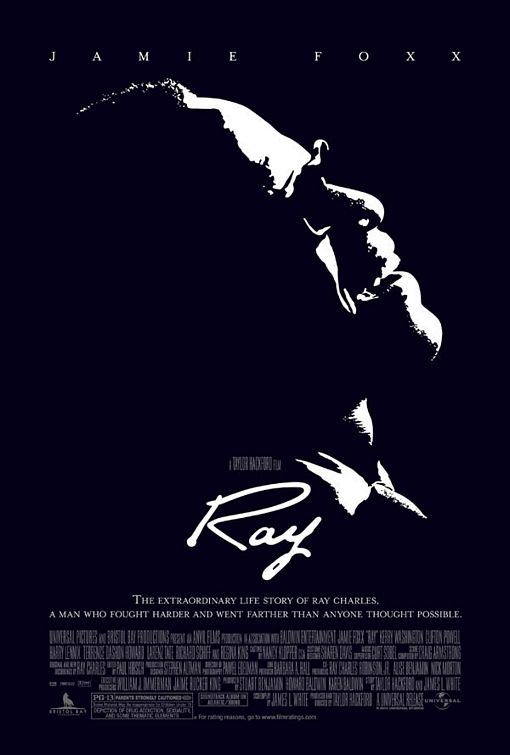 Ray Charles Robinson, aka Ray
Charles, was a man that lived in the dark for most of his life, but that
sure didn’t preclude that he was a timid, and introverted man.
Ray Charles Robinson, aka Ray
Charles, was a man that lived in the dark for most of his life, but that
sure didn’t preclude that he was a timid, and introverted man.
Clearly, from his birth in Georgia in 1930 to his death this year of liver disease, Charles emerged as one of the pre-eminent figures in American music. Yet, what's really interesting about Taylor Hackford’s new biopic RAY is that there's so much more to this legendary figure than just music. The music is here, to be sure, (and what glorious music it is!), but one of the more fascinating aspects about Charles was what a handful he really was to those around him. He could sing as good as anyone and was a watershed figure in soul music, but he was also an emotionally and physically troubled man.
He was born with sight and became blind at the age of seven (very soon after he witnessed his baby brother drown to death, which is a perpetual haunting memory for him throughout his life). Charles may have loved music, but he also loved drugs, and went from smoking marijuana and then graduated to harder drugs like heroin, which also got him into some substantial trouble with the law. Charles would also emerge as a Civil Rights figure, refusing to play in states that supported the Jim Crow Laws of segregation, which subsequently led to his “lifetime” ban of ever playing in his home state again. On the opposite end, Charles was not an overly sympathetic man, which could have been an easy trap for a filmmaker to fall into, especially when you consider the fact of his condition. What Hackford’s film does is paint us a portrait of a man that is multifaceted in his personal and emotional battles. Yes, he battled his blindness everyday, which clearly made life difficult, but manageable, but he was also a fiery and cocky man. He persevered to get what he wanted and when he wanted it. He just may go down as one of the more unconventional and uncompromising musical figures of the last century.
His
list of accomplishments are amazing, in hindsight, if you consider the social
and political forces of his day. He
started his career wanting to sound much like Nat King Cole and then eventually
managed to discover a symbiotic fusion of gospel music and rhythm and blues.
He single-handedly revamped gospel music, basically inventing soul, often
to the dismay of its supporters. Then, he segued from gospel to full
orchestration music, which was much more mainstream at the time, and then
committed musical heresy by going away from these mainstream impulses and
turning to country music (not prime musical real estate for a black man during
the time). On top of his artistic
accomplishments, Charles is shown here as a shrewd and cunning businessman, who
suddenly left Atlantic Records (which gave him his career) and jumped ship to go
to ABC to sign exclusive deals where he had control over his music and owned the
rights. Outside of his music
career, Charles was a drug addict and an adulterer, and one who fathered
children outside of his own marriage. Clearly,
for those who are only familiar with Ray Charles the artist, Hackford’s RAY
may be an eye-opener in its revelations.
The film, more or less, focuses
exclusively on Charles’ post-war career from the forties to the late sixties,
with a very brief epilogue in 1979. The
film opens with a 21-year-old Ray (played by Jamie Foxx, more on him later) as
he heads for a lounge club in Seattle. Much
of these key moments in his life, as with later scenes, are intercut well with
moments from his childhood as we learn somewhat vaguely about his life as a
poor boy growing up in Georgia. His
mother (Sharon Warren) was destitute and without much material possessions in
her life, but she demands and strictly adheres to her desire that little Ray,
despite his blindness, will not be taken for granted of in life.
She teaches him (often with cold-hearted methods) to take control of his
life and condition and to stand his ground firmly and never look back.
She forces him to go for a school for the blind as part of his education.
These early scenes are not so much expository filler as they are crucial
to getting to understand what makes the adult Charles tick. You can trace his sure-fire and confident demeanor to his
rough childhood and his ability to be frank and sometimes arrogantly honest can
also be sensed as being influenced by his upbringing.
He was raised as an impoverished child with nothing, but he sure was not
going to live the rest of his life that way.
His first trip to Seattle and his
gigs there would prove to be a springboard for a series of events that would
define Charles that we're familiar with today.
We see an important meeting with a young and energetic Quincy Jones
(Lorenz Tate) and also bare witness to Charles' unfortunate introduction to
drugs at the hands of his friend, a dwarf emcee at the Seattle nightclub named
Oberon (played very well by Warrick Davis).
It's from Seattle that Charles matures and develops into the musical
figure that is now legendary. We
see him launching soul music and then sign with Atlantic Records, which would
prove to be an integral aspect of his career, in terms of him being noticed by
the mainstream.
What’s refreshing
about this period in his career is the way that Hackford and screenwriter James
L. White manage to not create one-dimensional figures in these music executives
that are schemingly evil in their intentions.
Whereas other biopics paint these figures as money grubbing and blood
sucking media locusts, it's kind of nice to see the men in this film shown as,
well, really liking music and being passionate about it.
Sure, they want to make a buck, but they want to make it at the expense
of truly great music. Even
when Charles leaves the Atlantic men, which could be construed as a move
that’s a bit unflattering, the execs seem, more or less, supportive.
The film then moves not only into the musical turning points
of Charles’ life, but also wisely focuses on the other eccentricities of his
career, which were namely women and drugs.
We see him meeting, falling in love, and marrying Della Bea (the
wonderful Kerry Washington). Unfortunately,
we also see the many other loves of his life, which included not one, but two
affairs, one with Ann
Fisher (Aunjanie Ellis) a blues singer, and Margie Hendricks (Regina King), a
member of his backup group, the Raelettes.
The film is uncompromising and brutal with its honesty of this aspect of
Charles' life, and it's kind of amazing how down to earth and honest Charles is
with his womanizing ways. He does not hide behind a false façade and try to ignore his
addictions; he more or less comes clean when approached, often with responses
that are as simple as “it’s what I need to perform.”
Della Bea, nevertheless, stands by Charles and is the poster girl for a
woman that is steadfast, supportive (maybe a bit too supportive) and one that
stands by her man with both resentment and conviction.
The film is very perceptive in how it allows the wife figure to be so
accepting while, at the same time, being so turned off by her husband’s
dealings. Clearly, Charles was not
a saint, and Della Bea’s resiliency with him is inspirational in its own
right.
It’s easy to continue to discuss the film and its story
more, but mention has to be made of the man behind Charles, Jamie Foxx.
Has their been a contemporary actor that keeps getting significantly
better with each successive performance than him?
I think that the key to the emergence of Foxx as one of our best
actors is in his choice of directors and scripts.
He was surprisingly effective in Oliver Stone’s ANY GIVEN SUNDAY,
terrific as troubled
Drew “Bundini” Brown in Michael Mann’s ALI, and later would re-team with
Mann for what I considered his very best performance as a shy and timid cab
driver in this year’s
COLLATERAL.
Now
he’s Ray Charles in a truly great, exuberant, and textured performance of
complexity. He does everything so
right with his role. He captures the real essence of Charles the man, from
his look to his body language, to his subtle nuances, and even to his
speech patterns. It's one of the
more effortless performances I’ve seen this year, one where you kind of forget
that you are watching the actor in the part and just get lost in it.
Foxx delicately plays a balancing act with the man, portraying his as
funny, sad, pompous, cocky, and a man with a strident resolve.
Like Val Kilmer in his similar and overlooked performance as Jim Morrison
in THE DOORS, Foxx does not imitate Charles; he completely inhabits and
channels him. Of course, at
first, it's apparent that Foxx is lip synching to the vocals of the real Charles
(who did some re-recording for this film before he died) but Foxx captures
everything about this man so perfectly that you forget this after awhile.
You really grow to accept him as the legendary music figure, and Foxx’s
willingness to be completely unflinching with his portrayal is wholeheartedly
deserving of an Oscar nomination next spring.
The
music and strong performance by Foxx in the lead role are the saving graces of
the film, but RAY is not a film void of problems.
The film is both, strangely, conventional and unconventional.
We get all of the standard elements of the biopic genre that we’ve seen
countless times before (embittered wives, figures that are dealing with
addictions, etc), but it's told with a certain level of energy that other
lesser biopics miss. The running
time of the film (it’s nearly two and a half hours) does not quite
satisfactorily cover the depth of Charles' life as much as I would have liked it
too. The screenplay kind of lumbers
around and focuses too narrowly on a small portion of his life, and has a
tendency to gloss over some of the other pertinent aspects of Charles (we have a
brief moment about his arrest and convictions that are barely dealt with, and
any deep probing into Charles’ feelings or attitudes about the Civil Rights
movement are only superficially handled). Some
of the supporting figures are also only sparsely developed and quickly become
afterthoughts. There are also moments that inspire groans and
unintentional laughs. There is one
ham-fisted scene where Charles, in a fierce argument with his mistress,
instantaneously leads the two of them into creating, on the spot, the hit song
“Hit the Road, Jack” (yup…sure…uh-huh).
That moment sort of stretches the terms “dramatic” and “artistic"
liberty a bit too strenuously. I am
altogether sure that the inception of that song was not quite so easy.
RAY is a good film, but it could have been a great film about a great man. It’s a small shame that it could not have been more. I nevertheless give a recommendation based on the fantastic performance by Foxx and the tone of the overall film that does not try to hide the problems that Charles battled for much of his life. I would have liked to see more about his life from 1966 to his death in 2004, and with the film’s running time and with a more streamlined and cohesive screenplay that does not wander aimlessly at times, this could have been accounted for. Yet, RAY still remains a moving portrait of one of music’s all-time great performers, and a fresh reminder that, behind every great artist, there also seems to be a tormented soul. The film, and Foxx, digs so deeply into this persona that it becomes really difficult to separate the real Ray Charles from the performance.
In that sense, RAY is a triumph, and Foxx owns the film all the way through.
