


 A
film review by Craig
J. Koban December
25, 2019
A
film review by Craig
J. Koban December
25, 2019
RICHARD
JEWELL

2019, R, 129 mins.
Paul Walter Hauser as Richard Jewell / Sam Rockwell as Watson Bryant / Kathy Bates as Bobi Jewell / Jon Hamm as Tom Shaw / Olivia Wilde as Kathy Scruggs / Nina Arianda as Nadya
Directed by Clint Eastwood / Written by Billy Ray

The new
fact-based drama RICHARD JEWELL is a flawed, but modest return to form for
director Clint Eastwood after a recent string of misfires like THE
MULE and the disastrously awful THE
15:17 TO PARIS. The
89-year-old director's 41st film behind the camera is a thoroughly
enthralling - albeit with many problematic caveats - chronicle of Richard
Jewell, the American security guard that became famous during the 1996
Centennial Park Olympic bombings in Atlanta, Georgia, during which time he
was initially hailed as a hero for saving lives, but later became a false
prime suspect by the FBI (he was eventually found innocent, but not after
his life was nearly crushed in the ensuing media firestorm).
RICHARD JEWELL is captivating in large part to an Oscar worthy turn
by Paul Walter Hauser in the titular role, but the film's aggressively
simplistic handling of media politics (and one journalist in particular)
really dramatically holds the film back at times.
Jewell was indeed
a hero, but his path towards that was an incredibly bumpy one.
He discovered a backpack on Olympic Park grounds containing three
pipe bombs, and it was his alerting of authorities and the subsequent
evacuation of most of the people in harm's way that indeed spared
countless souls. Unfortunately
for Jewell, the Atlanta Journal Constitution newspaper started running
reports that he was being potentially targeted as a suspect by the FBI and
police, which led to a "trial by media" that nearly convicted
the poor sap and ruined him. He
was never officially charged, but the whole ordeal left Jewell and his
family broken. In the
aftermath of this hellish ordeal, Jewell was eventually and publicly
thanked in 2006 by Governor Sonny Perdue.
Jewell later died the following year due to heart failure at the
age of 44.
All of this is,
of course, incredibly intriguing material for big screen appropriation,
and Eastwood - with screenwriter Billy Ray - sees the tragic story of
Jewell through a viewfinder of portraying law enforcement and the media as
the villains and shows the immense power of both in terms of swaying
public opinion of a man towards guilt, despite all evidence pointing
towards his absolute innocence. RICHARD
JEWELL is set well before the advance of social media, but its themes here
as a relevant as ever. It
rightfully shows how just about any ordinary person can be propped up for
instant overnight hero worship, but can also be reduced to hated villain
by the same media in no time as well.
Jewell's story is, undoubtedly, a truly frightening cautionary
parable about defenseless citizens that have to face the combined might of
government and news powers that are out to get them using an any means
necessary approach. There have been so many movies over the years (like recent
Oscar Best Picture winning SPOTLIGHT)
that rightfully portrays journalists as unwavering heroes and pursuers of
the greater truth, but RICHARD JEWELL is the antithesis to that: it
alarming relays how good people can be smeared and ruined for the sake of
selling papers.
|
|
Eastwood and Ray
approach Jewell's story with the director's trademark filmmaking economy
and simplicity, although the handling of some of the factual details
surround this narrative of one man emerging triumphant over the
establishment is, as mentioned, awkwardly
dealt with. Of the important
details that the film doesn't fudge is in its overall portrayal of Jewell,
who's not shown here as a one-note saint caught between a massive rock and
a hard place. When we meet
Jewell (Hauser) he's a man struggling to find a place within law
enforcement, a dream vocation that frustratingly alludes him.
He was recently fired by a local Atlanta college, which forced him
to take an offer of working a low rent security detail at Centennial Park
for the upcoming Olympics. Of
course, he takes this gig as seriously as a proverbial heart attack, which
makes him the butt of petty jokes for the police on the scene, but things
change when he uncovers the aforementioned explosive device.
Jewell is hailed for his bravery early on, but a hostilely
determined FBI agent (a quietly menacing Jon Hamm) starts building a case
for Jewell's guilt of the act of terrorism.
When Atlanta
Journal Constitution reporter Kathy Scruggs (Olivia Wilde) gets a wind of
this she ravenously sees huge headline potential, realizing that the
pressure to arrest Jewell and charge him will sell papers.
Jewell finds some solace with his supportive mother (a superb Kathy
Bates), and later decides to secure legal counsel in an old friend in
Watson Bryant (the routinely reliable Sam Rockwell) to help him sift
through the ensuing legal shit storm to come.
Disastrously, the FBI is unwavering in their drive to use every
sneaky method at their disposal to get dirt on Jewell and arrest him, with
Scrubs and other newspapers relishing in the coverage, which negatively
starts to destroy the public's faith in Jewell's innocence. Jewell himself, mostly inadvertently, doesn't help matters
either, mostly because he perfectly fits the profile of a lone nut
desperate for attention. That,
and his spotty employment career with multiple complaints from his
ex-bosses combined with other damning - albeit circumstantial - details
(like his gun obsession) starts to really hurt his legal chances.
RICHARD JEWELL is
a routinely strong drama because of the remarkable acting trifecta of
Hauser, Bates, and Rockwell. Bates
is especially convincing and more than a bit heartbreaking as this elderly
mother that has to deal with the mounting psychological grief of knowing
that she has no power whatsoever to shield and protect her son from the
outside forces that want to destroy him.
Rockwell is as commendably stalwart as ever as this pragmatic, but
slightly in over his head attorney that sees multiple wrongs happening to
his client. RICHARD JEWELL is
absolutely Hauser's film, though, and he gives such a phenomenally
credible and lived-in performance as gentle spoken, well meaning and noble
minded, but increasingly conflicted nobody that covets everything about
law enforcement until he sees those very institutions begins to conspire
against him. What's perhaps
so sad about Hauser's brilliant turn here is that he absolutely deserves
Academy recognition with a nomination, but will likely lose out because of
the other big name heavy industry players all vying for a trophy.
Between his work in RICHARD JEWELL, BLACKKKLANSMAN
and I, TONYA Hauser is making a confident
claim for being one of the finer new character actors working today.
There's simply not an inauthentic beat with any of his
performances.
Unfortunately, I
have to address the large controversial elephant in the room here when it
comes to the veracity of RICHARD JEWELL's recreation of the events in
question. Most specifically,
the off-putting handling of the Scruggs character herself, which was the
center of many pre-release articles (citing family members of Scruggs and
her former colleagues) that deeply criticized the film's portraying of her
as a journalist that would offer sex (among other things) to an FBI agent
for a lead on the Jewell story. The
FBI agents in question are not presented in a favorable light either, with
most of them being power hungry and manipulatively vile men that threw the
legal rule book out the window in trying to convict Jewell.
Movies take dramatic license all the time with history (not
defending that, but it happens), but what Eastwood, Ray, and Wilde do with
Scruggs is demeaningly paradoxical to the film's themes.
Scruggs is shown as a venomous shark that seems to take great joy
in trying to destroy Jewell (plus, the manner she prostitutes herself -
which is apparently manufactured - doesn't speak highly to how Eastwood
treats his female characters).
Wilde's
grotesquely over-the-top performance here does her and the part no favors
whatsoever. She's less a
flesh and blood human being than she is a caricatured plot device that
cartoonishly shows up to make Jewell's life miserable when the script
requires it. The manner that
Scruggs has this moral and ethical epiphany late in the film about being
wrong about Jewell is one of the most emotionally and dramatically false
moments of any movie in many a moon.
It's never once credible. Wilde
has somewhat pathetically defended her performance on social media by
saying that it was "out of her hands," not to mention that she
lamented that it was sexist to lambaste Scruggs in the film for selling
her body for news leaks when the male FBI agent did the same and faced
zero criticism. However, the
main agent in the film is a composite of many people, whereas Scrubs was a
real person that's no longer around to defend herself (she died in 2001).
The central irony of RICHARD JEWELL is that is tries to rightfully
evoke the corruption of slandering one person...while engaging in
character assassination of another person.
It all leaves a very bad taste in the mouth.
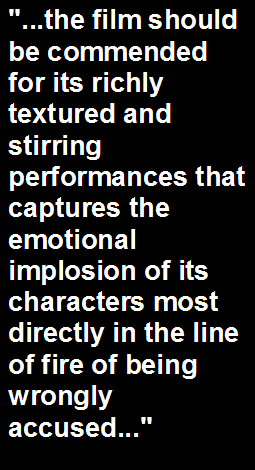
That's too bad, because there's a truly great historical drama buried deep beneath this film's troublesome and hard to ignore creative choices. I'm nevertheless giving RICHARD JEWELL a passing grade, mostly because Eastwood's direction is fine, unfussy, and no-nonsense in telling the man's Olympic ordeal (the bombing sequence in film is one of the more suspenseful moments of any recent film on his resume). On top of that, the film should be commended for its richly textured and stirring performances that captures the emotional implosion of its characters most directly in the line of fire of being wrongly accused. If only the film were more level headed and minded in terms of offering a holistic and fair approach about all other players involved in this historical narrative. There's multiple lessons to be learned from RICHARD JEWELL about painting people with the wrong brushstrokes.
