A film review by Craig J. Koban January 5, 2012
WAR HORSE  ½
½
Albert Narracott: Jeremy Irvine / Rose Narracott: Emily Watson / Lyons:
David Thewlis / Ted Narracott: Peter Mullan / Grandfather: Niels
Arestrup / Capt. Nicholls: Tom Hiddleston
Directed by Steven Spielberg / Written by Lee Hall and Richard
Curtis, based on the novel by Michael Morpurgo and the stage play
by Nick Stafford.
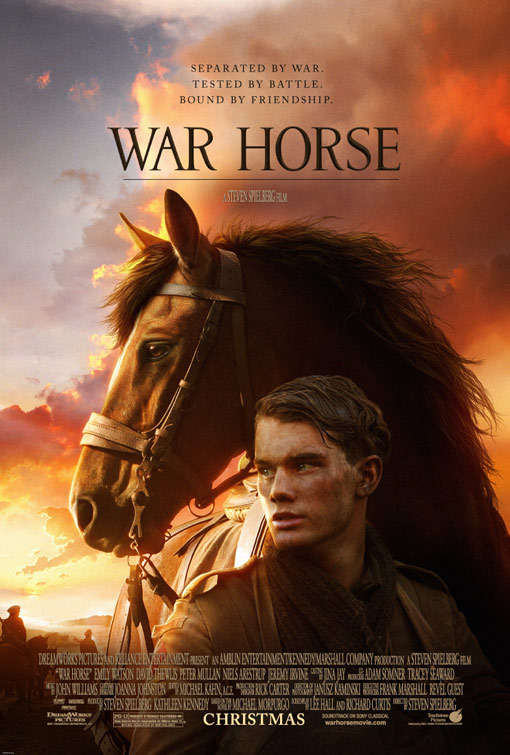 Steven
Spielberg’s WAR HORSE tells a story of youthful friendship that’s not
too unlike his E.T.- THE
EXTRA-TERRESTRIAL, only this time it involves a young man and his
beloved steed. Like
Spielberg’s SAVING PRIVATE RYAN, WAR HORSE tells a story of the
brutality of war, but this time around he delves into the Great War
instead of World War II. However, but both films share the
commonality of highlighting one universal truth: the horrors of war make
men endure hellish ordeals during which they either suffer or die.
WAR HORSE, though, also points out how animals – by no fault of
their own – also die for reasons beyond their control.
Oftentimes, they perished in battle because men on both sides
simply gave up on them as useful and healthy adversaries on the
battlefront.
Steven
Spielberg’s WAR HORSE tells a story of youthful friendship that’s not
too unlike his E.T.- THE
EXTRA-TERRESTRIAL, only this time it involves a young man and his
beloved steed. Like
Spielberg’s SAVING PRIVATE RYAN, WAR HORSE tells a story of the
brutality of war, but this time around he delves into the Great War
instead of World War II. However, but both films share the
commonality of highlighting one universal truth: the horrors of war make
men endure hellish ordeals during which they either suffer or die.
WAR HORSE, though, also points out how animals – by no fault of
their own – also die for reasons beyond their control.
Oftentimes, they perished in battle because men on both sides
simply gave up on them as useful and healthy adversaries on the
battlefront.
There are two distinct
hemispheres vying for attention in Spielberg’s film:
Firstly, there is the fairy tale majesty of the opening sections of
WAR HORSE that details the budding friendship and ultimate love between an
adolescent and his horse. The
second thread of the film is about the bitter and uncompromising brutality
of war and how it claims human and non-human lives.
Both sections stir up a different sets of emotions in viewers: the
pastoral and classically beauty of the introductory segments make WAR
HORSE feel like a sentimental and gorgeously mounted fable, whereas its
war sequences seem more grounded in a gritty and harsh veracity.
This, unfortunately, is the
main problem with WAR HORSE: it can’t seem to find a way to have its
storybook trappings exists cohesively with its palpably savage view of
war. As a result, the film
feels both visually opulent and emotionally schmaltzy…and perhaps too
much for its own good. Yet, the film on paper seems like such a perfect
win-win/home run for Spielberg: he envisioned and orchestrated some
of the greatest war footage ever committed to celluloid in SAVING PRIVATE
RYAN and his chronicling of boyhood friendship with an unlikely companion
made E.T. the family classic it has long since been regarded.
WAR HORSE is also as beautiful looking of a film and as technically
exemplary as Spielberg has ever made. As
a populist filmmaker, he also has had a stellar career of making his
films emotionally accessible without being too obvious about it.
Yet, WAR HORSE is perhaps too
labored and too mechanical in its yearning to tug heart
strings. I found myself
utterly taken in with the film’s impeccable artistry, but far less so
with its emotional story. It
has the façade of a technical masterstroke work, but as far as
genuinely moving audience members, WAR HORSE is a bit of a stilted and
overly telegraphed affair. Based on the 1982 young-adult book of the
same name by Michael Morpurgo and later a play that
premiered in London in 2007, the film tells the story of a young British
lad named Albert (newcomer Jeremy Irvine) that lives on the farm of his
mother and father, Ted (Peter Mullan) and Rose (Emily Watson).
Their troubled farm is in on the verge of foreclosure, seeing as
its landlord (David Thewlis) is constantly threatening to take it away.
Ted does buy a young horse that he sees potential in, but by all
accounts will not be able to handle farm implements very well.
Albert, however, makes it his mission to train and love the horse
so that he can save the family’s much-needed new crop.
The bond between Albert and
Joey (the name he gives the horse) becomes almost unbreakable, but when
bills start piling up Albert’s father does the unthinkable of selling
Joey into the army for use in the recent break-out of World War I.
Albert is predictably devastated by the news, but realizes that he
must part ways with Joey to save his family farm.
Joey does manage to see some initial action on the battlefront, but
when his new owner is killed in action, Joey is taken by the
Germans and used as manual labor, of sorts, to pull heavy gun wagons.
He manages to escape German captivity and goes though a series of
new owners. Meanwhile, Albert
has grown of age and has joined the British military, but while partaking
in his duties for his country he never stops looking for the horse that
meant so much to him.
|
|
Perhaps more than any other
film he has directed, WAR HORSE revels in Spielberg’s admiration of past
directorial icons, most notably John Ford.
The film is very self-consciously Ford-esque throughout and has
numerous visual echoes of films as far ranging as ALL’S QUIET ON THE
WESTERN FRONT and GONE WITH THE WIND.
Spielberg arguably has never made a more exquisitely picturesque
film and his collaboration with long-time cinematographer Janusz Kaminski
evokes a powerful panoramic eye for stunning open-world compositions.
The color palette of the opening scenes alone are warm, inviting,
and have a poetic grace to them, which give the film a carefully modulated
grandeur.
WAR HORSE also contains action
scenes of spectacular immediacy. The
front line footage of trench warfare echoes Spielberg’s aesthetic in SAVING
PRIVATE RYAN (granted, it’s much more sanitized here for its PG-13
rating) and the imagery here packs an unmistakable and lingering impact.
There are a couple of moments that stand out, like an intense
life-or-death moment between Joey and a heavily armored tank that
illustrates how vulnerable horses were versus new industrialized fighting
methods. The film’s
greatest and most grisly moment shows Joey galloping - as heavy artillery
blasts overhead - through, over, and beside trenches and finally through
barb wire fences in a frenzied last ditch effort to stay alive.
Watching this extraordinary sequence reminded me of the power of
naturally shot subjects over CGI-created ones: Spielberg has gone on
record to state that there is only a few seconds worth of digital
tinkering in the film, which if correct makes this footage that much more
superlatively orchestrated.
Again, the problem with WAR
HORSE is not with its impeccable film craftsmanship; it has more to do
with the emotional core of the narrative.
The main story – provided by Richard Curtis (LOVE ACTUALLY, PIRATE
RADIO) and Lee Hall (BILLY ELLIOT) – becomes too enraptured by
secondary and tertiary subplots of the lives of other characters when it
should have honed in more on Albert himself, who is barely defined as a
character, beyond that of a spirited and determined kid that will do
anything to be reunited with his horse. The supporting characters are actually given a bit more
weight and the performances are even more well rounded: I liked Tom
Hiddleston as the British officer that makes it his mission to look after
Joey in war; Emily Watson does fine work as Albert’s pragmatic and tough-minded
mother; and Niels Arestrup is especially memorable playing a French farmer
that finds himself tending to his granddaughter’s new attachment to Joey
when they find themselves a part of the horse's life in-between war
battles. Arestrup’s
monologue about a passenger pigeon’s duty as a communication device
during war is serenely intoxicating.
Yet, the main focal point here
should have been Albert, and the screenplay just spends too much of its
already long 146 minutes on a series of detoured vignettes in World War I.
Albert himself is just a curious abstraction in the film as a
character: we understand his love of his horse, but we really
don’t learn anything else about him throughout the story.
Other characters in the film are essentially one-note props brought
in to provide conflict (like Thewlis one-dimensionally mean land owner).
There is also the manner of how the script brings everything to a
head for the film’s would-be teary-eyed conclusion, which feels
constructed on a series of amazing and very, very lucky
coincidences; if only life during war was as conveniently planned.
The final moments of the film – which are derived from the aforementioned mechanical plot developments – are indeed stirringly magnificent. Done mostly with silhouetted figures set against a backdrop of a deep red-orange sun-set backdrop and John Williams trumpeting – but sometimes too assaultive through the rest of the film – score, Spielberg envisions a silent denouement that’s a mesmerizingly rendered feast for the eyes. It's a joyously positive ending for the film as well that certainly wears its emotions on its sleeves, so to speak. Regrettably, I just found myself less moved by it than I was completely taken in with its meticulous and unabashedly dazzling craftsmanship. WAR HORSE is a rousing work of a great and proven filmmaker on a pure visual level, but as a dramatic work it feels just as dutifully manufactured to elicit cued-up emotional responses.
