

 A
film review by Craig
J. Koban March
1,
2016
A
film review by Craig
J. Koban March
1,
2016

RANK: #6
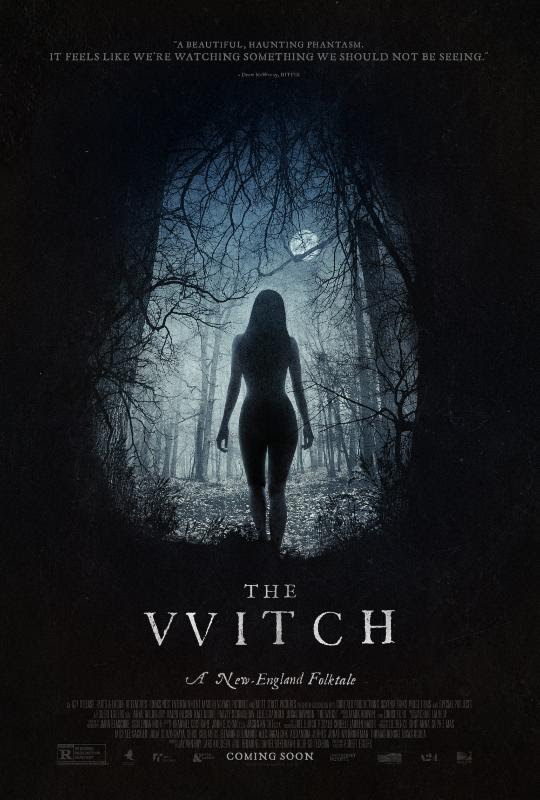
THE WITCH 
Anya Taylor-Joy as Thomasin / Ralph Ineson as William / Kate Dickie as Katherine / Harvey Scrimshaw as Caleb / Ellie Grainger as Mercy / Lucas Dawson as Jonas
Written and directed by Robert Eggers
 Any
horror film can throw violence, gore, and jump scare up on the screen in
hopes of terrifying audience members.
Any
horror film can throw violence, gore, and jump scare up on the screen in
hopes of terrifying audience members.
I’ve
always been more frightened, though, of the intangible unknown of what’s
to come next in a film from scene to scene.
Recent magnificent horror films like last year’s IT
FOLLOWS and THE WITCH understand this notion rather perfectly.
Making his directorial debut, New Hampshire-born, Brooklyn based
Robert Eggers wisely understands that the key to truly unnerving tension
and real horror in a horror film is in establishing and maintaining a
chronic sensation of dread throughout.
What’s so diabolically scary about THE WITCH is not only the
film’s ubiquitously ominous atmosphere, but also in how methodically
patient and deliberate it is in building up on our shared and escalating
feelings of unease throughout. As
a result, Eggers’ film becomes a relentlessly eerie and nail-biting
triumph of tone.
THE
WITCH’s historical setting is audacious, not to mention crucial to the
film’s innate ability to immerse us in a world that feels tactile and
credible, despite taking place hundreds of years in the past.
Set in mid-17th Century New England, the film does a sensational job of evoking its time and place, especially for how it
relays a deeply devout Christian family that’s petrified of going
against the greater will and good of God.
This, of course, ties into the larger themes of the religious
hysteria of the era in terms of the infamous witch trials (which would
occur 60 years after the events of the film) and how they tested faith
and, to a degree, the sanity of many.
THE WITCH ultimately becomes so unsettling because of the sheer and
limitless power of its period specific authenticity. With modest, but strikingly rendered production design,
haunting cinematography, and actors thanklessly performing with thick
Old English timbers, there’s rarely a moment in the film when you doubt
the plausibility of this Scripture quoting colonial family unit and their
slow descent into madness. And
that’s what makes THE WITCH so bloody nightmarish to endure.
|
|
The
film opens in 1630’s Massachusetts and we are quickly introduced to the
aforementioned family. William
(Ralph Ineson) has taking his clan – made up of wife Katherine (Kate
Dickie), son Caleb (Harvey Scrimshaw), daughter Thomasin
(Anna-Taylor-Joy), and twins Mercy and Jonas (Ellie Grainger and Jonas
Dawson) – away from his community and into the far reaches of the woods in
hopes of starting life anew. Even
though farming and providing for themselves will be an endlessly hellish
ordeal considering their relative isolation, William remains headstrong
and positive minded about his family’s chances.
Tragedy unfortunately steps in one day when William's newborn
baby mysteriously vanishes without a trace (while under Thomasin’s
care), leaving William and his wife utterly crestfallen.
Multiple searches into the woods come up short, which only further
deepens the family’s sense of despair.
Now,
just who or what in the hell took this little innocent baby?
The film remains curiously aloof early on, but it soon becomes
abundantly clear that some supernatural entity is at play here.
What’s unknown, though, is whether or not Thomasin herself is in
league with purveyors of witchcraft or not (she’s becomes the family’s
prime suspect, since she was the last person with the baby, not to mention
that some innocuous playtime with her twin siblings has them sounding off
the alarms as to her innocence). Further
tragedies begin to mount on the family’s already heavily burdened
shoulders, which only helps fuel all of their paranoid delusions.
With each new emotional trial that befalls them witchcraft (and
Thomasin’s potential involvement) seems to be a more disturbingly
likely culprit by the day. William
- once a sound, decent, and headstrong patriarch - sees his own grasp of
sanity slipping, which begins to have a devastating impact on his
family’s well being.
THE
WITCH is one of the finest examples of slow-burn horror that I’ve seen
in quite some time. It never
fully rushes out of the gate to shock us, but rather it takes its time to
ground us in the plight of this family, which makes their mental implosion all the more distressing. The
film is less about schlock and awe action and torture porn mayhem (traits
that so many modern horror films subscribe to) than it is about
engineering scrupulously modulated menace to the point where just about
anything in the film feels like a harbinger of torment.
Eggers clearly studied his Kubrickian influences rather astutely,
seeing as THE WITCH – much like THE SHINING – is about channeling the
film’s chilling and pressurized environment, which suffocates not only
the characters that reside within it, but also viewers that have to
experience their suffering. Shot with carefully orchestrated camera work and
controlled editorial choices in the Canadian wilderness and mixed further
with composer Mark Korven’s screechy and sinister chords, Eggers gets
maximum bang for his modest, low budget buck.
The
film is also much more thematically dense and rich than so many other
contemporary horror films.
Notions of man versus nature are elicited for obvious reasons, as
the film – beyond its genre parameters – becomes a fully engrossing
chronicle of Europeans desperately trying to tame the foreboding
landscape that threatens their existence on a daily basis.
In many respects, THE WITCH is a bravura work for getting audiences
into the headspaces of its characters and asks us to understand what
living under such conditions was like centuries ago.
Then, of course, the film’s overt spiritual dimension grabs a hold
as it investigates how faith and religion – without coming off as
temperamentally preachy – is both a positive source of inner strength as
well as a negative catalyst of feverous agitation for the family.
Beyond that, the film adds a whole added complex layer of intrigue in
exploring incestuous adolescent sexuality between siblings and how
children – even at remarkably tender ages – are able to milk their
parents’ fears regarding their offspring and twist it into something even
more unsavory.
THE
WITCH becomes engrossing in the simple, but far-reaching
questions it poses at viewers: Is there really an evil witch in the woods
that’s waging a cerebral war on this family?
Or, has the family become so enraptured and obsessed in their own
zealot-like religious beliefs that they simply believe that demonic forces
are the only logical answers to their horrendous problems?
Is Thomasin an agent of evil as well…or is she simply a blameless
victim of her family’s ever-growing mistrust in her?
The individual performances are sensationally realized and only
help cement the film’s tantalizing possibilities.
Ineson and Dickie are immensely strong as the parents and have extremely difficult jobs of showing their
respective character’s unraveling
sanity without overselling it to the point of feeling obtrusively
over-the-top. Anna Taylor-Joy
is particularly powerful as Thomasin in the sense that she has to portray a deeply troubled young women that’s torn between the unholy
accusations of her hostile family that might also be harboring secrets regarding her real motives and allegiances.
The fact that THE WITCH constantly makes us debate her innocence
and/or guilt is to its revered credit.
Eggers builds everything to boil in a final act that unequivocally gets under your skin in tortuous ways. It could easily be argued that the final few minutes of THE WITCH perhaps makes the mistake – that it doesn’t make during 95 percent of its running time – of specifically explaining too much for its own good (a more vague and open ended conclusion might have been a finer choice). Yet, Eggers maintains such a Hitchcockian manipulation and hypnotic stranglehold over his audience that I was simply willing to forgive some last minute scripting indiscretions. THE WITCH is a highly rare breed of horror film in the manner that it provokes the mind as well as it unsettles our very souls. Compellingly, you see very little, if any, witches in the film. But that’s the point. Eggers’ film is masterfully terrifying for what we don’t see throughout
