A film review by Craig J. Koban February 16, 2011
THE EAGLE

Marcus: Channing Tatum / Esca: Jamie Bell / Uncle Aquila: Donald
Sutherland / Guern: Mark Strong / Seal Prince: Tahar Rahim / Lutorius:
Denis O'Hare
Directed by Kevin Macdonald / Written by Jeremy Brock, based
on Rosemary Sutcliff's novel The Eagle of the Ninth
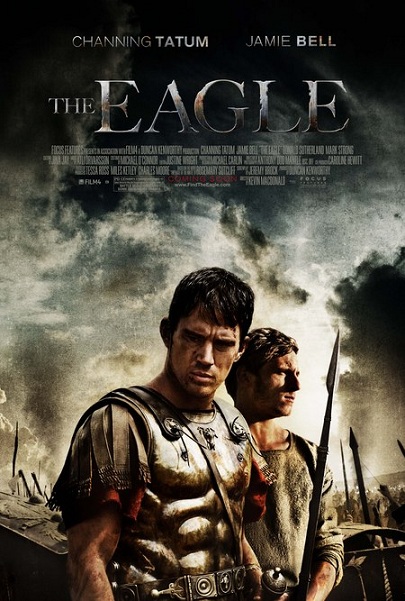 Kevin Macdonald’s THE EAGLE
is a film with an evocatively brawny sense of authentic period detail that
regrettably contains individual performances that don't feel authentic.
This cinematic adaptation of the Rosemary Sutcliff 1954 young adult
historical novel THE EAGLE OF THE NINTH does a splendid job of immersing
audiences in its richly grainy, grungy, and sepia-toned atmosphere of 2nd
Century Rome. Certainly, this
film was made on a budget that would barely cover the catering costs of
GLADIATOR and definitely does not have its epic scope, nor does it need
to. Yet, for as solid as THE
EAGLE is as a visual journey, the resulting sword and sandal action
thriller becomes distracting because of its spotty
casting and its main lead character, which ultimately has the unintended effect of pulling you out of the story.
Kevin Macdonald’s THE EAGLE
is a film with an evocatively brawny sense of authentic period detail that
regrettably contains individual performances that don't feel authentic.
This cinematic adaptation of the Rosemary Sutcliff 1954 young adult
historical novel THE EAGLE OF THE NINTH does a splendid job of immersing
audiences in its richly grainy, grungy, and sepia-toned atmosphere of 2nd
Century Rome. Certainly, this
film was made on a budget that would barely cover the catering costs of
GLADIATOR and definitely does not have its epic scope, nor does it need
to. Yet, for as solid as THE
EAGLE is as a visual journey, the resulting sword and sandal action
thriller becomes distracting because of its spotty
casting and its main lead character, which ultimately has the unintended effect of pulling you out of the story.
MacDonald is by no means an
unaccomplished filmmaker: he made one of the best documentaries I’ve
seen in TOUCHING THE VOID and he also thanklessly helmed the
political thriller STATE OF PLAY.
He aims for a sense of immediate historical veracity in THE EAGLE
(despite the fact that very little is historically known about the tribes
that Romans encountered) and he does so by employing Anthony Dod
Mantle’s (SLUMDOG MILLIONAIRE and
127 HOURS) lush and primal
cinematography. However, the way
he casts the Romans in the film with many American actors is peculiar.
It has been said that MacDonald was attempting to make some modern
day allegories to how Rome’s imperialistic might and aggression echoes
the United States’, but I don’t find that connection to be very
clearly delineated. All that
is clear is that many of the Roman characters sound more like they
belong on a contemporary New York street corner than in Britannia circa 117
AD.
The biggest miscalculation,
though, is with Channing Tatum’s casting in the main role of Marcus
Aquila, a headstrong, resolute, and empowered Roman commander.
Now, there is no doubt that his granite jawed and sculpted physique
makes him a perfect physical specimen for the role, but as a performer
with emotional range, Tatum is essentially a blank void.
His expressions throughout the film range from grimacing and stoic
to even more grimacing and stoic and his dialogue is uttered with a sort
of pseudo English accent morphed with the pouting intonations of a boy
band member. He performs more
than adequately when it comes to fisticuffs and sword swinging gallantry,
but when he is forced to settle down in quieter introspective moments, he
never once comes off as credible. His
casting is all sorts of wrong.
The film – during the
opening title cards – deals with the disappearance of the Roman Ninth
Legion that marched far north into unfamiliar territories from the colony
of modern day England and into the uncharted wilds of Scotland, where they
were never heard from again. A
famous Roman artifact known as "The Eagle of the Ninth" was in the possession
of Ninth Legion when they braced themselves on their trek up North and was
presumable lost while they were there.
To journey into the mysterious and dangerous lands to locate
and recover the Eagle would be a massive heroic feat and accomplishment.
This is where Marcus Aquila
steps in, and he certainly has personal reasons for wanting the golden
statue back. Two decades
earlier his father, a respected and mighty Roman warrior, was one of the
men of the Ninth that had disappeared and it has been largely held that
he was the man that lost the Eagle.
This dubious legacy weighs down heavily on young Marcus as he bears
down in his current assignment as the leader of a small and minor Roman
outpost. His self-imposed
mission to reclaim the Eagle and restore his father’s legacy is put on
hold when he is seriously wounded in battle and taken to his uncle’s villa
for recovery.
During his rehabilitation
Marcus and his uncle attend a gladiatorial contest where Marcus is
surprisingly taken in with the raw courage of a slave named Esca (the very
decent Jamie Bell, one of the few performance standouts) and convinces the
fickle Roman crowd to spare his life.
Afterwards, Marcus acquires Esca as his personal slave and even
though Esca despises Rome’s militaristic extremes with all of his
being, he agrees to serve the man who essentially saved his life.
Yet, the two form a very unlikely bond and alliance when Marcus
decides that they will both traverse across thee highlands of Caledonia
and fledge on north of Hadrian’s Wall to go where the Ninth notoriously
did so that Marcus can reclaim the much sought after Eagle.
Macdonald is able to muster
some thematic curiosity in this otherwise problematic film: There are the obligatory
notions of honor, duty, and loyalty when it comes to Marcus’ quest, not
to mention that the film becomes sort of compelling when he and Esca come
across the mystifying and otherworldly tribes that may or may not have had
something to do with the Ninth’s disappearance.
The culture clash presented within the story between the wild and
nomadic tribes and Rome alongside the juxtaposition of Marcus’ loyalty
to Rome’s imperial pursuits and his coming to grips with Esca’s
beliefs and traditions provides much of the interest in the film.
There is no doubt that THE EAGLE is at least inquisitive about its
period and is actively involved in presenting it.
Yet, the film fumbles when it
comes to the central relationship between the slave and his owner.
The script sort of teases audiences as to where the real loyalties
lie with Esca while he is on his treacherous journey with Marcus, but the
modest intrigue generated here is resolved rather predictably.
There is also very little development of the characters of Marcus
and Esca beyond there requirements towards the general plot trajectory (one’s a Roman soldier, one’s his slave, they both are enemies that
become frenamies, so to speak, but there is very little substance beyond
that). Then there is the
conclusion of the film which is more than a bit clumsily hypocritical:
MacDonald has pained to categorize Rome as an empire whose ambitions are
matched by its own barbaric tendencies to harm others, but, in the end,
the film sides with Marcus and his empire versus the tribes they battle.
A vastly more compelling choice would have been to allow viewers to
make up their own minds as to which entity is worthy of their support.
Alas, THE EAGLE takes the lazy and straightforward route by making
the tribes the evil savages and Rome the politically civilized and
justified society.
Again, I appreciated the ruggedness and handsomeness of the production values here: On a basic level, THE EAGLE has an old fashioned visual allure that thankfully does not revel in contemporary, CGI-infested overkill, which is ultimately refreshing. However, the individual battle scenes and brawls are kind of insipidly choreographed and edited (you are rarely given a prevailing sense of spatial relationships and who is fighting who in most cases, which is not helped by the fact that MacDonald has a nasty habit of framing the battles with close-ups and jarring editing). Combined with this is the fact that – until the story gets Marcus and Esca deep into unfamiliar and hostile enemy territory – THE EAGLE is ill paced and rarely generates much suspense. The film only becomes truly involving about two-thirds of the way in, which leaves the build up to that point kind of lacking.
Lastly, there is one other
problem with this film: it lacks…well…balls.
THE EAGLE was annoyingly rated PG-13 and despite the apparent
mayhem displayed on screen, the action is shockingly bloodless.
If you want to see a similar film about the same era that has
considerable more testosterone-laced nerve and fortitude, then watch last
year’s CENTURION (also featuring Roman soldiers warring against Northern
tribes), which was an unapologetic, hard-R rated testament to sword
slicing carnage and blood curdling chaos.
That film never succumbed to the pressures of the wimpy and limp-dicked
limitations of a more box office and audience friendly PG-13, nor did it
feel the need to sheepishly cast a former American model turned actor as
Roman soldier.
